Eigenvalues and Eigenvectors - MIT Mathematics
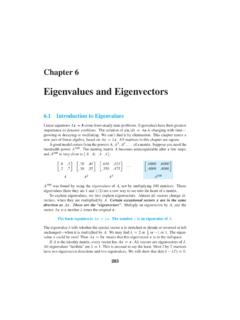
6.1 Introduction to Eigenvalues Linear equationsAx D bcomefrom steady stateproblems. Eigenvalueshave theirgreatest importance in dynamic problems. The solution of du=dt D Au is changing with time— growing or decaying or oscillating. We can’t find it by elimination. This chapter enters a new part of linear algebra, based on Ax D x.
Download Eigenvalues and Eigenvectors - MIT Mathematics

Information
Domain:
Source:
Link to this page:
Documents from same domain
Introduction to Linear Algebra, 5th Edition
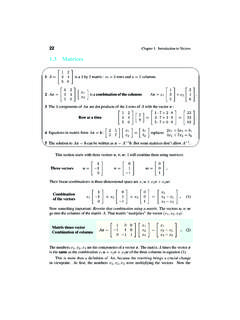
math.mit.edu1.3 Matrices 1 A = ... Linear Equations One more change in viewpoint is crucial. Up to now, the numbers x 1,x 2,x 3 were known. The right hand side b was not known. We found that vector of differences by multiplying A times x. Now we think of b as known and we look for x.
Eigenvalues and Eigenvectors - MIT Mathematics
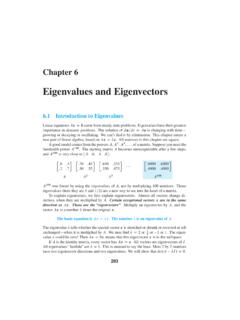
math.mit.edu6.1. Introduction to Eigenvalues 287 Eigenvalues The number is an eigenvalue of Aif and only if I is singular: det.A I/ D 0: (3) This “characteristic equation” det.A I/ D 0 involves only , not x. When A is n by n,
4 Cauchy’s integral formula - MIT Mathematics
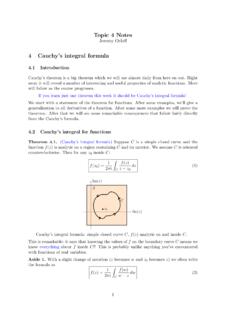
math.mit.edu4 Cauchy’s integral formula 4.1 Introduction ... 4 CAUCHY’S INTEGRAL FORMULA 4 4.3.1 Another approach to some basic examples Suppose Cis a simple closed curve around 0. We have seen that Z C 1 z ... Since an integral is basically a sum, this translates to the triangle inequality for integrals.
A FRIENDLY INTRODUCTION TO GROUP THEORY
math.mit.eduA FRIENDLY INTRODUCTION TO GROUP THEORY 3 A good way to check your understanding of the above de nitions is to make sure you understand why the following equation is correct: jhgij= o(g): (1) De nition 5: A group Gis called abelian (or commutative) if gh = hg for all g;h2G. A group is called cyclic if it is generated by a single element, that is,
4.3 Least Squares Approximations
math.mit.edu4.3. Least Squares Approximations 221 Figure 4.7: The projection p DAbx is closest to b,sobxminimizes E Dkb Axk2. In this section the situation is just the opposite. There are no solutions to Ax Db. Instead of splitting up x we are splitting up b. Figure 4.3 shows the big picture for least squares. Instead of Ax Db we solve Abx Dp.

Linear programming 1 Basics - MIT Mathematics
math.mit.edu2 subject to: 5x 1 + 7x 2 8 4x 1 + 2x 2 15 2x 1 + x 2 3 x 1 0;x 2 0: Some more terminology. A solution x= (x 1;x 2) is said to be feasible with respect to the above linear program if it satis es all the above constraints. The set of feasible solutions is called the feasible space or feasible region. A feasible solution is optimal if its ...
Square Roots via Newton’s Method
math.mit.eduSquare Roots via Newton’s Method S. G. Johnson, MIT Course 18.335 February 4, 2015 1 Overview ...
V7. Laplace’s Equation and Harmonic Functions
math.mit.eduA. Existence. Does there exist a φ(x,y) harmonic in some region containing Cand its interior R, and taking on the prescribed boundary values? B. Uniqueness. If it exists, is there only one such φ(x,y)? C. Solving. If there is a unique φ(x,y), determine it by some explicit formula, or approximate it by some numerical method.
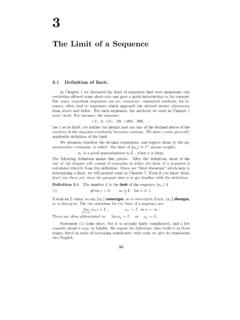
The Limit of a Sequence - MIT Mathematics
math.mit.edu“obvious” using the definition of limit we started with in Chapter 1, but we are committed now and for the rest of the book to using the newer Definition 3.1 of limit, and therefore the theorem requires proof. Theorem 3.2B {an} increasing, L = liman ⇒ an ≤ L for all n; {an} decreasing, L = liman ⇒ an ≥ L for all n. Proof.
Introduction to Linear Algebra, 5th Edition
math.mit.eduIntroduction to Vectors 1.3 Matrices ... linear algebra, and the output Ax is a linear combination of the columns of A. With numbers, you can multiply Ax by rows. With letters, columns are the good way. ... Let me repeat the solution x in equation (6). A sum matrix will appear!
Related documents
Schaum's Outline of Linear Algebra
www.astronomia.edu.uyThis book is designed for use as a textbook for a formal course in linear algebra or as a supplement to all current standard texts. It aims to present an introduction to linear algebra which will be found helpful to all readers regardless of their fields of specification. More material has been included than can be covered in most first courses.

Linear Algebra in Twenty Five Lectures
www.math.ucdavis.eduThese linear algebra lecture notes are designed to be presented as twenty ve, fty minute lectures suitable for sophomores likely to use the material for applications but still requiring a solid foundation in this fundamental branch

INTRODUCTION MACHINE LEARNING
robotics.stanford.edu1.1 Introduction 1.1.1 What is Machine Learning? Learning, like intelligence, covers such a broad range of processes that it is dif- cult to de ne precisely. A dictionary de nition includes phrases such as \to gain knowledge, or understanding of, or skill in, by study, instruction, or expe-

Matrix Theory and LINEAR ALGEBRA - Dalhousie University
www.mathstat.dal.caMatrix Theory and Linear Algebra is an introduction to linear algebra for students in the first or second year of university. The book contains enough material for a 2-semester course. Major topics of linear algebra are presented in detail, and many applications are given. Although it is not a proof-oriented book,

Introduction to Vectors and Tensors Volume 1
oaktrust.library.tamu.educourse. We feel Volume I is suitable for an introductory linear algebra course of one semester. Given this course, or an equivalent, Volume II is suitable for a one semester course on vector and tensor analysis. Many exercises are included in each volume. However, it is likely that teachers will wish to generate additional exercises.
Introduction to Linear Algebra, 5th Edition
math.mit.eduIntroduction to Vectors ... linear algebra, and the output Ax is a linear combination of the columns of A. With numbers, you can multiply Ax by rows. With letters, columns are the good way. Chapter 2 will repeat these rules of matrix multiplication, and explain the ideas.

Introduction to Modern Algebra - Clark University
mathcs.clarku.eduIntroduction 1.1 Algebra The word \algebra" means many things. The word dates back about 1200 years ago to part of the title of al-Khwarizm ’s book on the subject, but the subject itself goes back 4000 years ago to ancient Babylonia and Egypt. It was about solving numerical problems that we would now identify as linear and quadratic equations.

Linear Algebra - pku.edu.cn
www.math.pku.edu.cnlinear transformations, their algebra, their representation by matrices, as well as isomorphism, linear functionals, and dual spaces. Chapter 4 defines the algebra of polynomials over a field, the ideals in that algebra, and the prime factorization of a polynomial. It also deals with roots, Taylor's formula, and the Lagrange inter polation ...

Introduction to Applied Linear Algebra
vmls-book.stanford.eduThis book is meant to provide an introduction to vectors, matrices, and least squares methods, basic topics in applied linear algebra. Our goal is to give the beginning student, with little or no prior exposure to linear algebra, a good ground-ing in the basic ideas, as well as an appreciation for how they are used in many

Linear Algebra and Its Applications
anandinstitute.orgLinear algebra moves steadily to n vectors in m-dimensional space. We still want combinations of the columns (in the column space). We still get m equations to produce b (one for each row). Those equations may or may not have a solution. They always have a least-squares solution. The interplay of columns and rows is the heart of linear algebra.