Eigenvalues, eigenvectors, and eigenspaces of linear ...
We’re particularly interested in the study the ge-ometry of these transformations in a way that we can’t when the transformation goes from one vec-tor space to a di erent vector space, namely, we’ll compare the original vector x to its image T(x). Some of …
Download Eigenvalues, eigenvectors, and eigenspaces of linear ...

Information
Domain:
Source:
Link to this page:
Documents from same domain
Summary of basic probability theory Math 218, …
mathcs.clarku.eduSummary of basic probability theory Math 218, Mathematical Statistics D Joyce, Spring 2016 Sample space. A sample space consists of a un-derlying set , whose elements are called outcomes, a collection of subsets of called events, and a function Pon the set of events, called a probability

Introduction to Modern Algebra - Clark University
mathcs.clarku.eduAlgebra became more general and more abstract in the 1800s as more algebraic structures were invented. Hamilton (1805{1865) invented quaternions (see section2.5.2) and Grassmann

Practice Integration Z Math 120 Calculus I - Clark University
mathcs.clarku.eduZ 3 p 7vdv. Since you can rewrite the integrand as 3 p 7v1=3, therefore its integral is 3 4 3 p 7v4=3 + C: 4. 18. Answer. Z 4 p 5t dt. The integral of 4 p 5 t 1=2 is equal to 8 p 5 t1=2 +C. You could also write that as 8 p t=5 + C. 19. Answer. Z 1 3x2 + 3 dx This integral equals 1 3 arctanx+ C. 20. Answer. Z x4 6x3 + ex p x p x dx.
Covariance and Correlation Math 217 Probability and ...
mathcs.clarku.eduCorrelation. The correlation ˆ XY of two joint variables Xand Y is a normalized version of their covariance. It’s de ned by the equation ˆ XY = Cov(X;Y) ˙ X˙ Y: Note that independent variables have 0 correla-tion as well as 0 covariance. By dividing by the product ˙ X˙ Y of the stan-dard deviations, the correlation becomes bounded ...

Determinants, part III Math 130 Linear Algebra
mathcs.clarku.edu2x + 3y 4z = 2 3x 2y + 5z = 7 First, compute the determinant of the 3 3 co-e cient matrix. = 1 1 3 2 3 4 3 2 5 = 54 Next, replace the rst column by the constant vec-tor, and compute that determinant. x = 6 1 3 2 3 4 7 2 5 = 27 Then in the unique solution, x = x= = 1 2. Next, replace the second column by the constant vector, and compute that ...

Directional derivatives, steepest a ascent, tangent planes ...
mathcs.clarku.edunormal to the surface. If x is any point in R3, then rf(a) (a x) = 0 says that the vector a x is orthogonal to rf(a), and therefore lies in the tangent plane, and so x is a point on that plane. Example 2 (Continuous, nondi erentiable func-tion). You’re familiar with functions of one vari-able that not continuous everywhere. For example,

Some linear transformations on R2 Math 130 Linear Algebra
mathcs.clarku.eduExample 8 (Projections). Consider the 2 2 matrix 1 0 0 0 . It sends the vector x y to the vector x 0 . This particular transformation is a projection from 2-space onto the x-axis that forgets the y-coordinate. Projections have 1-eigenspaces and 0-eigenspaces. What are they for this projection? This projection will map our leaf to the x-axis as ...

Kernel, image, nullity, and rank Math 130 Linear Algebra
mathcs.clarku.eduhomogeneous system Ax = 0. Furthermore, these two lines are parallel, and the vector 2 4 1=2 3=2 0 3 5shifts the line through the origin to the other line. In summary, for this example, the solution set for the nonhomogeneous equation Ax = b is a line in R3 parallel to the solution space for the homogeneous equation Ax = 0.

Gradient, divergence, and curl Math 131 Multivariate Calculus
mathcs.clarku.edur= @ @x 1; @ @x 2;:::; @ @x n which, when applied to f yields rf. This ris called the del operator. We can treat this del operator like a vector itself. We can combine it with other vector operations like dot product and cross product, and that leads to the concepts of divergence and curl, respectively. De nition 1. We de ne the divergence of a ...
Related documents

Mathematics for Physics - gatech.edu
goldbart.gatech.eduThe second part (Chapters 10 to 14) focuses on modern di erential ge-ometry and topology, with an eye to its application to physics. The tools of calculus on manifolds, especially the exterior calculus, are introduced, and vii. viii PREFACE used to investigate classical mechanics, electromagnetism, and non-abelian

Tensor Calculus - Saint Mary's University
www.ap.smu.caquantities (e.g., moment of inertia, viscosity, spin) and in the senior year, Riemannian ge-ometry and general relativity require mathematical entities of still higher rank. The tools of vector analysis are simply incapable of allowing one to write down the governing laws in
Cumbre Vieja Volcano -- Potential collapse and tsunami at ...
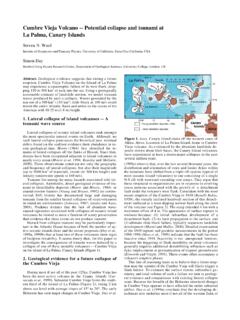
www.cityofboston.govThe inferred ge-ometry and volume of the expected failure coincide closely with features of the previous La Palma collapse (~566 ka), remains of which are still visible to the north on Cumbre Nueva (Day et al., 1999a). 3. Landslide Tsunami Model - Generalities The section above provides a feeling for the size and shape
Tensors for Beginners
www.ipgp.frObvious examples of differentiable manifolds are the lines and surfaces of ordinary ge-ometry. Our 3-D physical space (with, possibly, curvature and torsion) is also represented by a differentiable manifold. The space-time of general relativity is a four dimensional dif-ferentiable manifold. Acoordinatesystemmaynot“cover”allthemanifold.
Introduction to Differential Geometry
www.math.toronto.eduChapter 1 Introduction 1.1 Some history In the words of S.S. Chern, ”the fundamental objects of study in differential geome-try are manifolds.” 1 Roughly, an n-dimensional manifold is a mathematical object that “locally” looks like Rn.The theory of manifolds has a …

Ancient Greek Mathematics - University of California, Irvine
www.math.uci.eduseveral of the major ideas of Greek mathematics. In particular, it helps explain the primacy of Ge-ometry in their mathematics: lengths are real things that the Greeks wanted to compare using numbers. A core Pythagorean belief was that of commensurability: given two lengths, there exists a sub-length dividing exactly into both.