
Electric Potential Difference, - Physics Courses
A parallel plate capacitor has a constant electric field of 500 N/C; the plates are separated by a distance of 2 cm. Find the potential difference between the two plates. Example of Potential Difference + + + + + + + _ difference _ _ _ _ _ _ ΔV Remember: potential ΔV does not depend on the presence of any test charge in the E-field! d
Download Electric Potential Difference, - Physics Courses

Information
Domain:
Source:
Link to this page:
Documents from same domain
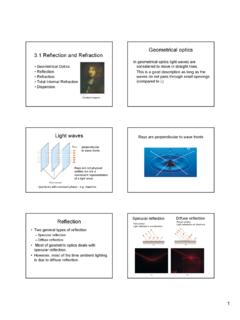
3.1 Reflection and Refraction - University of California ...
courses.physics.ucsd.edu3.1 Reflection and Refraction • Geometrical Optics • Reflection • Refraction • Total Internal Refraction • Dispersion Christian Huygens Geometrical optics In geometrical optics light waves are ... Refraction and Reflection The light beam (3) is refracted at the interface. 4
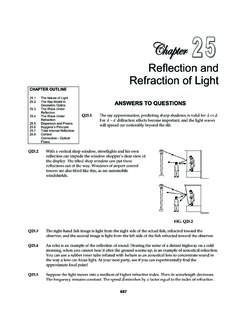
Reflection and Refraction of Light
courses.physics.ucsd.edu688 Reflection and Refraction of Light Q25.6 If a laser beam enters a sugar solution with a concentration gradient (density and index of refraction increasing with depth) then the laser beam will be progressively bent downward (toward the normal) as it passes into regions of greater index of refraction.
Lecture Notes on Classical Mechanics (A Work in Progress)
courses.physics.ucsd.eduLecture Notes on Classical Mechanics (A Work in Progress) Daniel Arovas Department of Physics University of California, San Diego May 8, 2013
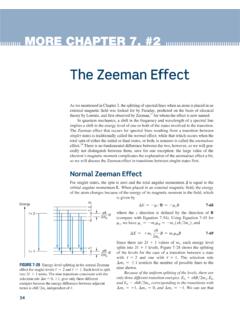
The Zeeman Effect - Physics Courses
courses.physics.ucsd.eduMore Chapter 7 37 spin-orbit effect and decouples L and S so that they precess about B nearly indepen- dently; thus, the projections of L behave as if S 0, and the effect reduces to three lines, each of which is a closely spaced doublet. EXAMPLE 7-5 Magnetic Field of the Sun The magnetic field of the Sun and stars can be determined by measuring the Zeeman-effect splitting of …
Lecture Notes on Condensed Matter Physics (A Work in …
courses.physics.ucsd.eduLecture Notes on Condensed Matter Physics (A Work in Progress) Daniel Arovas Department of Physics University of California, San Diego March 14, 2010
Lecture Notes on Classical Mechanics (A Work in Progress)
courses.physics.ucsd.eduLecture Notes on Classical Mechanics (A Work in Progress) Daniel Arovas Department of Physics University of California, San Diego May 8, 2013
Lagrangian Mechanics - Physics Courses
courses.physics.ucsd.edu2 CHAPTER 6. LAGRANGIAN MECHANICS 6.2 Hamilton’s Principle The equations of motion of classical mechanics are embodied in a variational principle, called Hamilton’s principle. Hamilton’s principle states that the motion of a system is such that the action functional S q(t) = Zt2 t1 dtL(q,q,t˙ ) (6.2) is an extremum, i.e. δS = 0.
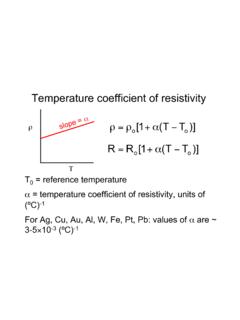
Temperature coefficient of resistivity
courses.physics.ucsd.eduPower Transmission Transmitting electrical power is done much more efficiently at higher voltages due to the desire to minimize (I2R) losses. Consider power transmission to a small community which is 100 mi from the power plant and which consumes power at a rate of 10 MW. In other words, the generating station needs to supply whatever power it ...
Lecture Notes on Superconductivity (A Work in Progress)
courses.physics.ucsd.eduLecture Notes on Superconductivity (A Work in Progress) Daniel Arovas Congjun Wu Department of Physics University of California, San Diego June 23, 2019
Physics 1B: Electricity & Magnetism
courses.physics.ucsd.eduMedical Devices (Defibrillators) EM Radiation (visible light, radio, TV, cell phones) Ch. 19: Electric Forces & Electric Fields Properties of electric charges & how they interact with each other --on both macroscopic and microscopic scales. Electric Charges & Conservation of Charge
Related documents
Chapter 5 Capacitance and Dielectrics
web.mit.eduproduces a potential difference. Find the capacitance of the system. Figure 5.2.1 The electric field between the plates of a parallel-plate capacitor Solution: To find the capacitance C, we first need to know the electric field between the plates. A real capacitor is finite in size. Thus, the electric field lines at the edge of the plates are not
Chapter 3 Electric Potential - MIT
web.mit.eduThe potential difference ∆V represents the amount of work done per unit charge to move a test charge from point A to B, without changing its kinetic energy. Again, electric potential should not be confused with electric potential energy. The two quantities are related by q0 ∆Uq=∆0 V (3.1.10) The SI unit of electric potential is volt (V):
Electric Potential Work and Potential Energy
www.phys.ufl.edupotential energy of a particle like the electron crossing an electric potential difference. Consider an electron crossing a potential difference of 1 volt: This is a tiny number, which we can define as one electron-volt (abbreviated “eV”).
Motion of Charged Particles in Electric and Magnetic Fieldsx
www.subhasishchandra.comElectric field between two parallel plates having a potential difference of V volts and having separation d metres between them is given as E= / The SI unit for Electric field is Newtons/Coulomb (N/C). Electric Potential: Electric potential (V) at a point is defined as the work done on a positive charge to bring it from infinity to that point.

Lecture 4 Electric Potential - Cornell University
courses.cit.cornell.eduElectric Potential In this lecture you will learn: • Electric Scalar Potential • Laplace’s and Poisson’s Equation ... • The line integral of E-field between any two points is the difference of the potentials at those points ()() 1 2 2 1 2 1 E.ds.ds r r r r r r r r r r r r r r r
1 THE LIGHT BULB EXPERIMENT: Exploring Simple Electric ...
faraday.physics.utoronto.caPotential difference or voltage: this has to do with the "push" on charges that the electrical force has between two points in a circuit. More clearly, it is the difference in potential energy that a 1 Coulomb charge experiences in being transferred between the two points in the circuit that are being compared. Units are Joules/Coulomb = Volts.

(a)€€€€ Define the electric potential at a point in an ...
umutech.net(ii)€€€€€State how you would use the graph to find the electric potential difference between the points A and B. _____ _____ (1) E 7 KHS HUPLWWLYLW\R II UHHV SDFH00 is 8.9 × 10⁻¹² F m–1. (i)€€€€€€Calculate the total charge on the Earth. ...

Electric circuits, Current, and resistance (Chapter 22 and 23)
www.physics.brocku.caA current density J & the electric field E are established in a conductor when a potential difference (Vb-Va) is maintained across the conductor J = σE -----Ohm’s Law σ is called electrical conductivity of the materials Ohmicmaterials: In these materials the ratio of J and E is a constant “σ”. In other words, it is J