
ELEMENTARY DIFFERENTIAL EQUATIONS
The second order Euler equationis discussed in Section 7.4, where it sets the stage for the method of Frobenius. As noted at the beginning of Section 7.4, if you want to include Euler equations in
Download ELEMENTARY DIFFERENTIAL EQUATIONS

Information
Domain:
Source:
Link to this page:
Documents from same domain
Probability, Statistics, and Stochastic Processes
ramanujan.math.trinity.eduProbability, Statistics, and Stochastic Processes Peter Olofsson Mikael Andersson A Wiley-Interscience Publication JOHN WILEY & SONS, INC. New York / Chichester / Weinheim / Brisbane / Singapore / Toronto
THE METHOD OF LAGRANGE MULTIPLIERS - Trinity …
ramanujan.math.trinity.eduTHE METHOD OF LAGRANGE MULTIPLIERS William F. Trench Andrew G. Cowles Distinguished Professor Emeritus Department of Mathematics Trinity University
INTRODUCTION TO REAL ANALYSIS - Trinity …
ramanujan.math.trinity.eduINTRODUCTION TO REAL ANALYSIS William F. Trench AndrewG. Cowles Distinguished Professor Emeritus Departmentof Mathematics Trinity University San Antonio, Texas, USA
Improper Integrals - Trinity University
ramanujan.math.trinity.eduThat’s the easy implication. For the converse, now suppose the stated Cauchy criterion holds. For natural numbers n alet a n = Z n a f(x)dx: Let …
STUDENT SOLUTIONS MANUAL FOR …
ramanujan.math.trinity.eduSTUDENT SOLUTIONS MANUAL FOR ELEMENTARY DIFFERENTIAL EQUATIONS AND ELEMENTARY DIFFERENTIAL EQUATIONS WITH BOUNDARY VALUE PROBLEMS William F. Trench Andrew G. Cowles Distinguished Professor Emeritus Department of Mathematics Trinity University San Antonio, Texas, USA
ELEMENTARY DIFFERENTIAL EQUATIONS
ramanujan.math.trinity.eduPreface Elementary Differential Equations with Boundary Value Problems is written for students in science, en-gineering,and mathematics whohave completed calculus throughpartialdifferentiation.
The one dimensional heat equation: Neumann and …
ramanujan.math.trinity.eduNeumann Boundary Conditions Robin Boundary Conditions Remarks At any given time, the average temperature in the bar is u(t) = 1 L Z L 0 u(x,t)dx. In the case of Neumann boundary conditions, one has u(t) = a 0 = f. That is, the average temperature is constant and is equal to the initial average temperature.
The two dimensional wave equation - Trinity University
ramanujan.math.trinity.eduThe 2D wave equation Separation of variables Superposition Examples Representability The question of whether or not a given function is equal to a double Fourier series is partially answered by the following result. Theorem If f(x,y) is a C2 function on the rectangle [0,a] ×[0,b], then
Introduction to Sturm-Liouville Theory - Trinity University
ramanujan.math.trinity.eduOrthogonality Sturm-Liouville problems Eigenvalues and eigenfunctions Inner products with weight functions Suppose that w(x) is a nonnegative function on [a,b].
The Chinese Remainder Theorem - ramanujan.math.trinity.edu
ramanujan.math.trinity.eduThe Chinese remainder theorem (CRT) asserts that there is a unique class a+ NZ so that xsolves the system (2) if and only if x2a+ NZ, i.e. x a(mod N). Thus the system (2) is equivalent to a single congruence modulo N. Although we only proved one implication, one can actually show that the …
Related documents
Second Order Differential Equations
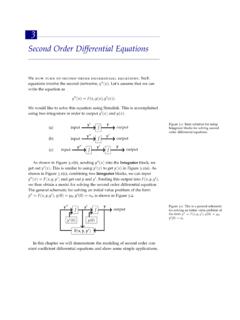
people.uncw.edusecond order differential equations 45 x 0 0.5 1 1.5 2 2.5 3 3.5 4 4.5 5 y 0 0.05 0.1 0.15 y(x) vs x Figure 3.4: Solution plot for the initial value problem y00+ 5y0+ 6y = 0, y(0) = 0, y0(0) = 1 using Simulink. Recall the solution of this problem is found by first seeking the
Second Order Linear Differential Equations
www.math.uh.eduAny second order differential equation can be written as F(x,y,y0,y00)=0 This chapter is concerned with special yet very important second order equations, namely linear equations. Recall that a first order linear differential equation is an equation which can be written in the form y0 + p(x)y= q(x) where p and q are continuous functions on ...
Second Order Linear Differential Equations
www.math.utah.eduSecond Order Linear Differential Equations 12.1. Homogeneous Equations A differential equation is a relation involvingvariables x y y y . A solution is a function f x such that the substitution y f x y f x y f x gives an identity. The differential equation is said to be linear if it is linear in the variables y y y .
First-Order Differential Equations and Their Applications
assets.press.princeton.eduThe order of a differential equation is the order of the highest derivative of the unknown function (dependent variable) that appears in the equation. The differential equations in (1) are of first, second, and fourth order, respectively. Most of the equations we shall deal with will be of first or second order.
Second Order Linear Differential Equations
www.personal.psu.educharacteristic equation; solutions of homogeneous linear equations; reduction of order; Euler equations In this chapter we will study ordinary differential equations of the standard form below, known as the second order linear equations: y″ + p(t) y′ + q(t) y = g(t). Homogeneous Equations: If g(t) = 0, then the equation above becomes y ...
Second Order Linear Partial Differential Equations Part I
www.personal.psu.eduinto a simultaneous system of 2 ordinary differential equations. They are a second order homogeneous linear equation in terms of x, and a first order linear equation (it is also a separable equation) in terms of t. Both of them can be solved easily using what we …

First Order Partial Differential Equations
people.uncw.edu2 partial differential equations Second order partial derivatives could be written in the forms ¶2u ¶x2,uxx,¶xxu, D2xu. ¶2u ¶x¶y ¶2u ¶y¶x,uxy,¶xyu, DyDxu. Note, we are assuming that u(x,y,. . .) has continuous partial derivatives.
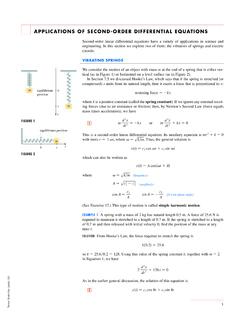
APPLICATIONS OF SECOND-ORDER DIFFERENTIAL …
www.math.pitt.edu4 APPLICATIONS OF SECOND-ORDER DIFFERENTIAL EQUATIONS FORCED VIBRATIONS Suppose that, in addition to the restoring force and the damping force, the motion of the spring is affected by an external force . Then Newton’s Second Law gives Thus, instead of the homogeneous equation (3), the motion of the spring is now governed
Second Order Differential Equation Non Homogeneous
bionics.seas.ucla.eduSecond Order Linear Differential Equations – Homogeneous & Non Homogenous v • p, q, g are given, continuous functions on the open interval I ¯ ® c ( ) 0 ( ) ( ) g t y p t y q t y Homogeneous Non-homogeneous

Second Order Systems
www.et.byu.eduSecond Order Systems Second Order Equations 2 2 +2 +1 = s s K G s τ ζτ Standard Form τ2 d 2 y dt2 +2ζτ dy dt +y =Kf(t) Corresponding Differential Equation K = Gain τ= Natural Period of Oscillation ζ= Damping Factor (zeta) Note: this has to be 1.0!!!