Encoder-DecoderwithAtrous Separable Convolution for ...
Depthwise separable convolution:Depthwiseseparableconvolution[27,28] or group convolution [7,65], a powerful operation to reduce the computation cost and number of parameters while maintaining similar (or slightly better) perfor-mance. This operation has been adopted in many recent neural network designs
Download Encoder-DecoderwithAtrous Separable Convolution for ...

Information
Domain:
Source:
Link to this page:
Documents from same domain
What Have We Learned From Deep Representations for …
openaccess.thecvf.comwhat these powerful models actually have learned. In this paper we shed light on deep spatiotemporal net-works by visualizing what excites the learned models us-ing activation maximization by backpropagating on the in-put. We are the first to visualize the hierarchical features
Finding Tiny Faces in the Wild With Generative Adversarial ...
openaccess.thecvf.comfaces, which are unfriendly for the face classifier. Toward-s this end, we design a refinement sub-network to recover some detailed information. In the discriminator network, the basic GAN [17, 12, 8] is trained to distinguish the real and fake high resolution images. To classify faces or non-
Squeeze-and-Excitation Networks - openaccess.thecvf.com
openaccess.thecvf.comSqueeze-and-Excitation Networks Jie Hu1∗ Li Shen2∗ Gang Sun1 hujie@momenta.ai lishen@robots.ox.ac.uk sungang@momenta.ai 1 Momenta 2 Department of Engineering Science, University of Oxford Abstract Convolutional neural networks are built upon the con-
RegularFace: Deep Face Recognition via Exclusive ...
openaccess.thecvf.comRegularFace: Deep Face Recognition via Exclusive Regularization Kai Zhao Jingyi Xu Ming-Ming Cheng ∗ TKLNDST, CS, Nankai University kaiz.xyz@gmail.com cmm@nankai.edu.cn
Protecting World Leaders Against Deep Fakes
openaccess.thecvf.comProtecting World Leaders Against Deep Fakes Shruti Agarwal and Hany Farid University of California, Berkeley Berkeley CA, USA {shrutiagarwal, hfarid}@berkeley.edu
Auto-DeepLab: Hierarchical Neural Architecture Search for ...
openaccess.thecvf.comAuto-DeepLab: Hierarchical Neural Architecture Search for Semantic Image Segmentation Chenxi Liu1∗, Liang-Chieh Chen 2, Florian Schroff2, Hartwig Adam2, Wei Hua2, Alan Yuille1, Li Fei-Fei3 1Johns Hopkins University 2Google 3Stanford University Abstract Recently, NeuralArchitectureSearch(NAS)hassuccess-
PointNet: Deep Learning on Point Sets ... - CVF Open Access
openaccess.thecvf.comPointNet: Deep Learning on Point Sets for 3D Classification and Segmentation Charles R. Qi* Hao Su* Kaichun Mo Leonidas J. Guibas Stanford University
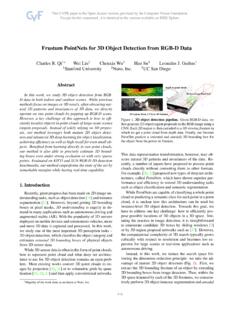
Frustum PointNets for 3D Object Detection From RGB-D Data
openaccess.thecvf.comFrustum PointNets for 3D Object Detection from RGB-D Data Charles R. Qi1∗ Wei Liu2 Chenxia Wu2 Hao Su3 Leonidas J. Guibas1 1Stanford University 2Nuro, Inc. 3UC San Diego Abstract In this work, we study 3D object detection from RGB-D data in both indoor and outdoor scenes.
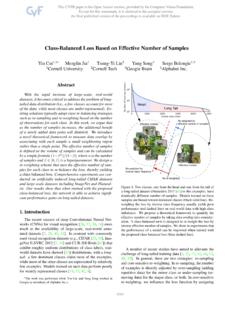
Class-Balanced Loss Based on Effective Number of Samples
openaccess.thecvf.comand large-scale datasets including ImageNet and iNatural-ist. Our results show that when trained with the proposed class-balanced loss, the network is able to achieve signifi-cant performance gains on long-tailed datasets. 1. Introduction The recent success of deep Convolutional Neural Net-works (CNNs) for visual recognition [26, 37, 38, 16] owes
ESRGAN: Enhanced Super-Resolution Generative Adversarial ...
openaccess.thecvf.comESRGAN: EnhancedSuper-Resolution Generative Adversarial Networks Xintao Wang 1, Ke Yu , Shixiang Wu2, Jinjin Gu3, Yihao Liu4, Chao Dong 2, Yu Qiao , and Chen Change Loy5 1 CUHK-SenseTime Joint Lab, The Chinese University of Hong Kong 2 Shenzhen Institutes of Advanced Technology, Chinese Academy of Sciences 3 The Chinese University of Hong Kong, …
Related documents
Andrew G. Howard Menglong Zhu Bo Chen Dmitry …
arxiv.orgDepthwise separable convolution are made up of two layers: depthwise convolutions and pointwise convolutions. We use depthwise convolutions to apply a single filter per each input channel (input depth). Pointwise convolution, a simple 1 1convolution, is then used to create a …

fchollet@google - arXiv
arxiv.orgDepthwise separable convolutions, which our proposed architecture is entirely based upon. While the use of spa-tially separable convolutions in neural networks has a long history, going back to at least 2012 [12] (but likely even earlier), the depthwise version is more recent. Lau-rent Sifre developed depthwise separable convolutions
Xception: Deep Learning With Depthwise Separable …
openaccess.thecvf.comdepthwise separable convolutions in the TensorFlow framework [1]. • Residual connections, introduced by He et al. in [4], which our proposed architecture uses extensively. 3. The Xception architecture We propose a convolutional neural network architecture based entirely on depthwise separable convolution layers.

Neural Architecture Search: A Survey
www.jmlr.orgoperations like depthwise separable convolutions (Chollet, 2016) or dilated convolutions (Yu and Koltun, 2016); and (iii) hyperparameters associated with the operation, e.g., number of lters, kernel size and strides for a convolutional layer (Baker et al., 2017a; Suganuma

Deep Learning with Keras : : CHEAT SHEET
raw.githubusercontent.comIntro Deep Learning with Keras : : CHEAT SHEET Keras is a high-level neural networks API developed with a focus on enabling fast experimentation. It supports multiple back-

Comparison of YOLOv3, YOLOv5s and MobileNet-SSD V2 for ...
www.irjet.netdepthwise separable convolution, which lowered the model size and complexity cost of the network to a decent level, to make it usable for low processing applications. Thereafter in the second edition of the MobileNet family, an inverted residual structure is provided for much better modularity and this version has been named MobileNetV2.