
Energy Systems - IPCC
tion happens more rapidly in electricity generation than in the industry, buildings and transport sectors (medium evidence, high agreement). In the majority of low-stabilization scenarios, the share of low-carbon electricity supply (comprising RE, nuclear and CCS) increases from the current share of approximately 30% to more than
Download Energy Systems - IPCC

Information
Domain:
Source:
Link to this page:
Documents from same domain
Summary for Policymakers - IPCC
www.ipcc.chSummary for Policymakers 2 Introduction This Synthesis Report is based on the assessment carried out by the three Working Groups of the Intergovernmental

Other Land Use (AFOLU) - ipcc.ch
www.ipcc.ch816 Agriculture, Forestry and Other Land Use (AFOLU) 11 Chapter 11 Executive Summary Agriculture, Forestry, and Other Land Use (AFOLU) is unique among the sectors considered in this volume, since the mitiga-
22 — Africa - IPCC
www.ipcc.ch1199 22 Africa Coordinating Lead Authors: Isabelle Niang (Senegal), Oliver C. Ruppel (Namibia) Lead Authors: Mohamed A. Abdrabo (Egypt), Ama Essel (Ghana), Christopher Lennard (South Africa),
Transport and its infrastructure - ipcc.ch
www.ipcc.ch326 Transport and its infrastructure Chapter 5 Hybrid vehicles have also played a role, though their market penetration is currently small. Reductions in drag coefficients
Synthesis Report Summary for Policymakers Chapter
www.ipcc.chSummary for Policymakers 2 SPM Introduction This Synthesis Report is based on the reports of the three Working Groups of the Intergovernmental Panel on Climate Change
Working Group II Fact Sheet Climate Change 2014: …
www.ipcc.chIPCC WGII Technical Support Unit • c/o Carnegie Institution for Science 260 Panama Street • Stanford, CA 94305 USA Phone: (+1) 650-353-4257 • Fax: (+1) 650-462-5968 • email: media@ipcc-wg2.gov • www.ipcc-wg2.gov/AR5/

Climate Change 2007 – The Physical Science Basis …
www.ipcc.chThis Synthesis Report with its Summary for Policymakers is the fourth and final part of the Fourth Assessment Report (AR4) of the Intergovernmental Panel on Climate Change
Summary for Policymakers - IPCC
www.ipcc.ch5 SPM Summary for Policymakers Sustainable development and equity provide a basis for assessing climate policies and highlight the need for …
19 — Emergent Risks and Key Vulnerabilities - IPCC
www.ipcc.ch1041 Emergent Risks and Key Vulnerabilities Chapter 19
Summary for Policymakers - IPCC
www.ipcc.chSummary for Policymakers 3 Figure SPM.1. Atmospheric concentrations of carbon dioxide, methane and nitrous oxide over the last 10,000 years (large
Related documents

Energy from waste
assets.publishing.service.gov.uk• As a partially renewable energy source it can also contribute to our renewable energy targets which are aimed at decarbonising energy generation. • It has the added advantage that it is non-intermittent, so it can complement other renewable energy sources such as wind or solar.

HYDROPOWER DEVELOPMENT AND ECONOMIC GROWTH IN …
www.adb.orgII. OVERVIEW OF NEPAL’S ELECTRICITY SECTOR The energy sector plays a very important role in economic development and evidence shows that expanding the electricity sector contributes to economic growth in many countries. The underperforming electricity sector in Nepal, with inadequate and unreliable supply of poor-quality electricity, was a major
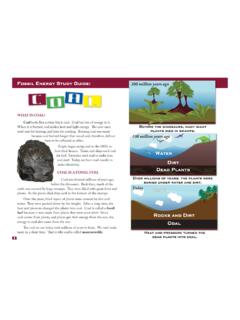
Fossil Energy Study Guide: 300 million years ago
www.energy.govElectricity-generating plants send out electricity using a transformer, which changes the electricity from low voltage to high voltage. Th is is an important step, as it gives electricity the jolt it needs to travel from the power plant to its fi nal destination. Voltages are often as high as 500,000 volts at this point.
A Guide to Community Solar: Utility, Private, and Non ...
www.nrel.govNet metering: Most on-site renewable energy systems use net metering to account for the value of the electricity produced when production is greater than demand. Net-metering allows customers to bank this excess electric generation on the grid, usually in the form of kilowatt-hour (kWh) credits that can be used as needed during a given period.

Easy Guide to Heat Pumps - ofgem.gov.uk
www.ofgem.gov.ukElectricity meter readings will need to be provided every quarter as part of your periodic data submission. You ... evidence COP At least 2.9 COP confirmed by manufacturer’s datasheet ... underpins the scheme3 only allows support for the ‘renewable generation of heat’. Therefore, the heat generated by the ...

The Sixth Carbon Budget Electricity generation
www.theccc.org.ukCarbon intensity of electricity generation decreased by 55% between 2008 and 2018, from 535 gCO. 2 /kWh to 245 gCO. 2 /kWh. That reflects a shift away from coal towards gas and renewable generation (Figure M5.3). Nuclear also contributes to low-carbon electricity generation. – In 1990, coal generated 80% of UK electricity. Following the