
Ergonomics
Ergonomics Overview Ergonomics is the science of fitting the job to the worker. Designing work stations and tools to reduce work-related musculoskeletal disorders (MSDs) can help workers stay healthy and companies to reduce or eliminate
Download Ergonomics

Information
Domain:
Source:
Link to this page:
Documents from same domain
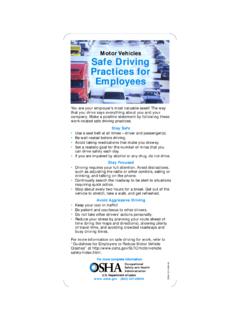
Motor Vehicles Safe Driving Practices for Employees
www.osha.govMotor Vehicles Safe Driving Practices for Employees You are your employer’s most valuable asset! The way that you drive says everything about you and your
U. S. Department of Labor Occupational Safety and …
www.osha.govU. S. Department of Labor Occupational Safety and Health Administration Notice of Alleged Safety or Health Hazards . For the General Public: This form is provided for the assistance of any complainant and is not intended to constitute the exclusive means by
Controlling Hazardous Fume and - osha.gov
www.osha.govFactSheet Controlling Hazardous Fume and Gases during Welding Welding joins materials together by melting a metal work piece along with a …
OSHA 3220-10N 2004
www.osha.govWORKER SAFETY SERIES WAREHOUSING 11 Hazards & Solutions Warehouse operations can present a wide variety of potential hazards for the worker. For warehousing establishments, the
Job Safety and Health - osha.gov
www.osha.govJob Safety and Health. IT’S THE LAW! All workers have the right to: A safe workplace. Raise a safety or health concern with your employer or OSHA, or report a work-
Year 20 Log of Work-Related Injuries and Illnesses
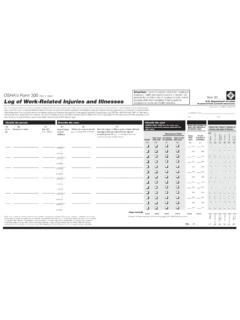
www.osha.govU.S. Department of Labor Occupational Safety and Health Administration OSHA’s Form 300 (Rev. 01/2004) Year 20__ __ Log of Work-Related Injuries and Illnesses You must record information about every work-related death and about every work-related injury or illness that involves loss of consciousness, restricted work activity or job transfer,
DEPARTMENT OF LABOR 29 CFR Part 1904
www.osha.gov2 The final rule also revises the requirements for reporting work-related fatality, injury, and illness information to OSHA. The current regulation requires employers to report …
CRANES AND DERRICKS IN CONSTRUCTION FINAL …
www.osha.govOSHA is making this document, the regulatory text, available for informational purposes only. This action does not affect the effective date of the final rule on Cranes and Derricks in Construction, which will be 90
Preventing Mold-Related Problems in the Indoor …
www.osha.govIntroduction This guide provides basic information about mold, mold sources, and building-related illnesses. Brief discussions are included on building design considerations for healthy indoor air,
HazardCommunicationGuidancefor CombustibleDusts
www.osha.govU.S.DepartmentofLabor OccupationalSafetyandHealthAdministration OSHA3371-08 2009 HazardCommunicationGuidancefor CombustibleDusts Occupational Safety and Health Act of 1970
Related documents
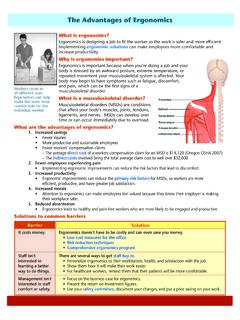
The Advantages of Ergonomics - Oregon
osha.oregon.govrepeated movement your musculoskeletal system is affected. Your body may begin to have symptoms such as fatigue, discomfort, and pain, which can be the first signs of a musculoskeletal disorder. What is a musculoskeletal disorder? Musculoskeletal disorders (MSDs) are conditions that affect your body’s muscles, joints, tendons, ligaments, and ...
eviCore Musculoskeletal Imaging Guidelines
www.evicore.comMusculoskeletal Imaging Musculoskeletal Imaging MS-2.1: Plain X-Ray The results of an initial plain x-ray are required prior to advanced imaging in all musculoskeletal conditions/disorders, unless otherwise noted in the guidelines, to rule out those situations that do not often require advanced imaging, such as
Health and safety at work - HSE
www.hse.gov.ukmusculoskeletal disorders showed a generally downward trend. Manual handling, awkward or tiring positions and keyboard work or repetitive action are estimated to be the main causes of work-related musculoskeletal disorders based on 2009/10-2011/12 LFS data. Estimates of work-related musculoskeletal disorders are based on self-reports from the

Diagnostic Code Descriptions (ICD9) - Mental Disorders
www2.gov.bc.caneurotic disorders, personality disorders and other nonpsychotic mental disorders (300 – 316) 300 neurotic disorders 300.0 anxiety states ... 306.0 musculoskeletal 306.1 respiratory 306.2 cardiovascular 306.3 skin 306.4 gastrointestinal 306.5 genitourinary 306.6 endocrine . 306.7 organs of special sense