
Fact Sheet - AOTA
gists, teachers, employers, and other professionals to determine the need for specialized evaluation and intervention. • Identify and modify sensory and environmental barriers that limit performance and participation in every-day activities, as well as individual strengths and supports.
Download Fact Sheet - AOTA

Information
Domain:
Source:
Link to this page:
Documents from same domain
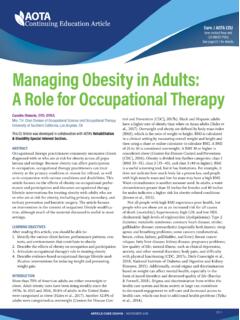
Managing Obesity in Adults: A Role for Occupational Therapy
www.aota.orgprogram development. Clear communication about the role of occupational therapy with everyone on the care team, as well as anyone in a facility or network who treats clients who are obese and might refer to occupational therapy, is critical. CONCLUSION Occupational therapy is …
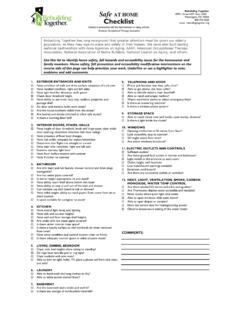
Safe 1899 L Street NW, Suite 1000 Rebuilding Together ...
www.aota.orgAT HOME Checklist Created in partnership with the Administration on Aging and the American Occupational Therapy Association ... Home safety, fall prevention and accessibility modification interventions on the ine or use a highlighter to note. problems and add comments.
University of Southern Indiana OTM Disclosure Statement
www.aota.orgACOTE’s Disclosure Statement regarding Probationary Accreditation Action: The occupational therapy master's program at the University of Southern Indiana, Evansville, Indiana, was placed on Probationary Accreditation effective April 21, 2018, because the program is in jeopardy of having its accreditation status withdrawn due to the mandated time limit for carrying an area of
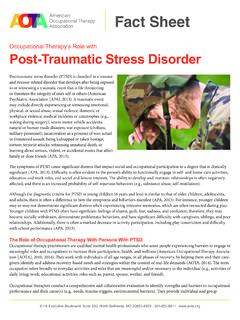
Occupational Therapy’s Role With Posttraumatic Stress …
www.aota.orgOccupational therapy enables people of all ages live life to its fullest by helping them to promote health, make lifestyle or environmental changes, and prevent—or live better with—injury, illness, or disability.
Occupational Therapy’s Role with Oncology
www.aota.orging a maximum level of independence and quality of life. Some examples can include: • Management of activities of daily living (ADLs) such as bathing and dressing through adaptations to the activity and environ-ment, and/or the use of assistive technology. • Lifestyle management such as preventative health, improved fitness, etc.
SELECTED ASSESSMENT TOOLS FOR OCCUPATIONAL …
www.aota.orgModified Barthel ADL Index of independence in ADLs created for hospital patients but can be used in sub-acute settings. Patient-Specific Functional Scale Patient determines functional ability with 5 activities (determined by therapist or patient) on a 10-point scale. Activities of Daily Living Index Interview and observation to determine ability
Pediatric Billing And Coding Tips And Tools
www.aota.org• Link interventions to performance outcomes. • Clearly state intervention approaches. • Document the type of assessment used and the results of the assessment. • Document clear recommendations and goals of continued treatment. Pediatric Billing And Coding Tips And Tools Contributions Made By: Cathy Brennan, MA, OTR/L, FAOTA
Choosing Wisely Handout - American Occupational Therapy ...
www.aota.org#1. Don’t provide intervention activities that are non-purposeful (e.g., cones, pegs, shoulder arc, arm bike). Purposeful activities—tasks that are part of daily routines and hold meaning, relevance, and perceived utility such
Model State Regulation for Supervision, Roles, and ...
www.aota.orgtherapy assistant and integrates that information into the evaluation and decision-making process. B. Intervention Planning (1) The occupational therapist has overall responsibility for the development of the occupational therapy intervention plan. (2) The occupational therapist and the occupational therapy assistant collaborate with the
Occupational Therapy’s Role with Skilled Nursing Facilities
www.aota.orgOccupational therapy enables people of all ages live life to its fullest by helping them to promote health, make lifestyle or environmental changes, and prevent—or live better with—injury, illness, or disability. By looking at the whole picture—a client’s …
Related documents
Managing Opportunities and Risks - CIMA
www.cimaglobal.comprofessionals because of their contribution to 1) designing,implementing and overseeing the technical aspects of the process described in this Guideline,and 2) informing the Board of this process and its outcome.Financial professionals can develop approaches to identifying and measuring opportunities and risks,contributing in six essential ways:

Healthy Gender Development and Young Children
depts.washington.eduProfessionals. offers practical guidance for teachers, caregivers, parents and staff. It draws on decades of research on child and gender development, and experiences of early childhood educators, pediatricians, and mental health professionals. We hope you find this resource helpful in your work to promote children’s resilience and early ...

A “Critical” Reflection Framework
www.education.vic.gov.au• To develop “the critical incident technique” to identify contributing factors to the success or failure in specific situations. Critical incident reflection is used in health, for example, seeking patient views and in multi- and inter-disciplinary team situations.

An Introduction to The ASAM Criteria for Patients and Families
www.aetna.comhow professionals such as physicians, providers, and funders of care rely on it to determine what services will best match a patient’s individual needs. It is not a clinical document and cannot be used to diagnose or identify care. he information provided in this document is intended to help you become an active

RETURNING TO SCHOOL AFTER A CONCUSSION
www.cdc.govidentify students with a concussion who are having trouble in the classroom, as well as changes in how a student is communicating or interacting with others. Speech-language pathology services may include testing, providing classroom strategies or modifications, and direct services to a student. School Principal or Other School Administrators

Care Transitions from Hospital to Home: IDEAL Discharge ...
www.ahrq.govIdentify which family members or friends will provide care at home and include them in conversations. D. iscuss with the patient and family five key areas to prevent problems at home. 1. Describe what life at home will be like. Include home environment, support needed, what the patient can o r cannot eat, and activities to do or avoid. 2 ...
Occupational Therapy’s Role with Mental Health Recovery
www.aota.orgviduals, families and caregivers, interdisciplinary professionals, and other mental health stakeholders, including behavioral health organizations, payers, and communities, to help transform the culture of mental health care through the promotion and ac-tive implementation of recovery-based principles and practices.

Example One: Visual, auditory and kinesthetic learning styles
www.education.vic.gov.auUse this information to think about the ways you may have learnt and identify your preferred approach. Once you have identified your preference you can put into place strategies to assist you to learn more effectively. Example One: Visual, auditory and kinesthetic learning styles Visual learning styles – this means you learn by seeing and looking