Example: quiz answers
RETURNING TO SCHOOL AFTER A CONCUSSION
identify students with a concussion who are having trouble in the classroom, as well as changes in how a student is communicating or interacting with others. Speech-language pathology services may include testing, providing classroom strategies or modifications, and direct services to a student. School Principal or Other School Administrators
Tags:
Information
Domain:
Source:
Link to this page:
Documents from same domain
School Chemistry Laboratory Safety Guide
www.cdc.govSchool Chemistry Laboratory Safety Guide. October 2006. U.S. Consumer Safety Product Commission DEPARTMENT OF HEALTH AND HUMAN SERVICES. Centers for Disease Control and Prevention
Biosafety in Microbiological and Biomedical …
www.cdc.goviii. Foreword. Biosafety in Microbiological and Biomedical Laboratories (BMBL) quickly became the cornerstone of biosafety practice and policy in the United States upon first
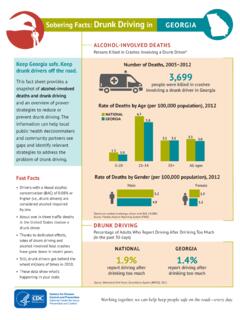
Sobering Facts: Drunk Driving in Georgia
www.cdc.govSobering Facts: Drunk Driving in GEORGIA Keep Georgia safe. Keep drunk drivers off the road. This fact sheet provides a snapshot of alcohol-involved deaths and drunk driving
ALCOHOLS III 1402
www.cdc.govALCOHOLS III: METHOD 1402, Issue 2, dated 15 August 1994 - Page 3 of 4 a. Remove and discard back sorbent section of a media blank sampler. b. Inject a known amount of analyte or DE stock solution directly onto front sorbent section
Fast Facts
www.cdc.govAny person working outdoors is at risk of exposure to poisonous plants, such as poison ivy, poison oak, and poison sumac. When in contact with skin, the sap oil (urushiol) of

Trans Fat: The Facts
www.cdc.gov• Read the Nutrition Facts label and ingredient list to compare foods. » Choose products with 0 grams trans fat. » Check the Ingredient List to see if there is any partially hydrogenated oil in the product.
ANTIBIOTIC RESISTANCE THREATS
www.cdc.govApr 23, 2013 · 6. ANTIBIOTIC RESISTANCE THREATS IN THE UNITED STATES, 2013. Executive Summary. Antibiotic Resistance Threats in the United States, 2013. is a snapshot of the complex problem
Chlorine Residual Testing
www.cdc.govChlorine Residual Testing Fact Sheet, CDC SWS Project 4 Methods to Test Free Chlorine in the Field in Developing Countries There are three main methods to test free chlorine residual in drinking water in the field
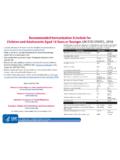
2018 Combined Recommended Immunization …
www.cdc.govRecommended Immunization Schedule for Children and Adolescents Aged 18 Years or Younger, UNITED STATES, 2018 Approved by the Advisory Committee on …
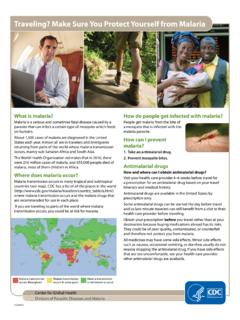
Traveling? Make Sure You Protect Yourself from …
www.cdc.govCS26201 Malaria transmission occurs throughout Malaria transmission occurs in some parts Malaria transmission is not known to occur Center for Global Health
Related documents
Managing Opportunities and Risks - CIMA
www.cimaglobal.comprofessionals because of their contribution to 1) designing,implementing and overseeing the technical aspects of the process described in this Guideline,and 2) informing the Board of this process and its outcome.Financial professionals can develop approaches to identifying and measuring opportunities and risks,contributing in six essential ways:

An Introduction to The ASAM Criteria for Patients and Families
www.aetna.comhow professionals such as physicians, providers, and funders of care rely on it to determine what services will best match a patient’s individual needs. It is not a clinical document and cannot be used to diagnose or identify care. he information provided in this document is intended to help you become an active

Fact Sheet - AOTA
www.aota.orggists, teachers, employers, and other professionals to determine the need for specialized evaluation and intervention. • Identify and modify sensory and environmental barriers that limit performance and participation in every-day activities, as well as individual strengths and supports.

Healthy Gender Development and Young Children
depts.washington.eduProfessionals. offers practical guidance for teachers, caregivers, parents and staff. It draws on decades of research on child and gender development, and experiences of early childhood educators, pediatricians, and mental health professionals. We hope you find this resource helpful in your work to promote children’s resilience and early ...

A “Critical” Reflection Framework
www.education.vic.gov.au• To develop “the critical incident technique” to identify contributing factors to the success or failure in specific situations. Critical incident reflection is used in health, for example, seeking patient views and in multi- and inter-disciplinary team situations.

Care Transitions from Hospital to Home: IDEAL Discharge ...
www.ahrq.govIdentify which family members or friends will provide care at home and include them in conversations. D. iscuss with the patient and family five key areas to prevent problems at home. 1. Describe what life at home will be like. Include home environment, support needed, what the patient can o r cannot eat, and activities to do or avoid. 2 ...
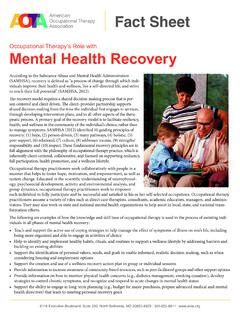
Occupational Therapy’s Role with Mental Health Recovery
www.aota.orgviduals, families and caregivers, interdisciplinary professionals, and other mental health stakeholders, including behavioral health organizations, payers, and communities, to help transform the culture of mental health care through the promotion and ac-tive implementation of recovery-based principles and practices.

Example One: Visual, auditory and kinesthetic learning styles
www.education.vic.gov.auUse this information to think about the ways you may have learnt and identify your preferred approach. Once you have identified your preference you can put into place strategies to assist you to learn more effectively. Example One: Visual, auditory and kinesthetic learning styles Visual learning styles – this means you learn by seeing and looking