
FactSheet
systems3 for mobile internal combustion engines. o Using a safe work permit system to control mobile combustion engine access into areas that could contain flammable vapors and gases. o Using a safe work permit system to control the use of open flames and spark-producing operations and equipment (e.g., welding, grinding, brazing, etc.) Training
Download FactSheet

Information
Domain:
Source:
Link to this page:
Documents from same domain
Motor Vehicles Safe Driving Practices for Employees
www.osha.govMotor Vehicles Safe Driving Practices for Employees You are your employer’s most valuable asset! The way that you drive says everything about you and your
U. S. Department of Labor Occupational Safety and …
www.osha.govU. S. Department of Labor Occupational Safety and Health Administration Notice of Alleged Safety or Health Hazards . For the General Public: This form is provided for the assistance of any complainant and is not intended to constitute the exclusive means by
Controlling Hazardous Fume and - osha.gov
www.osha.govFactSheet Controlling Hazardous Fume and Gases during Welding Welding joins materials together by melting a metal work piece along with a …
OSHA 3220-10N 2004
www.osha.govWORKER SAFETY SERIES WAREHOUSING 11 Hazards & Solutions Warehouse operations can present a wide variety of potential hazards for the worker. For warehousing establishments, the
Job Safety and Health - osha.gov
www.osha.govJob Safety and Health. IT’S THE LAW! All workers have the right to: A safe workplace. Raise a safety or health concern with your employer or OSHA, or report a work-
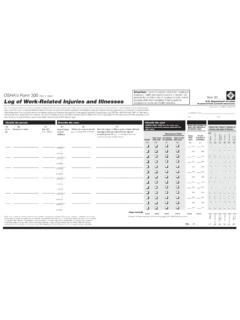
Year 20 Log of Work-Related Injuries and Illnesses
www.osha.govU.S. Department of Labor Occupational Safety and Health Administration OSHA’s Form 300 (Rev. 01/2004) Year 20__ __ Log of Work-Related Injuries and Illnesses You must record information about every work-related death and about every work-related injury or illness that involves loss of consciousness, restricted work activity or job transfer,
DEPARTMENT OF LABOR 29 CFR Part 1904
www.osha.gov2 The final rule also revises the requirements for reporting work-related fatality, injury, and illness information to OSHA. The current regulation requires employers to report …
CRANES AND DERRICKS IN CONSTRUCTION FINAL …
www.osha.govOSHA is making this document, the regulatory text, available for informational purposes only. This action does not affect the effective date of the final rule on Cranes and Derricks in Construction, which will be 90
Preventing Mold-Related Problems in the Indoor …
www.osha.govIntroduction This guide provides basic information about mold, mold sources, and building-related illnesses. Brief discussions are included on building design considerations for healthy indoor air,
HazardCommunicationGuidancefor CombustibleDusts
www.osha.govU.S.DepartmentofLabor OccupationalSafetyandHealthAdministration OSHA3371-08 2009 HazardCommunicationGuidancefor CombustibleDusts Occupational Safety and Health Act of 1970
Related documents

Land-Use Planning & Development Control: Planning For Air ...
www.iaqm.co.ukLand-Use Planning & Development Control: Planning For Air Quality ... Have one or more combustion processes, where there is a risk of impacts at relevant receptors. NB. this includes combustion plant associated with standby emergency generators (typically associated
The Building Regulations 2010 Combustion appliances and ...
assets.publishing.service.gov.ukCombustion appliances and fuel storage systems Approved Document J PAGE Section 3: Additional provisions, for gas burning appliances 43 Gas safety (Installation and Use) ... Control Body, either the local authority or an approved inspector, that their proposals comply with building regulations.
Principles of Engine Operation
web.itu.edu.tr• Abnormal combustion, parameters influencing knock and early ignition • Combustion in CI engines, parameters influencing ignition delay • Expension and exhaust strokes, exhaust emissions • Mixture preparation in SI engines • Carburator fundamentals, fuel injection, control of A/F ratio
Internal Combustion Engines
authors.library.caltech.eduInternal Combustion Engines Internal combustion engines are devices that generate work using the products ofcom bustion as the working fluid rather than as a heat transfer medium. To produce work, the combustion is carried out in a manner that produces high-pressurecombustion prod ucts that can be expanded through a turbine or piston.

Spill Control Requirements - US EPA
archive.epa.govNFPA® 4 Fire Control/Spill Control • Two issues are closely interrelated • Controlling material releases is pollution abatement and fire risk reduction • Fires often cause significant environmental impacts beyond the impact of combustion products

71-97406 Controls for Oil-Fired Heating - Honeywell
customer.honeywell.comFuel oil combustion requires that the fuel oil be atomized (broken into droplets), mixed with air, and then ignited. There are two basic types of oil burners, which are classified by their methods of preparing fuel for combustion. The two types are vaporizing burners and atomizing burners. Fig. 1. Oil burner types.
Combustion Modeling using Ansys CFD - asge-national.org
www.asge-national.orgperform combustion simulation using the EDC combustion and SST turbulence models. Whirlpool Reduced Burner Model Prep Time by 90 percent with ANSYS SpaceClaim New-Generation Designing a Better Burner • Whirlpool Brazil relies heavily on simulation to design gas burners for freestanding ranges, built-in ovens and cooktops.
CHAPTER 3 MOBILE COMBUSTION - IGES
www.ipcc-nggip.iges.or.jp3 MOBILE COMBUSTION 3.1 OVERVIEW Mobile sources produce direct greenhouse gas emissions of carbon dioxide (CO2), methane (CH4) and nitrous oxide (N2O) from the combustion of various fuel types, as well as several other pollutants such as carbon monoxide (CO), Non-methane Volatile Organic Compounds (NMVOCs), sulphur dioxide (SO2), particulate
Calculating Combustion Air For Fuel-Burning Appliances
www.rses.orgCombustion air is defined as “air necessary for com-plete combustion of a fuel, including theoretical air and excess air,” according to the International Fuel Gas Code Commentary 2015. In order to achieve complete combustion, the service engineer must en-sure that the fuel-burning appliance(s) have the appro-

1.3 Fuel Oil Combustion
www3.epa.gov1.3.3.3 Nitrogen Oxides Emissions1-2,6-10,15,17-27 - . Oxides of nitrogen (NOx) formed in combustion processes are due either to thermal fixation of atmospheric nitrogen in the combustion air ("thermal NOx"), or to the conversion of chemically bound nitrogen in the fuel ("fuel NOx").The term NOx refers to the composite of nitric oxide (NO) and nitrogen