
FactSheet
Internal combustion engines require a specific fuel-to-air ratio to work properly. Air enters the engine through the intake that leads to the combustion chambers (cylinders). If employers allow internal combustion engines in areas where flammable vapors or gases exist, then the vapors and gases can enter the cylinders of the engine along with the
Download FactSheet

Information
Domain:
Source:
Link to this page:
Documents from same domain
Motor Vehicles Safe Driving Practices for Employees
www.osha.govMotor Vehicles Safe Driving Practices for Employees You are your employer’s most valuable asset! The way that you drive says everything about you and your
U. S. Department of Labor Occupational Safety and …
www.osha.govU. S. Department of Labor Occupational Safety and Health Administration Notice of Alleged Safety or Health Hazards . For the General Public: This form is provided for the assistance of any complainant and is not intended to constitute the exclusive means by
Controlling Hazardous Fume and - osha.gov
www.osha.govFactSheet Controlling Hazardous Fume and Gases during Welding Welding joins materials together by melting a metal work piece along with a …

OSHA 3220-10N 2004
www.osha.govWORKER SAFETY SERIES WAREHOUSING 11 Hazards & Solutions Warehouse operations can present a wide variety of potential hazards for the worker. For warehousing establishments, the

Job Safety and Health - osha.gov
www.osha.govJob Safety and Health. IT’S THE LAW! All workers have the right to: A safe workplace. Raise a safety or health concern with your employer or OSHA, or report a work-
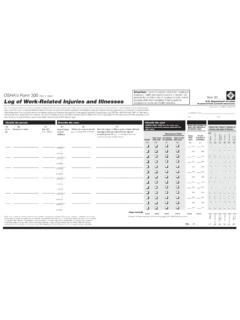
Year 20 Log of Work-Related Injuries and Illnesses
www.osha.govU.S. Department of Labor Occupational Safety and Health Administration OSHA’s Form 300 (Rev. 01/2004) Year 20__ __ Log of Work-Related Injuries and Illnesses You must record information about every work-related death and about every work-related injury or illness that involves loss of consciousness, restricted work activity or job transfer,
DEPARTMENT OF LABOR 29 CFR Part 1904
www.osha.gov2 The final rule also revises the requirements for reporting work-related fatality, injury, and illness information to OSHA. The current regulation requires employers to report …
CRANES AND DERRICKS IN CONSTRUCTION FINAL …
www.osha.govOSHA is making this document, the regulatory text, available for informational purposes only. This action does not affect the effective date of the final rule on Cranes and Derricks in Construction, which will be 90
Preventing Mold-Related Problems in the Indoor …
www.osha.govIntroduction This guide provides basic information about mold, mold sources, and building-related illnesses. Brief discussions are included on building design considerations for healthy indoor air,
HazardCommunicationGuidancefor CombustibleDusts
www.osha.govU.S.DepartmentofLabor OccupationalSafetyandHealthAdministration OSHA3371-08 2009 HazardCommunicationGuidancefor CombustibleDusts Occupational Safety and Health Act of 1970
Related documents

UNIT 5 COOLING SYSTEMS OF IC ENGINES Cooling ... - IGNOU
www.ignou.ac.inWe know that in case of Internal Combustion engines, combustion of air and fuel takes place inside the engine cylinder and hot gases are generated. The temperature of gases will be around 2300-2500 °C. This is a very high temperature and may result into burning of oil film between the moving parts and may result into seizing or welding of the ...
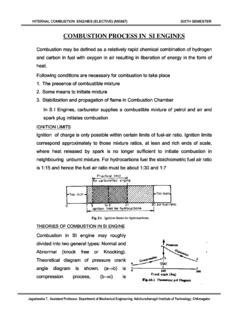
COMBUSTION PROCESS IN SI ENGINES
www.nitc.ac.ininternal combustion enginesinternal combustion engines (elective) (me667)(elective) (me667)(elective) (me667) sixth s sixth semester sixth semester emester Jagadeesha T, Assistant Professor, Department of Mechanical Engineering, Adichunchanagiri Institute of Technology, Chikmagalur
EMISSION REGULATION AND CONTROL SYSTEMS
www.nitc.ac.ininternal combustion enginesinternal combustion engines (elective) (me667)(elective) (me667)(elective) (me667) sixth semester sixth semester sixth semester Jagadeesha T, Assistant Professor, Department of Mechanical Engineering, Adichunchanagiri Institute of …
Environmental Effects of Battery Electric and Internal ...
sgp.fas.orgJun 16, 2020 · the internal combustion engine.3 In 2018, more than 361,000 plug-in electric passenger vehicles (including plug-in hybrid electric vehicles [PHEVs] and BEVs) were sold in the United States, as well as more than 341,000 hybrid electric vehicles (HEV).4 Nearly all automakers offer plug-in
Combustion Modeling using Ansys CFD - asge-national.org
www.asge-national.orgRocket engines IC engine CVD ... This generated a stable flame with nearly complete combustion, high levels of efficiency and low levels of carbon monoxide. ANSYS in Action ... depends on the internal flame structure Partially Premixed flames
1t-3.5t R Series Internal Combustion Counterbalanced ...
www.forklift.eeserving of 1t-3.5t R series internal combustion counterbalance forklift truck. For safety and performance of truck, all in charge of operation, maintenance and management must read and comprehend this manual well. The manual also applies to container fork-lift trucks. It is forbidden anybody without training and qualification to
3.2 Natural Gas-fired Reciprocating Engines
www3.epa.gov7/00 Stationary Internal Combustion Sources 3.2-1 3.2 Natural Gas-fired Reciprocating Engines 3.2.1 General1-3 Most natural gas-fired reciprocating engines are used in the natural gas industry at pipeline compressor and storage stations and at gas processing plants. These engines are used to provide mechanical shaft power for compressors and pumps.
3.3 Gasoline And Diesel Industrial Engines
www3.epa.govpredominant mechanism with internal combustion engines is thermal NOx which arises from the thermal dissociation and subsequent reaction of nitrogen (N2) and oxygen (O2) molecules in the combustion air. Most thermal NOx is formed in the high-temperature region of the flame from dissociated molecular nitrogen in the combustion air.