Fatigue Testing - ASM International
Fatigue Testing Introduction Fatigue is the progressive, localized, perma nent structural change that occurs in materials subjected to fluctuating stresses and strains that may result in cracks or fracture after a sufficient number of fluctuations. Fatigue fractures are caused by the simultaneous action of cyclic stress, tensile stress and ...
Download Fatigue Testing - ASM International

Information
Domain:
Source:
Link to this page:
Documents from same domain

ASM Handbook - ASM International
www.asminternational.orgASM International is indebted to the Co-Chairs and Editors of this Handbook, Stephen D. Cramer and Bernard S. Covino, Jr., who had the vision and the drive to undertake the huge effort to update and revise the 1987 Corrosion volume.

Friction Stir Welding of Ferrous and Nickel Alloys
www.asminternational.orgFriction Stir Welding of Ferrous and Nickel Alloys Carl D. Sorensen and Tracy W. Nelson ... Tool Cooling.The welding zone tempera-tures frequently reach 900 to 1200 °C (1650 to ... have high thermal conductivity relative to the tool steel commonly used for aluminum. To prevent damage to the spindle bearings and to establish a consistent ...

External Corrosion of Oil and Natural Gas Pipelines
www.asminternational.orgExternal Corrosion of Oil and Natural Gas Pipelines John A. Beavers and Neil G. Thompson, CC Technologies PIPELINES play an extremely important role

ALLOYING - ASM International
www.asminternational.orgALLOYING UNDERSTANDING THE BASICS Edited by J.R. Davis Davis & Associates ASM International® Materials Park, Ohio 44073-0002 www.asminternational.org fm 10/23/01 5:01 AM Page i

SUBJECT GUIDE Heat Treating - ASM International
www.asminternational.orgateria ar i 44732 :: 44335151 :: ainternatinarg :: eererieenterainternatinarg Published by ASM International:: Data shown are typical, not to be used for ...

Chapter 1 Introduction to Chemical Vapor Deposition (CVD)
www.asminternational.orgChapter 1 Introduction to Chemical Vapor Deposition (CVD) J. R. Creighton and P. Ho Sandia National Laboratories P.O. Box 5800, MS0601 Albuquerque, NM 87185-0601

Glass Fibers - ASM International
www.asminternational.orgGlass Fibers Frederick T. Wallenberger, James C. Watson, and Hong Li, PPG Industries, Inc. GLASS FIBERS are among the most versatile industrial materials known today.

Introduction to Selection of Titanium Alloys
www.asminternational.orgplanned for use in aircraft or in gas turbine en-gines for aerospace applications. Desired mechanical properties such as yield or ultimate strength to density (strength effi-ciency), fatigue crack growth rate, and fracture toughness, as well as manufacturing consider-ations such as welding and forming require-ments, are extremely important.
Introduction to Composite Materials - ASM International
www.asminternational.orgalong diagonal AD than along diagonal BC, the length of diagonal AD is not increased as much as that of diagonal BC. therefore, the initially square element deforms into the shape of a par-allelogram. Because the element has been dis-torted into a parallelogram, a shear strain g xy is induced as a result of coupling between the axial strains e ...
Properties of materials - ASM International
www.asminternational.orgMicrostructure . The structural features that can be seen using a microscope, but seldom with the naked eye; ranges from glassy to c rystalline; includes grain boundaries ... affects the extent of crystallization and resulting mechanical properties. Melting point . The temperature at which liquid b egins to form as a material is heated. Not
Related documents

Materials Data Book - University of Cambridge
www-mdp.eng.cam.ac.ukFast fracture 6 Statistics of fracture 6 Fatigue 7 Creep 7 Diffusion 8 Heat flow 8 II. PHYSICAL AND MECHANICAL PROPERTIES OF MATERIALS Melting temperature 9 Density 10 Young’s modulus 11 Yield stress and tensile strength 12 Fracture toughness 13 ...

Assignment 6 solutions
maecourses.ucsd.edustrain fracture toughness of 40 MPam (36.4 ksiin.). It has been determined that fracture results at a stress of 365 MPa (53,000 psi) when the maximum internal crack length is 2.5 mm (0.10 in.). For this same component and alloy, compute the stress level at which fracture will occur for a critical internal crack length of 4.0 mm (0.16 in.). Solution
Volume 2 - Fatigue Theory Reference Manual
abaqus-docs.mit.edusingle entity, and related fatigue life to the calculated engineering stresses in the component. Much current research is attempting to describe the whole fatigue process by the study of crack propagation from very small initial defects. Figure 1.2 shows a fatigue fracture from a shaft which was tested in bending. Crack initiation has

Material and Design Optimization for an Aluminum Bike …
web.wpi.edudetermining whether the predicted fatigue failure locations and cycles to failure are accurate. The last main objective involved optimizing material, heat treatment and geometry to improve fatigue life. The material selection, heat treatment and geometry of a bicycle frame all have a significant impact on the fatigue failure locations, and ...
Pressure Vessels Stresses Under Combined Loads Yield ...
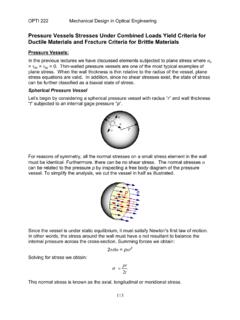
wp.optics.arizona.eduDuctile Materials and Fracture Criteria for Brittle Materials Pressure Vessels: In the previous lectures we have discussed elements subjected to plane stress where σ z = τ zx = τ zy = 0. Thin-walled pressure vessels are one of the most typical examples of plane stress. When the wall thickness is thin relative to the radius of the vessel, plane
Timken Bearing Damage Analysis with Lubrication Reference ...
www.timken.comIn some cases, the cause is contact fatigue (inclusion origin, point surface origin, geometric stress concentration and micro-spalling). In 90 percent of the cases, though, the cause is non-fatigue factors, including: • Foreign materials. • Corrosion. • Inadequate lubrication. • Improper handling. • Bad running conditions.

Mechanisms of fatigue-crack propagation in ductile and ...
www2.lbl.govstage of fatigue failure, as opposed to mere lifetime calculations, did not occur until the mid 1960s, when the concepts of linear elastic fracture mechanics and so-called ‘defect-tolerant design’ were first applied to the problem of subcritical flaw growth (Paris et al., 1961; Johnson