Filtration - MRWA
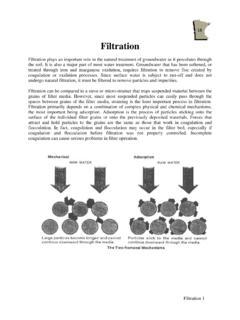
Filtration primarily depends on a combination of complex physical and chemical mechanisms, the most important being adsorption. Adsorption is the process of particles sticking onto the surface of the individual filter grains or onto the previously deposited materials. Forces that
Download Filtration - MRWA

Information
Domain:
Source:
Link to this page:
Documents from same domain

Lime-Soda Ash Softening - MRWA.com
www.mrwa.comLime Softening 1 Lime Softening . Chemical precipitation is one of the more common methods used to soften water. Chemicals normally used are lime (calcium …
Filtration - MRWA
www.mrwa.comFiltration 1 Filtration . Filtration plays an important role in the natural treatment of groundwater as it percolates through the soil. It is also a …
Membrane Filtration - MRWA
www.mrwa.comMembrane Filtration 1 Membrane Filtration . A membrane is a thin layer of semi-permeable material that separates substances when a driving force is applied across the membrane.
Corrosion - MRWA
www.mrwa.comCorrosion 1 Corrosion . Corrosion causes gradual decay and deterioration of pipes, both internally and externally. It can reduce the life of a pipe …
Lime-Soda Ash Softening - MRWA.com
www.mrwa.comLime Softening 1 Lime Softening . Chemical precipitation is one of the more common methods used to soften water. Chemicals normally used …

Iron and Manganese Removal - MRWA
www.mrwa.comIron and Manganese 1 Iron and Manganese . Iron and manganese control is the most common type of municipal water treatment in Minnesota. Iron and manganese occur naturally in groundwater.

Class D Study Guide - MRWA.com
www.mrwa.comClass D Study Guide . This study guide is designed for operators taking the Class D water operator . certification exam and is a condensed version of the Minnesota Water Works Operations Manual. This tool, along with your operating experience and
Iron and Manganese Removal - MRWA.com
www.mrwa.comRemoval by Iron and Manganese Filtration Removing iron and manganese from drinking water instead of sequestration it is recommended if the water contains over 0.3 ppm of iron or 0.05 ppm of manganese.

Financing Your Community Projects - mrwa.com
www.mrwa.comFinancing Your Clean Water and Drinking Water Municipal Infrastructure Projects With State Loan and Grant Funds Find out about the financing process when using the Clean Water and Drinking Water Revolving Funds, WIF, and Legacy Funds. Becky Sabie, Minnesota Public Facilities Authority
Class D Study Guide - MRWA.com
www.mrwa.comThe production of this study guide was a cooperative effort of staff from the Minnesota Department of Health, Minnesota Rural Water Association, and St. Cloud Technical College.
Related documents
Physical Chemistry of Surfaces - sciencenet.cn
image.sciencenet.cn4. The Free Energy of a Diffuse Double Layer 179 5. Repulsion between Two Planar Double Layers 180 6. The Zeta Potential 183 A. Electrophoresis 183 B. Electroosmosis 185 C. Streaming Potential 187 D. Sedimentation Potential 188 E. Interrelationships in Electrokinetic Phenomena 188 F. Potential, Surface Charge, and Colloidal Stability 189 7.
CHAPTER 6 WASTEWATER TREATMENT PROCESSES
web.deu.edu.trremoval of all particles of about 0.011 inch or larger (65 mesh). For some sludge handling pro-cesses, it may be necessary to remove, as a minimum, grit of 0.007 inch or larger (100 mesh). Grit removal, compared to other unit treatment processes, is quite economical and employed to achieve the following results:
Basic Principles of Wastewater Treatment
www.iwapublishing.com4 Sedimentation 125 4.1 Introduction 125 4.2 Types of settling 127 ... hance conversion processes, increase removal efficiencies and make the utilisation ... is that they detail biological treatment processes. No physical-chemical wastew-ater treatment processes are covered, although some physical operations, such as ...
Effluent Treatment Plant (ETP) - IIT Delhi
web.iitd.ac.inPurpose: Removal of floating and settleable materials such as suspended solids and organic matter. • Methods: Both physical and chemical methods are used in this treatment level. • Chemical unit processes: Chemical unit processes are always used with physical operations and may also be used with biological treatment processes.

Principles of Water and Wastewater Treatment Processes
ndl.ethernet.edu.etUnit 3 Physical Processes 45 3.1 Introduction 47 3.2 Sedimentation 48 3.3 Flotation 54 3.4 Screening 56 3.5 Comminution 61 3.6 Filtration 63 3.7 Centrifugal Separation 68 3.8 Self Assessment Questions 70 3.9 Solutions to Exercises 71 Unit 4 Chemical Processes 73 4.1 Introduction 75 4.2 Chemical Solution Dosing 76 4.3 pH Adjustment 81 4.4 ...
Sludge Treatment and Disposal - IWA Publishing
www.iwapublishing.com6.4 Processes to reduce pathogens 127 6.5 Operation and control 144 ... hance conversion processes, increase removal efficiencies and make the utilisation of some treatment processes feasible. Some treatment processes, such as anaer- ... although some physical operations, such as sedimentation and aeration, are dealt with since they are an ...
Farm water quality and treatment
www.dpi.nsw.gov.aucertain elements) or physical (for example, plant growth such as algae). Some problems may be more obvious than others, and some may require more extensive treatment. Water quality can affect plants, soils, livestock, irrigation equipment, domestic use and general farm activities.

01. Paper Industry - NITE
www.nite.go.jpThe processes of pulp derived from wastepaper can be divided roughly into four parts: (1) defiberization, (2) dirt removal, (3) deinking, and (4) bleaching. While paperboard manufacturing only requires the processes of (1) and (2), paper manufacturing requires (1) through (4) to satisfy quality requirements. (1) Defiberization process

Annals of the ICRP
www.icrp.orgThe removal of material from the respiratory tract by particle transport and absorption into blood. Committed effective dose [E(s)] The sum of the products of the committed organ or tissue equivalent doses and the appropriate organ or tissue weighting factors (w T), where s is the integration time in years following the intake.