Filtration - MRWA.com
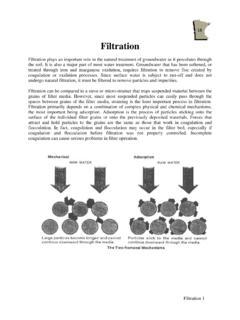
The filter sand used in rapid sand filters is manufactured specifically for the purpose of water filtration. Most rapid sand filters contain 24-30 inches of sand, but some newer filters are deeper. The sand used is generally 0.4 to 0.6 mm in diameter. This is …
Download Filtration - MRWA.com

Information
Domain:
Source:
Link to this page:
Documents from same domain

Lime-Soda Ash Softening - MRWA.com
www.mrwa.comLime Softening 1 Lime Softening . Chemical precipitation is one of the more common methods used to soften water. Chemicals normally used are lime (calcium …
Filtration - MRWA
www.mrwa.comFiltration 1 Filtration . Filtration plays an important role in the natural treatment of groundwater as it percolates through the soil. It is also a …
Membrane Filtration - MRWA
www.mrwa.comMembrane Filtration 1 Membrane Filtration . A membrane is a thin layer of semi-permeable material that separates substances when a driving force is applied across the membrane.
Corrosion - MRWA
www.mrwa.comCorrosion 1 Corrosion . Corrosion causes gradual decay and deterioration of pipes, both internally and externally. It can reduce the life of a pipe …
Lime-Soda Ash Softening - MRWA.com
www.mrwa.comLime Softening 1 Lime Softening . Chemical precipitation is one of the more common methods used to soften water. Chemicals normally used …

Iron and Manganese Removal - MRWA
www.mrwa.comIron and Manganese 1 Iron and Manganese . Iron and manganese control is the most common type of municipal water treatment in Minnesota. Iron and manganese occur naturally in groundwater.

Class D Study Guide - MRWA.com
www.mrwa.comClass D Study Guide . This study guide is designed for operators taking the Class D water operator . certification exam and is a condensed version of the Minnesota Water Works Operations Manual. This tool, along with your operating experience and
Iron and Manganese Removal - MRWA.com
www.mrwa.comRemoval by Iron and Manganese Filtration Removing iron and manganese from drinking water instead of sequestration it is recommended if the water contains over 0.3 ppm of iron or 0.05 ppm of manganese.

Financing Your Community Projects - mrwa.com
www.mrwa.comFinancing Your Clean Water and Drinking Water Municipal Infrastructure Projects With State Loan and Grant Funds Find out about the financing process when using the Clean Water and Drinking Water Revolving Funds, WIF, and Legacy Funds. Becky Sabie, Minnesota Public Facilities Authority
Class D Study Guide - MRWA.com
www.mrwa.comThe production of this study guide was a cooperative effort of staff from the Minnesota Department of Health, Minnesota Rural Water Association, and St. Cloud Technical College.
Related documents
CHAPTER 5 WATER TREATMENT PLANT
www.cpheeo.gov.inSlow Sand filtration was the first type of porous media filtration used in water treatment. This process is known for its simplicity and efficiency. During the initial operational period of slow sand filters, the separation of organic matter and other solids generates a layer of biological matter on the surface of the filter media.
Fundamentals of Granular Media Filtration
ca-nv-awwa.orgWHAT IS FILTRATION? |Definition: any process that removes suspended particles through a porous medium |Types of Filters yGranular media filters (GMF) |Slow sand filters |Rapid depth filters yMembrane filters (MF/UF/NF/RO) 4

4.5 Slope Protection - Kentucky Transportation Cabinet
transportation.ky.govSilt fences have a useful life of one season. Their principal mode of action is to slow and pond the water and allow soil particles to settle with some minor filtration through the fabric. Silt fences are not designed to withstand high heads of water, and therefore should be located where only shallow pools (i.e., 1.5 feet or less) can form.

WATER TREATMENT PLANT DESIGN - American Water …
www.awwa.orgMechanisms of Filtration / 9.2. Design Considerations / 9.2. Filter Operation and Maintenance / 9.40. Biological Filtration / 9.46. Biological Activated Carbon (BAC) / ... Slow Sand Filtration / 10.2. Diatomaceous Earth Filtration / 10.33. Acknowledgments / 10.47. Bibliography and References / 10.47.

Standard Operating Procedures for Water Treatment Plants
www.doh.wa.gov19. Pressure Filtration with Diatomaceous Earth (DE): A Simple Guide for Efficient Filter Operation, Celatom Filter Aids, 2014. 20. Slow Sand Filtration: Recommended Operations and Optimization Goals (331-601), Washington Department of Health, June, 2018.

Sand / Media Specifications
www.doh.wa.govMedia with small grain size slow the water movement and increase the chance of clogging. The effective size (D 10) and uniformity coefficient (Uc) are the principal characteristics of granular media treatment systems. The ideal sand media for intermittent sand filters is a coarse sand with an effective size between 0.3 mm and 0.5 mm.
Traditional and Household Water Purification Methods of ...
www.eolss.netHousehold Slow Sand Filtration Unit 4.4.1. Indian Design 4.4.2. Thailand Design 4.5. Household Defluoridator Glossary Bibliography Biographical Sketches Summary A safe and convenient water supply plays a vital role in public health and well-being of the society. While there are numerous conventional water treatment technologies

RecommendedRecommended Standards Standards for …
www.health.ny.gov4.3.3 Diatomaceous earth filtration 52 4.3.4 Slow sand filters 55 4.3.5 Direct filtration 57 4.3.6 Deep bed rapid rate gravity filters 59 4.3.7 Aerobic Bio-filtration of Surface Water 59 4.4 DISINFECTION 62