
Fire and Concrete Structures
Structural components still must be able to withstand dead and live loads without collapse even though the rise in temperature causes a decrease in the strength and modulus of elasticity for concrete and steel reinforcement. In addition, fully developed fires cause expansion of …
Download Fire and Concrete Structures

Information
Domain:
Source:
Link to this page:
Documents from same domain
Fire and Concrete Structures - Portland Cement …
www.cement.orgSteel Reinforcing steel is much more sensitive to high temperatures than concrete. Figure 3 shows the effect of high temperature on the yield strength of steel.
Guide Specification for High Performance Concrete …
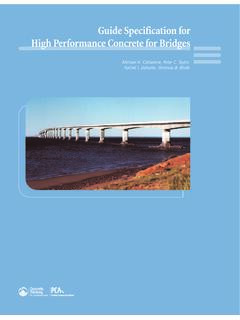
www.cement.orgGuide Specification for High-Performance Concrete for Bridges FIRST EDITION by Michael A. Caldarone, Peter C. Taylor, Rachel J. Detwiler, and Shrinivas B. Bhidé
Portland Cement Association TROWEL TIPS …
www.cement.orgMortar mixed to a laboratory flow consistency of 110 ± 5 percent as required for determination of compressive strength according to ASTM C270 property requirements
Efflorescence - Portland Cement Association
www.cement.orgEfflorescence Efflorescence is particularly affected by temperature, humidity, and wind. In the summer, even after long rainy periods, moisture
CONCRETE SEPTEMBER - cement.org
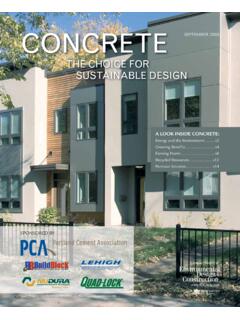
www.cement.orgother more energy-efficient building material ... dent of the Portland Cement Association (PCA). As a baseline, “Buildings with concrete external walls use up to 40 percent less energy than wood frame buildings,” he says. According to market research recently con- ... to build energy-efficient homes will have a major impact: “If these ...
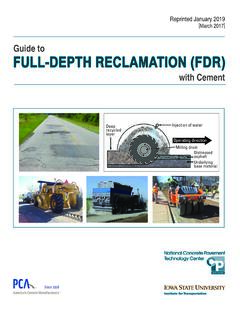
Guide to FULL-DEPTH RECLAMATION (FDR)
www.cement.orga new base layer. The FDR process begins with using a road reclaimer to pulverize an existing asphalt pavement and a portion of the underlying base, subbase, and/or subgrade. Usually the pulverized material is uniformly blended with an additional stabilizing material such as portland cement to provide an upgraded, homogeneous material.
Solar Reflectance Values of Concrete
www.cement.orgshows samples of the fine and coarse aggregates. Except for white portland cement, the portland cements were about the same shade of gray (Fig. 1). Individual particles of fine aggregate (typically erosion sediment largely consisting of granite, quartz, and feldspar) varied in color, and the lightest color fine aggregate was limestone (Fig. 2).
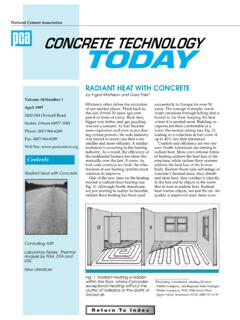
RADIANT HEAT WITH CONCRETE - Portland Cement …
www.cement.orgof heating address the heat loss of the structure, while radiant floor systems address the heat loss of the human body. Radiant floors take advantage of concrete’s thermal mass: they absorb and store heat, then conduct it directly to the feet and to objects in the room that in turn re-radiate heat. Radiant heat warms objects, not just the air ...
Related documents

Designing a Structural Steel Beam
personal.psu.edu3 Structural Floor Plan: Drawing of the beam, girder, and column layout for a building Please reference Figure 2. Tributary Width: Width of floor that contributes load to a structural member Please reference Figure 3. Force: Strength or energy exerted Load: Forces applied to a structure Figure 2: Structural Floor Plan Figure 3: Tributary Width 4 EQ. SPAC. @ 7.5’

Specification for Structural Joints Using High-Strength Bolts
www.boltcouncil.orgSpecification for Structural Joints sing igh-Strength Bolts 11 22 PREFACE The purpose of the Research Council on Structural Connections (RCSC) is: (1) To stimulate and support such investigation as may be deemed necessary and valu-able to determine the suitability, strength, and behavior of various types of structural

Structural Welding Code—Sheet Steel
app.aws.orgStructural Quality (ASTM A570). (3) Specification for Steel Sheet and Strip, Hot-Rolled and Cold-Rolled, High Strength, Low Alloy, with Im-proved Corrosion Resistance (ASTM A606). (4) Specification for Steel Sheet and Strip, Hot-Rolled or Cold-Rolled, High Strength, Low Alloy Columbium or Vanadium, or both (ASTM A607 Grades 45, 50, 55, 60, 65 ...

VHB Tapes
multimedia.3m.comVHB™ Tapes 3MTM VHBTM Tapes Product Information July 2013 Product Description 3M™ VHB™ Tapes are a family of double-sided foam tapes made from high performance acrylic adhesives. These tapes are able to form bonds of exceptional strength and have greater durability and elasticity than conventional double-sided foam tapes.

Design of Compression Members (Part 4 of AISC/LRFD)
user.engineering.uiowa.edu53:134 Structural Design II The design strength φ =φ c n c cr g = 0.85 P F A F A cr g Required strength ≤ Design strength ≤φP P u c n Check for Slenderness Ratio: Slenderness ratio (recommendation) (SPEC B7) KL r ≤/ 200 Local Buckling Local buckling is an instability due to the plates of the member becoming unstable.

Load and Resistance Factor Design (LRFD)
user.engineering.uiowa.edu53:134 Structural Design II γi A load factor φRn is the called the design strength ii i ∑γQ is the summation of all the load effects φRQniγ i ≥∑ i Resistance Factors φ: Fasteners. Beams flexure and shear. Compressio n members. Tension members fracture state
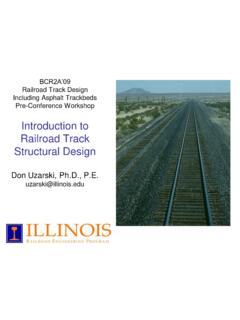
Introduction to Railroad Track Structural Design
web.engr.uky.edu• Using soil strength with a factor of safety - AREMA recommends a factor of safety of at least 2 and as much as 5 or more depending on the traffic (wheel loads and load repetitions) and soil conditions. - Company design standards will dictate (e.g. Army allows a design unconfined compressive strength (q u) of 1.0 q u for "normal" traffic