Five principles for effective questioning - PDST
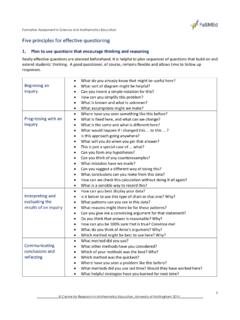
Five principles for effective questioning 1. Plan to use questions that encourage thinking and reasoning Really effective questions are planned beforehand. It is helpful to plan sequences of questions that build on and extend students [ thinking. A good questioner, of course, remains flexible and allows time to follow up responses. Beginning an ...
Download Five principles for effective questioning - PDST

Information
Domain:
Source:
Link to this page:
Documents from same domain

Active Learning & Teaching Methodologies Full …
pdst.ie2 Introduction The promotion of the use of a broad range of teaching methodologies and participant centred learning is a key underlying principle in Leaving Certificate Applied.
Using Graphic Organisers in SS S LEVEL Teaching and ERVICE ...
pdst.ieUsing Graphic Organisers in Teaching and Learning SSECOND LEVEL UPPORT SERVICE SEIRBHÍS TACAÍOCHTA DARA LEIBHÉAL The SLSS is funded by the Department of Education ...

English and Communications - PDST
pdst.ieenglish and communications • communications and the working world • oral communication and listening skills 3. obtain basic information from peers (1) in a personal context

Guided Reading: An Introduction - PDST
pdst.ie•Re-reading is crucial in the guided reading lesson. •Re-reading can be done in school as a familiar reading lesson or it can be sent home to be read as homework. Guided Reading in action Roll it there …. Text Selection •The book chosen must be at the children's

2016 - PDST
pdst.iesubstantial way through parent meetings. This would be particularly useful at the beginning of the school year before the Programme is implemented. Such meetings could have inputs from educators with responsibility for personal safety or sexuality education, as well as experts on drugs, or local providers of services such as guards, Health Service

03 Walk Tall First Class - PDST
pdst.ie01 I Belong in My Home page 108 02 I Belong with My Class page 112 03 Taking Care of our Classroom Environment page 120 04 I Belong in My Community page 125 05 When I’m Older I Would Like To Belong page 128 UNIT SIX: Media page 132 01 Facts or Fiction page 133 02 We are Modern Explorers page 136
Differentiation in action!
pdst.iefloor plans to facilitate groupwork Teach group work skills approachessuch as listening, turn-taking, welcoming all contributions, etc. explicitly Define areas of the classroom for independent and group work. If space allows, each child should havea“home base” deskthat they return to for whole-class teaching.

Introduction to Information & Communications Technology
pdst.ieThe theory of this unit should be taught very much at the level described. Safe work practices and care of equipment should be central to all the practical sessions, with emphasise on proper booting and closing down of the computer. Unit 2: Keyboarding While it is not intended that students should be able to touch-type

FOURTH CLASS - PDST
pdst.ieThe original Walk Tall classroom materials were devised in the mid-1990s on foot of a Ministerial Task Force Report (1996) which recommended that substance misuse preventative strategies should be put in place as early as possible in the classroom, and before children begin to experiment with drugs. At that time, the

2016 - PDST
pdst.ieupdate was timely, both in terms of tailoring the classroom materials to a more diverse pupil population, updating some of the content (for example, stories), and making a more explicit link between Walk Tall and the content objectives of the 1999 Social Personal and Health Education (SPHE) curriculum in order to assist classroom planning.
Related documents
The Importance of Questioning in Developing Critical ...
cpb-us-e1.wpmucdn.comQuestioning is an important component of the teaching/learning process and is embedded in quality instruction and strategic thinking. Questions are used to teach as well as to assess student understanding, and thus questioning plays a critical role in the overall

The Book on The Taboo against knowing who you are
terebess.huTHE BOOK On the Taboo Against Knowing Who You Are ALAN WATTS Alan Watts, who died in 1974, held both a master's degree in theology and a doctorate of divinity, and was best known as an interpreter of Zen Buddhism
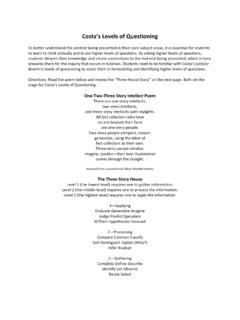
Costa’s’Levels’of’Questioning’
www.asd5.orgCosta’s’Levels’of’Questioning’! To!better!understand!the!content!being!presented!in!their!core!subject!areas,!it!is!essential!for!students!
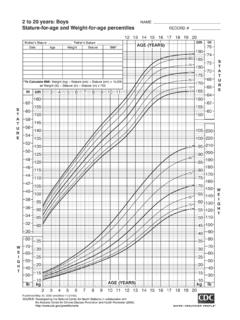
2 to 20 years: Boys, Stature-for-age and Weight-for-age ...
www.cdc.gov2 to 20 years: Boys Stature Weight-for-age percentiles-for-age and NAME RECORD # SOURCE: Developed b (2000). y the National Center for Health Statistics in collaboration with
The Delta Kappa Gamma Bulletin
www.dkg.isand Nappi argues for the importance of questioning in developing critical thinking skills at all levels. Indicating that use of technology is important to widely disparate generations, Lilienthal, Potthoff, and Anderson share the structure, benefits, and challenges of an
GAIN Working Group E i - Flight Safety Foundation
www.flightsafety.orgGAIN Working Group E viii Executive Summary This report is intended as an overview of how aviation organizations can promote improvements in …

Interactive Techniques (Kevin Yee)
www.usf.eduReverse Socratic Questioning – The instructor requires students to ask him/her questions, and the instructor answers in such a way as to goad another question immediately but also drive the next student question in a certain direction. 12. Pass the Pointer – Place a complex, intricate, or detailed image on the screen and ask