Generating Sequences With Recurrent Neural Networks
1;:::;x T) is passed through weighted connections to a stack of N recurrently connected hidden layers to compute rst the hidden vector sequences h n= (h 1;:::;h n T) and then the output vector sequence y = (y 1;:::;y T). Each output vector y t is used to parameterise a predictive distribution Pr(x t+1jy t) over the possible next inputs x t+1 ...
Download Generating Sequences With Recurrent Neural Networks

Information
Domain:
Source:
Link to this page:
Documents from same domain
![arXiv:0706.3639v1 [cs.AI] 25 Jun 2007](/cache/preview/4/1/3/9/3/1/4/b/thumb-4139314b93ef86b7b4c2d05ebcc88e46.jpg)
arXiv:0706.3639v1 [cs.AI] 25 Jun 2007
arxiv.orgarXiv:0706.3639v1 [cs.AI] 25 Jun 2007 Technical Report IDSIA-07-07 A Collection of Definitions of Intelligence Shane Legg IDSIA, Galleria …
Deep Residual Learning for Image Recognition - …
arxiv.orgDeep Residual Learning for Image Recognition Kaiming He Xiangyu Zhang Shaoqing Ren Jian Sun Microsoft Research fkahe, v-xiangz, v-shren, jiansung@microsoft.com
![arXiv:1301.3781v3 [cs.CL] 7 Sep 2013](/cache/preview/4/d/5/0/4/3/4/0/thumb-4d504340120163c0bdf3f4678d8d217f.jpg)
arXiv:1301.3781v3 [cs.CL] 7 Sep 2013
arxiv.orgFor all the following models, the training complexity is proportional to O = E T Q; (1) where E is number of the training epochs, T is the number of …
![@google.com arXiv:1609.03499v2 [cs.SD] 19 Sep 2016](/cache/preview/c/3/4/9/4/6/9/b/thumb-c349469b499107d21e221f2ac908f8b2.jpg)
@google.com arXiv:1609.03499v2 [cs.SD] 19 Sep 2016
arxiv.orgwhere 1 <x t <1 and = 255. This non-linear quantization produces a significantly better reconstruction than a simple linear quantization scheme. …
A Tutorial on UAVs for Wireless Networks: …
arxiv.orgA Tutorial on UAVs for Wireless Networks: Applications, Challenges, and Open Problems Mohammad Mozaffari 1, ... to UAVs in wireless communications is the work in …
Adversarial Generative Nets: Neural Network …
arxiv.orgAdversarial Generative Nets: Neural Network Attacks on State-of-the-Art Face Recognition Mahmood Sharif, Sruti Bhagavatula, Lujo Bauer Carnegie Mellon University
Massive Exploration of Neural Machine Translation ...
arxiv.orgMassive Exploration of Neural Machine Translation Architectures Denny Britzy, Anna Goldie, Minh-Thang Luong, Quoc Le fdennybritz,agoldie,thangluong,qvlg@google.com Google Brain

Mastering Chess and Shogi by Self-Play with a …
arxiv.orgMastering Chess and Shogi by Self-Play with a General Reinforcement Learning Algorithm David Silver, 1Thomas Hubert, Julian Schrittwieser, Ioannis Antonoglou, 1Matthew Lai, Arthur Guez, Marc Lanctot,1
Going deeper with convolutions - arXiv
arxiv.orgGoing deeper with convolutions Christian Szegedy Google Inc. Wei Liu University of North Carolina, Chapel Hill Yangqing Jia Google Inc. Pierre Sermanet
Andrew G. Howard Menglong Zhu Bo Chen Dmitry ...
arxiv.orgMobileNets: Efficient Convolutional Neural Networks for Mobile Vision Applications Andrew G. Howard Menglong Zhu Bo Chen Dmitry Kalenichenko Weijun Wang Tobias Weyand Marco Andreetto Hartwig Adam
Related documents

Discrete-Time Signals and Systems - Pearson
www.pearsonhighered.comIn Section 2.1, we discuss the representation of discrete-time signals as sequences and describe the basic sequences such as the unit impulse, the unit step, and complex exponential, which play a central role in characterizing discrete-time systems and form building blocks for more general sequences. In Section 2.2, the representation, basic
Sequences and summations - University of Pittsburgh
people.cs.pitt.eduSequences and summations CS 441 Discrete mathematics for CS M. Hauskrecht Sequences Definition: A sequence is a function from a subset of the set of integers (typically the set {0,1,2,...} or the set {1,2,3,...} to a set S. We use the notation an to denote the image of the integer n. We call an a term of the sequence.
Sequences and Series: An Introduction to Mathematical Analysis
people.math.harvard.eduChapter 1 Sequences 1.1 The general concept of a sequence We begin by discussing the concept of a sequence. Intuitively, a sequence is an ordered list of objects or events. For instance, the sequence of events at a crime scene is important for understanding the nature of the crime. In
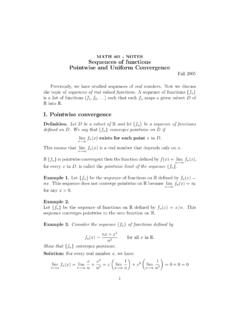
Sequences of functions Pointwise and Uniform Convergence
www.personal.psu.eduSequences of functions Pointwise and Uniform Convergence Fall 2005 Previously, we have studied sequences of real numbers. Now we discuss the topic of sequences of real valued functions. A sequence of functions {f n} is a list of functions (f 1,f 2,...) such that each f n maps a given subset D of

Real Analysis II 9.1 Pointwise Convergence of Sequence of ...
users.rowan.eduChapter 9 Sequences and Series of Functions 9.1 Pointwise Convergence of Sequence of Functions Definition 9.1 A Let {fn} be a sequence of functions defined on a set of real numbers E. We say that {fn} converges pointwise to a function f on E for each x ∈ E, the sequence of real numbers {fn(x)} converges to the number f(x).

Name: GCSE (1 – 9) Quadratic Sequences - Maths Genie
www.mathsgenie.co.ukGCSE (1 – 9) Quadratic Sequences Name: _____ Instructions • Use black ink or ball-point pen. • Answer all questions. • Answer the questions in the spaces provided – there may be more space than you need. • Diagrams are NOT accurately drawn, unless otherwise indicated. • You must show all your working out. Information

2021 ACEA European Oil Sequences
www.acea.autoEach set of Oil Sequences is designated for consumer use by a 2-part code comprising a letter to define the CLASS (e.g. C), and a number to define the CATEGORY (e.g. C2). In addition, for industry use, each sequence has a two-digit number to …

Sequences of Functions - 國立臺灣大學
www.csie.ntu.edu.twSequences of Functions Uniform convergence 9.1 Assume that f n → f uniformly on S and that each f n is bounded on S. Prove that {f n} is uniformly bounded on S. Proof: Since f n → f uniformly on S, then given ε = 1, there exists a positive integer n 0 such that as n ≥ n 0, we have |f n (x)−f (x)| ≤ 1 for all x ∈ S. (*) Hence, f (x) is bounded on S by the following