Getting Motivated to Change
Manuals for Adaptive Treatment. As Included in NREPP. Getting Motivated . To Change . A collection of materials for leading counseling sessions that address motivation and readiness for change. N. G. Bartholomew, D. F. Dansereau, and D. D. Simpson . TCU Institute of …
Download Getting Motivated to Change

Information
Domain:
Source:
Link to this page:
Documents from same domain

Understanding and Reducing Angry Feelings
ibr.tcu.eduBased on . TCU Mapping-Enhanced Counseling. Manuals for Adaptive Treatment. As Included in NREPP. UNDERSTANDING AND REDUCING. ANGRY FEELINGS. A collection of materials for leading counseling sessions
This manual was developed as part of the National ...
ibr.tcu.eduii This manual was developed as part of the National Institute on Drug Abuse (NIDA) Grant DA08608, Cognitive Enhancements for the Treatment of Probationers (CETOP). The Preparation for Change: The Tower of Strengths and the Weekly Planner training manual and related maps, handouts, and any data collection forms may be …

Building Social Networks - Texas Christian University
ibr.tcu.eduWhen accompanied by user-friendly information about client assessments that measure risks, needs, and progress over time, TCU Mapping-Enhanced Counseling manuals represent focused, time-limited strategies

Improving Workplace Communication
ibr.tcu.edu1 Team Awareness: Improving Workplace Communication Module 5 Improving Workplace Communication Participants will: • Identify norms and responsibilities in workplace communication • Identify and reduce blocks to effective listening • Understand role of informal communication (the grapevine) in the work setting

UNDERSTANDING AND REDUCING - Texas …
ibr.tcu.eduTexas Institute of Behavioral Research iii TCU-CJ (© 2004) TCU MAPPING-ENHANCED COUNSELING MANUALS Understanding and Reducing Angry Feelings Understanding Anger …

USING CLIENT ASSESSMENTS TO - Texas Christian …
ibr.tcu.eduBased on . TCU Mapping-Enhanced Counseling. Manuals for Adaptive Treatment. As Included in NREPP. USING CLIENT ASSESSMENTS TO . PLAN AND MONITOR TREATMENT (USING CEST GUIDE). A guide for using …

Mapping Your Treatment Plan: A Collaborative …
ibr.tcu.eduBased on . TCU Mapping-Enhanced Counseling. Manuals for Adaptive Treatment. As Included in NREPP. Mapping Your . Treatment Plan: A Collaborative Approach
MAPPING YOUR STEPS - Texas Christian University
ibr.tcu.eduThe Mapping Your Steps manual provides instructions and essential materials for the use of the Twelve Step maps as a counseling tool. The introduction presents the rationale

As Included in NREPP - Texas Christian University
ibr.tcu.eduAs Included in NREPP. UNLOCK YOUR THINKING. OPEN YOUR MIND. A collection of materials for leading counseling sessions that address thinking patterns that can hamper behavior change. N. G. Bartholomew and D. D. Simpson . TCU Institute of Behavioral Research (August 2005)
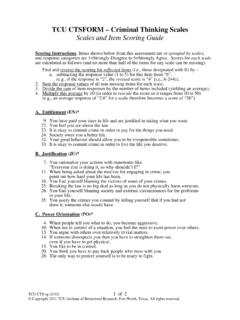
TCU CTSFORM – Criminal Thinking Scales Scales and Item ...
ibr.tcu.edu*A revised “Psychological Inventory of Criminal Thinking Styles (PICTS)” scale, taken from Walters, G. D. (1998). Changing lives of crime and drugs: Intervening with substance-
Related documents

Motivation to Change - Carleton University
carleton.ca3 1. No problem: Unaware of a problem and no thoughts of change. 2. On the fence: Thinking about changing, but still on the fence. 3. Preparation: Intending to change and planning what it would take to make the change happen. e.g. “I want to stop drinking, so I should go to treatment.” 4. Action: Taking first steps toward changing behaviour. e.g.

Stages of Change and Motivational Interviewing
eipd.dcs.wisc.eduabout change but clearly have no intention to change any time soon. ... who has been in treatment, continues to take buprenorphine, has stable housing and employment, has stable social relationships with people who do not use drugs, and appreciates ... strengthen patients’ motivation and commitment to change.

Hyperlipidemia Management Protocol STANFORD …
www.med.stanford.edu1) Incomplete patient effort and self-motivation: Some patients are unable or unwilling to comply with strict dietary changes, such as a Step II diet, and a regular exercise regimen. 2) Nadir values of LDL cholesterol and triglycerides may not be achieved until after three to six months following lifestyle modification.
Group Treatment for Substance Abuse: Addressing …
www.naadac.orgGroup Treatment for Substance Abuse: Addressing Motivation and Processes of Change Carlo C. DiClemente, Ph.D. ABPP University of Maryland Baltimore County
LOW INTENSITY COGNITIVE BEHAVIOURAL COMPETENCY …
www.sheffield.ac.ukof three factors (a) capability to perform behavior change (b) the opportunity to carry out necessary behavior change and (c) the motivation for behavior change. During assessment, practitioners should utilize the COM-B model to inform and influence the gathering and synthesis of information to aid clinical decision-making and treatment planning.

Behaviour change models for PWPs - FINAL
www.ucl.ac.uk2014). Behaviour change approaches based on these have addressed help seeking, motivation for treatment and adherence to treatment among other areas. All of these models and associated behaviour change strategies could contribute to informing PWP "1
Motivating Clients for Treatment and Addressing Resistance
www.unodc.org1. Understand the nature of motivation as it influences behavioural change 2. Understand the role of the clinician and client when using motivational strategies for behavioural change 3. Understand the Stages of Change Model and be able to identify a minimum of 3 components 4. Identify a minimum of 3 principles of motivational interviewing