
Grades K–12
etc.), science clubs and related programs, and can be adopted for formal education settings. An exciting and productive study in rocket science can be implemented using the selected activities for the above-mentioned settings. The guide’s activities can be correlated to meet formal education’s core curriculum objectives or used for ancillary
Download Grades K–12

Information
Domain:
Source:
Link to this page:
Documents from same domain
Q: What do you do on the International Space …
www.nasa.govQ: What do you do on the International Space Station (ISS)? A: Astronauts and cosmonauts on the space station stay busy.There’s lots of work to operate the many science experiments on board.
NEPA RECORD OF ENVIRONMENTAL …
www.nasa.govDec 13, 2012 · JSC Form 1119 (Revised January 25, 2011)(MS Word October 2010) NEPA RECORD OF ENVIRONMENTAL CONSIDERATION (REC) Complete this form if you answered “yes” or “unknown” on any JF 1138 entries and if
Use of XSLT to transform the output of multiple …
www.nasa.govNASA IV&V International Workshop 2014 1 Use of XSLT to transform the output of multiple Static Code Analysis tools into a consistent analysis spreadsheet format
International Space Station Activity Book
www.nasa.govNational Aeronautics and Space Administration . Grades K-5 . This activity book belongs to: International Space Station Activity Book >>> For more information, check out the web sites on page 30!
Gravity, Who Needs It
www.nasa.govGravity, Who Needs It? ... six months on the space station versus three years on a Mars mission? No. ... human, being more isolated ...
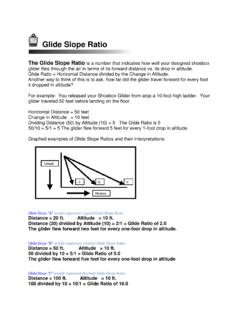
Glide Slope Ratio
www.nasa.govGlide Slope Ratio The Glide Slope Ratio is a number that indicates how well your designed shoebox glider flies through the air in terms of its forward distance vs. its drop in altitude. Glide Ratio = Horizontal Distance divided by the Change in Altitude.
Modeling, SiMulation, inforMation technology & …
www.nasa.govTA11-1 exeCuTive Summary Figure 1 is an initial draft strategic roadmap for the Modeling, Simulation, Information Technol-ogy and Processing Technology Area.
NASA Technology Roadmaps
www.nasa.gov2015 NASA Technology Roadmaps TA 11: Modeling, Simulation, Information Technology, and Processing TA 11- 2 July 2015 Foreword NASA is leading the way with a balanced program of space exploration, aeronautics, and science research.
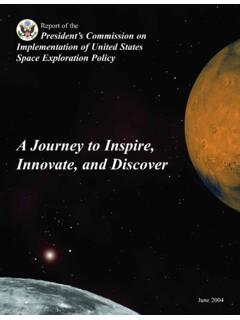
A Journey to Inspire, Innovate, and Discover
www.nasa.govReport of the President’s Commission on 2 Implementation of United States Space Exploration Policy Transmittal Letter June 4, 2004 The Honorable George W. Bush
National Aeronautics and Space Administration Headquarters
www.nasa.govGEMS is a Category 3 project (less than $250M) in Phase B, and was requesting transition from Formulation to Implementation (Phase C) where the official Agency baseline is established and external commitments are made
Related documents

Physics Lab 1: Zoooooooom! How fast is fast?
csip.cornell.eduAudience: Middle school physical science Objectives • Identify how to determine an object’s speed ... What is a reference point? An object that appears to stay in place in relation to an object being observed for motion. 2. What two things must you know to determine speed? Total distance traveled Total time to travel that distance
Lesson 3 - Investigating Eyesight
www.abc.net.auActivities (Individual or small groups / 30 – 45 min) y Students can do each activity individually, with a partner or in small groups. y You may could stop to discuss each activity individually ...
INSPIRED ISSUE BRIEF: INQUIRY-BASED TEACHING
inspiredteaching.orgThree middle school science teachers in urban public schools taught fundamental concepts of physics by using a computer-based inquiry curriculum. Instead of emphasizing facts and details, the curriculum engaged students in authentic scientific investigations that asked students to create and apply models of force and motion.

The Scratch Programming Language and Environment
web.media.mit.eduyoung people (ages 8 to 16) at after-school computer centers such as the Intel Computer Clubhouses [Resnick et al. 2003]. Scratch added programmability to media-manipulation activities that are popular in youth culture, and it en-couraged young people to learn through exploration and peer sharing, with
Recommendations for the Teaching of High School …
www.acs.orgscience standards to be learned. In nearly every case, these state science standards were influenced by two national-level publications, the National Research Council’s (NRC) National Science Education Standards (NSES) (NRC, 1996) and the American Association for the Advancement of Science’s Benchmarks for Scientific Literacy (AAAS, 1993).

GOODS AND SERVICES - Edutopia
www.edutopia.orgGoods (ASL Motion: Use your hands like scoops to come together to create a birds nest) Tangible objects that satisfy economic wants. Human Resources The health, education, experience, training, skills and values of people. Also known as human capital. Intermediate Good A good that is used in the production of final goods and services. Natural ...
KS3 Science Revision Worksheets Standard Edition
www.lansdowneschool.co.ukKS3 Science Revision Worksheets Standard Edition P. Hill, Beaver Educational Resources 2001. Registered to Edenham High School. CR0 7NJ. KS3 Science Revision Worksheets Standard Edition ISBN 0 9537409 5 1 Introduction. The aim of this resource is to provide pupils with a complete revision guide for the Key Stage 3 Science programme of study.

States of Matter
www.nasa.govPhysical Science • Position and movement of objects • Properties and changes in properties of matter • Transfer of energy . MANAGEMENT . For the first activity you may need to enhance prior knowledge about matter and energy from a supplemental handout called “Diagramming Atoms and Molecules in Motion.” At the middle school level, this ...
The Carbon Cycle - Noble
www.noble.orgMiddle School *MS-LS2-3 Students who demonstrate understanding will be able to: Develop a model to describe the cycling of matter and flow of energy among living and nonliving parts of an ecosys-tem. MS-PS1-4 Students who demonstrate understanding will be able to: Develop a model that predicts and describes changes in
The Physical Activity Questionnaire for Older Children ...
www.prismsports.orgvigorous activities; they simply provide a summary activity score (see the scoring section in Chapters 2 and 3). 3) The PAQ-C and the PAQ-A are only appropriate when used during the school year; they should not be used to assess physical activity in …