
Grounded Language-Image Pre-training
(GLIP-L) on 27M grounding data, including 3M human-annotated fine-grained data and 24M web-crawled image-text pairs. For the 24M image-text pairs, there are 78.1M high-confidence (> 0:5) phrase-box pseudo annotations, with 58.4M unique noun phrases. We showcase two real examples of the generated boxes in Figure2. The teacher
Download Grounded Language-Image Pre-training

Information
Domain:
Source:
Link to this page:
Documents from same domain
![arXiv:0706.3639v1 [cs.AI] 25 Jun 2007](/cache/preview/4/1/3/9/3/1/4/b/thumb-4139314b93ef86b7b4c2d05ebcc88e46.jpg)
arXiv:0706.3639v1 [cs.AI] 25 Jun 2007
arxiv.orgarXiv:0706.3639v1 [cs.AI] 25 Jun 2007 Technical Report IDSIA-07-07 A Collection of Definitions of Intelligence Shane Legg IDSIA, Galleria …
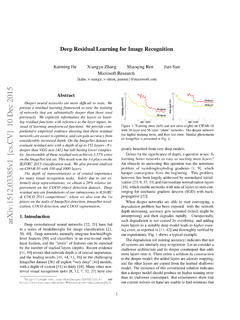
Deep Residual Learning for Image Recognition - …
arxiv.orgDeep Residual Learning for Image Recognition Kaiming He Xiangyu Zhang Shaoqing Ren Jian Sun Microsoft Research fkahe, v-xiangz, v-shren, jiansung@microsoft.com
![arXiv:1301.3781v3 [cs.CL] 7 Sep 2013](/cache/preview/4/d/5/0/4/3/4/0/thumb-4d504340120163c0bdf3f4678d8d217f.jpg)
arXiv:1301.3781v3 [cs.CL] 7 Sep 2013
arxiv.orgFor all the following models, the training complexity is proportional to O = E T Q; (1) where E is number of the training epochs, T is the number of …
![@google.com arXiv:1609.03499v2 [cs.SD] 19 Sep 2016](/cache/preview/c/3/4/9/4/6/9/b/thumb-c349469b499107d21e221f2ac908f8b2.jpg)
@google.com arXiv:1609.03499v2 [cs.SD] 19 Sep 2016
arxiv.orgwhere 1 <x t <1 and = 255. This non-linear quantization produces a significantly better reconstruction than a simple linear quantization scheme. …
A Tutorial on UAVs for Wireless Networks: …
arxiv.orgA Tutorial on UAVs for Wireless Networks: Applications, Challenges, and Open Problems Mohammad Mozaffari 1, ... to UAVs in wireless communications is the work in …
Adversarial Generative Nets: Neural Network …
arxiv.orgAdversarial Generative Nets: Neural Network Attacks on State-of-the-Art Face Recognition Mahmood Sharif, Sruti Bhagavatula, Lujo Bauer Carnegie Mellon University
Massive Exploration of Neural Machine Translation ...
arxiv.orgMassive Exploration of Neural Machine Translation Architectures Denny Britzy, Anna Goldie, Minh-Thang Luong, Quoc Le fdennybritz,agoldie,thangluong,qvlg@google.com Google Brain
Mastering Chess and Shogi by Self-Play with a …
arxiv.orgMastering Chess and Shogi by Self-Play with a General Reinforcement Learning Algorithm David Silver, 1Thomas Hubert, Julian Schrittwieser, Ioannis Antonoglou, 1Matthew Lai, Arthur Guez, Marc Lanctot,1
Going deeper with convolutions - arXiv
arxiv.orgGoing deeper with convolutions Christian Szegedy Google Inc. Wei Liu University of North Carolina, Chapel Hill Yangqing Jia Google Inc. Pierre Sermanet
Andrew G. Howard Menglong Zhu Bo Chen Dmitry ...
arxiv.orgMobileNets: Efficient Convolutional Neural Networks for Mobile Vision Applications Andrew G. Howard Menglong Zhu Bo Chen Dmitry Kalenichenko Weijun Wang Tobias Weyand Marco Andreetto Hartwig Adam
Related documents

Sapiens: A Brief History of Humankind
free.epubebooks.netHumans spread from Africa to Eurasia. Evolution of different human species. 500,000 Neanderthals evolve in Europe and the Middle East. 300,000 Daily usage of fire. 200,000 Homo sapiens evolves in East Africa. 70,000 The Cognitive Revolution. Emergence of fictive language. Beginning of history. Sapiens spread out of Africa. 45,000 Sapiens settle ...
IS LANGUAGE UNIQUE TO THE HUMAN SPECIES?
www.columbia.eduunique to their possessors, and one of them is the language of the human species. Basically, the purpose of communication is the preservation, growth, and development of the species (Smith and Miller 1968:265).
Part I. Introduction Chapter 1. What is Human Ecology ...
www.des.ucdavis.eduHuman ecology is an approach to the study of human be-havior marked by two committments. First, human ecologists think that humans should be ... What language one speaks is not a core feature for example be- ... posed of specialized species, each occupying a unique ecological niche. It is often useful to
What does it mean to be human? - Emory University
www.psychology.emory.edusymbolic language (e.g., Deacon, 1997), or as it is now hotly ... The bottom-line of what it means to be human is the unique way we share resources to survive collectively. ... The Human Niche Species share the same physical environment and often the same basic resources such as air, water, or trees. ...

The Study of Language and Language Acquisition
www.ling.upenn.eduFundamental to modern linguistics is the view that human language is a natural object: our species-specific ability to acquire a language, our tacit knowledge of the enormous complexity of language, and our capacity to use language in free, appropriate, and infinite ways are attributed to a property of the natural world, our brain.

How did language begin? - Linguistic Society of America
www.linguisticsociety.orgA related question is what aspects of language are unique to language and what aspects just draw on other human abilities not shared with other primates. This issue is particularly controversial. Some researchers claim that everythingin language is built out of other human abilities: the ability for vocal imitation, the ability