GROUP DEVELOPMENT THEORY
GROUP DEVELOPMENT THEORY As a group or organization forms, it goes through certain predictable stages, progressing from a collection of individuals to a …
Download GROUP DEVELOPMENT THEORY

Information
Domain:
Source:
Link to this page:
Documents from same domain
GROUP DECISION MAKING
www.sdsmt.eduGROUP DECISION MAKING ASSETS OF GROUP CONSENSUS APPROACH Greater sum total of knowledge and information. Greater number of approaches to a problem. Participation in problem solving increases acceptance. A lower-quality solution that has a wide acceptance can be more effective than a higher-quality solution that lacks acceptance.

UNDERSTANDING GROUP PROCESS - South Dakota School …
www.sdsmt.eduUNDERSTANDING GROUP PROCESS Group process refers to how an organization’s members work together to get things done. Typically, organizations spend a great deal of time and energy setting and striving to reach goals but give little ... aggressor, recognition seeker, …

GOAL SETTING
www.sdsmt.eduserve as self-motivators and energizers. How does one develop effective goals? Think about the future. If you are developing group goals, try to think of at least two ways to describe the future through the group’s or member’s tasks or purposes. Use your organization’s purposes statement. A purpose defines what the goals need to be and then

EVENT PLANNING
www.sdsmt.eduEVENT PLANNING So, you’re going to plan a big event, but you don’t know where to start. Don’t panic. This information is designed to help you through this process and smooth out the rough spots of planning and preparing for a successful and memorable event. The first step is to determine why you are putting on the event.

DELEGATION
www.sdsmt.eduDelegation – giving others the authority to act on your behalf, accompanied with responsibility and accountability for results. A leader cannot do all of the work for an organization; if one tries, he or she will not be successful at leading. Learning how to delegate responsibility (the art of spreading the work around) is an
PLANNING A RETREAT - South Dakota School of Mines and ...
www.sdsmt.eduPLANNING A RETREAT You can have a retreat just about anywhere. You could stay on campus (e.g., a room in Surbeck Student Center) or off-campus (e.g., at a city park). Find a place where your group will best be able to achieve its goals for the retreat. RETREAT CHECKLIST Decide on a …
Related documents
The Punctuated-Tuckman: Towards a New Group …
files.eric.ed.govTuckman Model In 1965, Bruce Tuckman published an article dealing with the stages of group development. In total, he analyzed 50 articles dealing with group development from three types of groups: therapy groups, training groups, and laboratory groups. Tuckman postulated that four general stages of group development could be identified within
Stages of Small-Group Development Revisited
faculty.wiu.eduTuckman’s second stage, “storming,” has for the most part been eliminated. Although Lacoursiere’s group demonstrated anger and hostility toward an outside force, Spitz and Sadock’s group appeared only to touch on themes of anger and discontent in their group discussions. It …
Stages of Group Development
www.actonalz.orgBruce Tuckman has developed one of the most well-referenced models in which there are five consistent stages of group development: forming, storming, norming, performing, and adjourning. Most groups progress through these stages. Each stage builds on the previous stage and prepares the group for performing.
5 Stages of Group Development
med.fsu.eduTuckman’s final stage, Adjourning, involves the termination of task behaviors and disengagement from relationships. A planned conclusion usually includes recognition for participation and achievement and an opportunity for members to say personal goodbyes. Concluding a group can create some apprehension - in effect, a minor crisis.
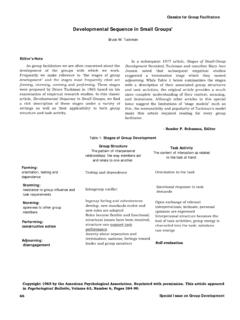
Developmental Sequence in Small Groups'
www.communicationcache.comBruce W. Tuckman Editor's Note As group facilitators we are often concerned about the development of the groups with which we work. Frequently we make reference to "the stages of group development" and the stages most frequently cited are forming, storming, norming and performing. These stages were proposed by Bruce Tuckman in 1965 based on his
Study on Theory of Group Development; Groups and Teams
iosrjournals.orgTuckman postulated that the group development consisted of 4 stages, viz., Forming, Storming, Norming, and Performing. Tuckman‟s study suffered from certain limitations in that the past studies had more therapy groups and less of natural groups. Further the studies were not subject to much quantitative rigour.
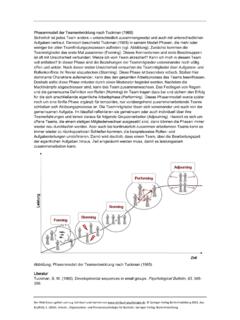
Phasenmodell der Teamentwicklung nach Tuckman (1965)
lehrbuch-psychologie.springer.comPhasenmodell der Teamentwicklung nach Tuckman (1965) Sicherlich ist jedes Team anders – unterschiedlich zusammengesetzt und auch mit unterschiedlichen Aufgaben vertraut. Dennoch beschreibt Tuckman (1965) in seinem Modell Phasen, die mehr oder weniger bei allen Teamfindungsprozessen auftreten (vgl. Abbildung). Zunächst kommen die
Unit 9: Team Building in Business
qualifications.pearson.comTo introduce Tuckman’s theory of team development you can introduce the ‘stage coach game’. In groups, learners discuss a handout on Tuckman’s stages of group development and group behaviours. Learners then attempt to correctly classify the behaviours.
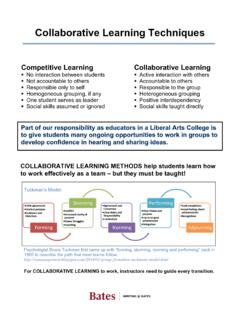
Collaborative Learning Techniques - Bates College
www.bates.eduTuckman’s Model: For COLLABORATIVE LEARNING to work, instructors need to guide every transition. Some Examples of Collaborative Learning Techniques: Think/Write, Pair, Share: The think/write, pair, share strategy is a cooperative
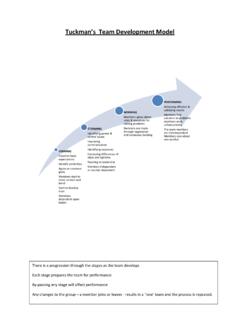
Tuckman’s Team Development Model
www.gla.ac.ukTuckman’s Team Development Model Each stage prepares the team for performance By FORMING Establish basic expectations Identify similarities Agree on common goals Members start to make contact and bond Start to develop trust Members dependent upon leader STORMING Identifying power & control issues Improving communication Identifying resources