Guide
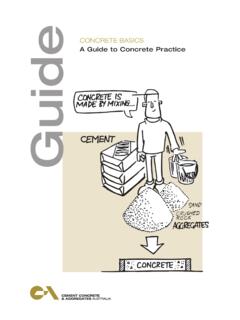
Concrete Basics provides a clear, concise explanation of all aspects of making quality concrete; from the Materials and Properties involved through Planning, Preparation, Finishing and Curing. Concrete Basics addresses the needs of unskilled and semi-skilled persons undertaking general concreting projects including home and handyman projects.
Download Guide

Information
Domain:
Source:
Link to this page:
Documents from same domain
Joints in Concrete Buildings - CCAA
www.ccaa.com.auUnplanned construction joints These are joints that are forced upon the concrete-placing crew because of an interruption in supply of a duration long enough for the concrete to take its initial set.
Joints in Concrete Buildings - ccaa.com.au
www.ccaa.com.auDEFINITION The word ‘joint’ is used in building parlance to cover elements which have to perform quite different functions, eg beam-column joints and isolation

CCAA T57 Guide
www.ccaa.com.au4 Guide to off-form ConCrete finishes 2.3 INSITU v PRECAST While the more-appropriate approach will vary from project to project, precast has some advantages over insitu work in terms of the range and quality

Durability of Masonry Mortar - CCAA
www.ccaa.com.auDurability of Masonry Mortar Page 3 Typical cement:lime:sand mortar compositions were chosen with one exception of an M3 mix of cement and sand without lime.
CCAA T57 Guide
www.ccaa.com.auConcrete is the most commonly used construction material for loadbearing and non-loadbearing elements. its ability to be shaped and reflect the

RESIDENTIAL Concrete Driveways and Paths
www.ccaa.com.auby weight of cement to be used will need to be specified. Aggregates. Any information necessary to identify the coarse aggregate required – size, type, texture, colour (e.g. nominal 10-mm aggregate consisting of 90% brown rounded river gravel and 10% crushed white quartz). Cement colour. Normal grey, off-white or white.

Curing of Concrete
www.ccaa.com.auPage of 7 > curing of ncreteco n Curing by preventing excessive loss of moisture from the concrete: either by > leaving formwork in place > 20covering the concrete with an impermeable membrane after the formwork has been removed > by the application of a suitable chemical curing agent (wax etc) > or by a combination of such methods n Curing by continuously …
Guide to Residential Floors Guide
www.ccaa.com.aufloors suitable for residential buildings ranging from single, detached houses to medium density buildings of apartments and flats. For slab-on-ground floors it provides an understanding of the footing/slab selection, design, detailing and construction requirements contained in AS 2870 and the Housing Provisions of the BCA. The requirements of

Residential Concrete Driveways and Paths
www.ccaa.com.au5.3 Assessment of Cracks 10 6 SPECIFICATION CHECKLIST 10 7 REFERENCES 12 july 2006 Data sheet > > ResidentiAl Concrete driveways and Paths the bAsiC funCtion of residential pavements such as driveways, paths and patios is to provide safe, easy access onto or around a property. > 1 INTRODUCTION 2 2 PLANNING otpath2.1 fo Area 2 2.2 Pavement Grades 2

Concrete Panel Buildings
www.ccaa.com.authe panel weights for a concrete density of 2400 kg/m3 are given in Table 2. For heavily reinforced panels, the additional weight of the reinforcement may need to be considered to accurately determine the appropriate cranage. Panel Systems Concrete panels can be used either as cladding to the building, or as part of the loadbearing structure,
Related documents
Curing Concrete, Chapter 12 - Memphis
www.ce.memphis.eduCuring is the maintenance of a satisfactory moisture con-tent and temperature in concrete for a period of time imme-diately following placing and finishing so that the desired properties may develop (Fig. 12-1). The need for adequate curing of concrete cannot be overemphasized. Curing has a strong influence on the properties of hardened concrete;

Properties of Concrete - Memphis
www.ce.memphis.eduConcrete Curing Concrete Curing Concrete Curing Concrete strength gain versus time for concrete exposed to outdoor conditions. Concrete continues to gain strength for many years when moisture is provided by rainfall and other environmental sources. Compressive Strength Compressive Strength- is defined as the measured maximum resistance of a ...

Resurfacing Concrete - QUIKRETE
quikrete.commay reappear due to movement in base concrete. Curing Instructions: Under normal conditions no special curing is required. Temperature should remain above 50˚F (10˚C) for 8 hours. Protect surface from freezing for 24 hours after applying. Protect from rain for at least 6 hours. Do not cover unless immediate rain protection in necessary. When ...
Reinforced Concrete Design
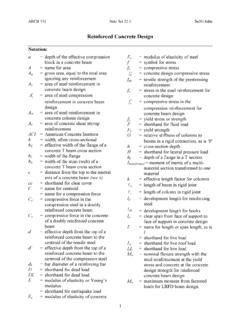
faculty-legacy.arch.tamu.eduConcrete is a mixture of cement, coarse aggregate, fine aggregate, and water. The cement ... Curing is allowing the hydration process to proceed with adequate moisture. Black tarps and curing compounds are commonly used. Finishing is the process of adding a texture, commonly by

Minor Cracks and Fractures - QUIKRETE: Cement and Concrete ...
quikrete.com1/16" so it is smooth with the surrounding concrete. 1. Vigorously rub the wire brush over the flaking concrete to loosen all damaged concrete. The tip of the trowel can be used to pry up loose sections of the flaked concrete. 2. Sweep away all loose particles and dust. 3. If needed, clean the surface using QUIKRETEâ Concrete & Asphalt Cleaner.

Cementall Data - Concrete Solutions and Supply - Home
concretesolutionsandsupply.comsuch as oil, asphalt, curing compounds, acids, dirt and loose debris. Roughen surfaces and remove all unsound concrete. Immediately prior to placement the repair surfaces shall be thoroughly saturated with no standing water. MIXING: The use of a power driven mechanical mixer, such as a mortar mixer or a drill mounted mixer, is recommended.
C31/C31M - 19 Standard Practice for Making and Curing ...
dot.ca.gov4.3.3 Adequacy of curing and protection of concrete in the structure, or 4.3.4 Form or shoring removal time requirements. 5. Apparatus 5.1 Molds, General—Molds for specimens or fastenings thereto in contact with the concrete shall be made of steel, cast

IS 9013 (1978): Method of making, curing and determining ...
law.resource.orgthe compressive strength of concrete within a short period and thereby to estimate whether it is likely to reach the specified strength at 28 days or not. 0.4 The need for having a reliable and fast method for evaluating controlled concrete in the field using accelerated curing technique was recognized by Cement and Concrete Sectional Committee ...
306R-16: Guide to Cold Weather Concreting
www.concrete.orgCHAPTER 10—CURING RECOMMENDATIONS AND METHODS, p. 20 10.1—Introduction, p. 20 10.2—Curing during the protection period inside an enclosure, p. 20 10.3—Curing following the protection period, p. 21 CHAPTER 11—ACCELERATION OF SETTING AND STRENGTH DEVELOPMENT, p. 21 11.1—Introduction, p. 21 11.2—Accelerating admixtures, p. 21
308R-16: Guide to External Curing of Concrete
www.concrete.org3.2—Use of water for curing concrete, p. 15 3.3—Initial curing methods, p. 15 3.4—Final curing measures, p. 16 3.5—Termination of curing measures, p. 20 3.6—Cold-weather protection and curing, p. 20 3.7—Hot-weather protection and curing, p. 21 David M. Suchorski, Chair Erik Holck, Vice Chair Lawrence Homer Taber *, Secretary ACI ...