Guidelines - NCCA
present a range of activities that will interest and motivate the student differentiate teaching approaches, methods, materials, resources and learning tasks according to individual, group and whole class student needs make the beginning and end points of tasks clear, and avoid ambiguity
Download Guidelines - NCCA

Information
Domain:
Source:
Link to this page:
Documents from same domain
Mathematics in Early Childhood and Primary Education (3-8 ...
ncca.ieThe literature offers a range of perspectives, and advice, as to the issues for educators in integrating these elements into their practices. In doing so, the vision of ‘mathematics for all’ is supported. ... Mathematics in Early Childhood and Primary Education (3–8 years) 18.

Literacy in Early Childhood and Primary Education (3-8 years)
ncca.ieFinally, theoretical perspectives emphasising the key role in literacy learning of children’s motivation, engagement and sense of self efficacy are reviewed. Disposition and a sense of being able emerge as crucial components in young children’s literacy development.

Curriculum reform: An education change perspective
ncca.ieThe National Quality Framework for Early Childhood Education and Care (NQF) National Foundation Skills Strategy for Adults Advancing Quality in Higher Education The Australian Workforce and Productivity Agency My University website National Partnership Agreement on Skills Reform 2013 National Partnership Agreement on Universal Access to Early
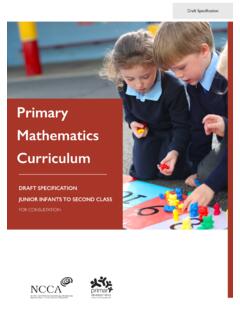
Primary Mathematics Curriculum - NCCA
ncca.ieMeasures 4 - Measuring 46 Measures 5 – Time 48 Measures 6 – Money 50 ... that is, communicating, reasoning, argumentation, justifying, generalising, representing, problem-solving, and connecting, ... Children’s progress towards Learning Outcomes will be influenced by their varying circumstances, experiences and abilities. ...
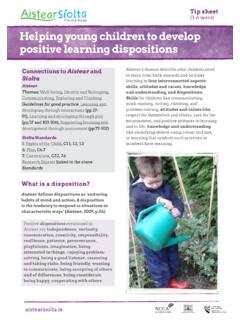
Helping young children to develop positive learning ...
ncca.ieHelping young children to develop positive learning dispositions Tip sheet (3-6 years) Aistear’s themes describe what children need to learn from birth onwards and outlines learning in four interconnected aspects: skills, attitudes and values, knowledge and …

A Framework for the Junior Cycle - NCCA
ncca.ieof assessment approaches, both formative and summative, that generate evidence of this learning by students. The approach to reporting will facilitate provision of assessment information based on the following elements: Ongoing formative assessments, including routine teacher-designed tasks and tests

Junior Cycle Wellbeing Guidelines
ncca.ie3.7 Assessment practices and student wellbeing 31 3.8 School policies 32 ... 4.5 Providing a Wellbeing programme for students engaging with ... 5 OECD (2017), PISA 2015 Results (Volume III): Students’ Well-Being, OECD Publishing, Paris. 6 Weare, K. (2000).
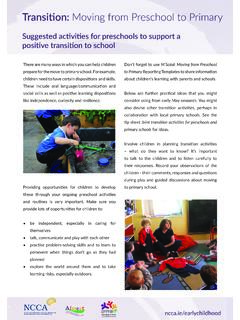
Transition: Moving from Preschool to Primary
ncca.iesome of the enjoyable activities they will be able to do in the yard when they start school. • a bus tour and simply ‘drive-by’ the local schools. This is a good idea if the children are moving on to a number of schools. • a virtual visit - use skype/facetime sessions with the school/s. The children in the infant class might show
Key Elements of Good Practice to Support the ... - NCCA
ncca.ieprovide resources to support early childhood educators in enhancing the learning and development of children from birth to three years old. The NSAI was established to support the co-ordinated roll out of Síolta (Centre for Early Childhood Development and Education [CECDE], 2006) and Aistear (National Council for Curriculum and Assessment, 2009).
G uidelines f or g od p r a c t i c e - NCCA
ncca.ieAistear: the Early Childhood Curriculum Framework Introduction Aistear is the curriculum framework for children from birth to six years in Ireland. It describes learning and development through the four interconnected themes of Well-being, Identity and Belonging, Communicating, and Exploring and Thinking
Related documents
Get help and support GCSE PHYSICS - AQA
filestore.aqa.org.uk• have fewer contexts so students don’t get confused • have questions that increase in difficulty so students feel confident • have been written with our GCSE Maths and A-level science teams, so students have consistency between content and questions. AQA GCSE Physics 8463. GCSE exams June 2018 onwards. Version 1.1 30 September 2019
Healthy Body Image: A Lesson Plan for Middle School Students
www.extension.purdue.eduunfortunately, knowledge alone is not enough to motivate most people to adopt a healthy lifestyle. The number of teenagers who are overweight has risen steadily over the past two decades. in indiana, 15 percent of teenage respondents to the ...

Unit/Lesson Planning Guide: Key Questions to Consider ...
edwp.educ.msu.eduJun 24, 2010 · challenge students to change and expand their initial ideas, explain new ideas, give students multiple chances to apply and use new ideas, engage students in reflecting on their learning and growth.) Designing daily lesson plans What, specifically, do I want students to learn from this lesson that will

GCSE (9-1) History
qualifications.pearson.comStudents answer a question based on a provided source and a question that assesses their knowledge and understanding. Section B . Students answer a single four-part question, based on two provided sources and two provided interpretations. *This weighting relates to assessed content, before including marks for SPaG.
Teaching Diverse Students - SAGE Publications Inc
www.sagepub.comstudents when making assignments, giving presentations, conducting discussions, and grading examinations. “Realistic” in this context means that the standards are high enough to motivate students to do their best work but not so high that students
Stress Levels Among the Senior High School Students in ...
www.ijsrp.orgStress motivate and help one to become productive. However, experiencing or responding too much stress can be harmful so that, it may have a negative effect on the functioning mind and learnings of students.
Summary Student Motivation— An Overlooked Piece of …
files.eric.ed.govCan Money or Other Rewards Motivate Students? Some schools and districts have sought to motivate students to work harder by providing them with money or other rewards. Examples include programs that give cash to students for earning good grades, reading books, attending after-school study sessions, demonstrating good atten-dance and behavior, or
9 Tips for Motivating Children
www.apa.orgMotivation includes students’ intrinsic interest in tasks that they find enjoyable and personally relevant. It also takes into account their goals for learning, their capacity to track progress towards these goals, their commitment to learning tedious but necessary skills, and their expectations for …