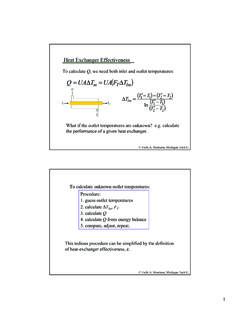
Heat Exchanger Effectiveness
The heat capacity of the oil is 1.89 kJ/kg K, and the average heat capacity of water over the temperature range of interest is 4.192 kJ/kg K. The overall heat-transfer coefficient of the exchanger is 300 W/m2 K, and the area for heat transfer is 15.4 m2. What is the total amount of heat transferred? ©Faith A. Morrison, Michigan Tech U.
Download Heat Exchanger Effectiveness

Information
Domain:
Source:
Link to this page:
Documents from same domain
CM3215 Fundamentals of Chemical Engineering …
pages.mtu.eduControl Valve Lecture, CM3215 Morrison 2/17/2016 1 CM3215 Fundamentals of Chemical Engineering Laboratory Professor Faith Morrison Department of Chemical Engineering

Basic Concepts of Human Genetics - pages.mtu.edu
pages.mtu.edu1 Basic Concepts of Human Genetics • The genetic information of an individual is contained in 23 pairs of chromosomes. Every human cell contains the 23 pair of chromosomes. • One pair is called sex chromosomes Male: XY Female: XX • Other 22 pairs of homologous chromosomes are called autosomes. • The autosome …

Pumping System Curves - Michigan Technological …
pages.mtu.eduPumping System Head CM3215 FAM 3Mar2014 1 CM3215 Fundamentals of Chemical Engineering Laboratory Professor Faith Morrison Department of Chemical Engineering
Chapter 4 - Student
pages.mtu.eduIn Chapter 4, the following problem modules explain the heat transfer processes involved in fuel cell vehicles and in the processes for producing fuel for fuel cells. 4.1-1 Heat Loss through a Stainless Steel Bipolar Plate
Heat Exchanger Effectiveness
pages.mtu.eduHeat Exchanger Effectiveness ... Double-pipe or 1-1 Shell-and-Tube Heat Exchangers ©Faith A. Morrison, Michigan Tech U. 8 Final Exam CM 310 November 16, 1998 ... The heat capacity of the oil is 1.89 kJ/kg K, and the average heat capacity of water over the temperature range of interest is 4.192 kJ/kg K. The overall heat-transfer coefficient of ...

Introduction to Electromagnetic Theory
pages.mtu.edu1/19/18 1 Lecture topics • Laws of magnetism and electricity • Meaning of Maxwell’s equations • Solution of Maxwell’s equations Introduction to Electromagnetic Theory

Note: This document represents a draft of text that is ...
pages.mtu.edubalance equations we choose the boundaries and then note the quantities of mass, energy, or momentum that cross the boundaries (Figure 2). A closed system is a system that does not have any mass crossing its boundaries.

Compressibility Factor from Redlick-Kwong Equations
pages.mtu.eduCompressibility Factor from Redlick-Kwong Equations (Dr. Tom Co 9/2/08) Working Equations: (based on Cutlip and Shacham, 2008, pp. 101-103) Let be pressure in …

STEAM TABLES - Michigan Technological University
pages.mtu.eduSaturated Steam: TEMPERATURE Table STEAM TABLES ( from M. D. Koretsky, "Engineering and Chemical Thermodynamics", John Wiley & Sons, 2004)

ROBOT OPERATIONS - Michigan Technological University
pages.mtu.eduR-J3, R-J3iB and R-30iA Controller This training focuses on the FANUC Robotics R-J3, R-J3iB and R-30iA controller. The R-J3 series uses advanced technology packaged in a
Related documents

Heat Exchanger Fundamentals
d6s74no67skb0.cloudfront.netThe heat is transferred from the hot fluid to the metal isolating the two fluids and then to the cooler fluid. Types of Heat Exchanger Construction. Although heat exchangers come in every shape and size imaginable, the construction of most heat
The theory behind heat transfer
www.alfalaval.comwhere the heat is transferred through heat transfer surfaces. Temperature losses through radiation can be disregarded when considering heat exchangers in this brochure. Indirect heat exchangers are available in several main types (plate, shell-and-tube, spiral etc.) In most cases the plate type is the most efficient heat exchanger.
Chapter 17. Work, Heat, and the First Law of Thermodynamics
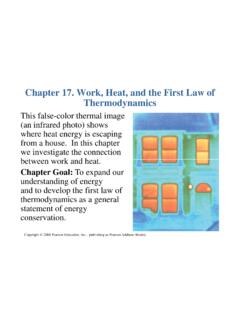
physics.gsu.eduHeat, Temperature, and Thermal Energy • Thermal energy Eth is an energy of the system due to the motion of its atoms and molecules. Any system has a thermal energy even if it is isolated and not interacting with its environment. The units of Eth are Joules. • Heat Q is energy transferred between the system and

Chapter 19. Heat Engines and Refrigerators
physics.gsu.eduHeat QH = Q34 is transferred into the gas. 4. The gas expands adiabatically, with Q = 0, until the temperature decreases back to TC. Work is done in all four processes of the Carnot cycle, but heat is transferred only during the two isothermal processes.

LAB ACTIVITY: HEAT, TEMPERATURE AND CONDUCTION
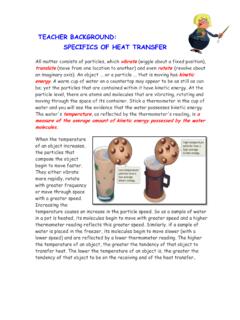
gml.noaa.govHeat is the amount of kinetic energy that is transferred from a substance at a higher temperature to a substance at a lower temperature and is another word for thermal energy. Heat is measured in joules. The scientific meaning of heat has to do with energy that is being transferred. During
TEACHER BACKGROUND: SPECIFICS OF HEAT TRANSFER
gml.noaa.govHeat is transferred from the hot water to the cold water until both samples have the same temperature. The transfer of heat from the hot water through the metal can to the cold water is referred to as conduction. Conduction involves the transfer of heat from one location to …
Measuring the Specific Heat of a Metal Element
home.miracosta.eduA. Use Equation 1 to calculate Q, the heat transferred from the mineral sample to the water, in joules (again, the specific heat of water is 4.184 g J •°C. B. Use the value of Q calculated in part A and Equat ion 2 to calculate s, the specific heat of the mineral. 2.

Heat Exchanger Modeling, Sizing, and Design
pages.mtu.eduLectures 19 Applied Heat Transfer CM3110 12/3/2019 3 T , outer bulk temperature T, inner bulk temperature L BUT: The temperature difference between the fluid and the wall varies along the length of the heat exchanger. T1 T2 T1 T2 x The Simplest Heat Exchanger: Double‐Pipe Heat exchanger ‐counter current cold less cold less hot hot ...

Temperature and Heat Temperature, Heat, and Expansion
phys.unm.eduThe study of heat and its transformation to mechanical energy and work –1st law of thermodynamics When heat flows into (or out of) a system, the system gains (or loses) an amount of energy equal to the amount of heat transferred. ΔHeat = ΔInternal Energy + Work –Adding heat to a system can: increase the internal energy of the system