Transcription of The theory behind heat transfer
1 The theory behind heat transferPlate heat exchangersHeat transfer theoryThe natural laws of physics always allow the driving energy in a system to flow until equilibrium is reached. heat leaves the warmer body or the hottest fluid, as long as there is a temperature difference, and will be transferred to the cold heat exchanger follows this principle in its endeavour to reach equalisation. With a plate type heat exchanger, the heat penetrates the surface, which separates the hot medium from the cold one very easily. It is therefore possible to heat or cool fluids or gases which have minimal energy theory of heat transfer from one media to another, or from one fluid to another, is determined by several basic rules.
2 heat will always be transferred from a hot medium to a cold medium. There must always be a temperature difference between the media. The heat lost by the hot medium is equal to the amount of heat gained by the cold medium, except for losses to the exchangersA heat exchanger is a piece of equip-ment that continually transfers heat from one medium to another. There are two main types of heat exchangers. Direct heat exchanger, where both media are in direct contact with each other. It is taken for granted that the media are not mixed example of this type of heat exchanger is a cooling tower, where water is cooled through direct contact with air.
3 Indirect heat exchanger, where both media are separated by a wall through which heat is transfer theoryHeat can be transferred by three methods. Radiation Energy is transferred by electromag netic radiation. One example is the heating of the earth by the sun. Conduction Energy is transferred between solids or stationary fluids by the movement of atoms or molecules. Convection Energy is trans-ferred by mixing part of a medium with another ) Natural convection, where the move-ment of the media depends entirely upon density difference, and tempera-ture differences are evened ) Forced convection, where the move-ment of the media depends entirely or partly upon the results of an outside influence.
4 One example of this is a pump causing movement in a Alfa Laval heat exchangersInside view 2 heat transfer theory heat exchangers heat transfer theory heat exchanger types 4 Calculation method Temperature program heat load Logarithmic mean temperature difference Thermal length Density Cooling Flow rate Pressure drop Specific heat Viscosity Overall heat transfer coefficient Calculation method Construction materials Pressure and temperature limitations Fouling and fouling factors 8 Product range 9 Applications heat exchanger selection water/water heat exchanger selection water/oil heat exchanger selection water/glycol 10 Plate heat exchanger construction Plate heat exchanger components Brazed plate heat exchangers Fusion-bonded plate heat exchangers 11 Assembly11 InstallationRadiationHeat exchanger typesIn this brochure only indirect heat exchangers are discussed, those where the media are not mixed, but where the heat is transferred through heat transfer losses through radiation can be disregarded when considering heat exchangers in this heat exchangers are available in several main types (plate, shell-and-tube, spiral etc.)
5 In most cases the plate type is the most efficient heat exchanger. Generally it offers the best solution to thermal problems, giving the widest pressure and temperature limits within the constraint of current equip-ment. The most notable advantages of a plate heat exchanger are: Takes up much less space than a traditional shell-and-tube heat Laval heat exchangers 3 Thin material for the heat transfer surface this gives optimum heat transfer , since the heat only has to penetrate thin material. High turbulence in the medium this gives a higher convection, which results in efficient heat transfer between the media.
6 The consequence of this higher heat transfer coefficient per unit area is not only a smaller surface area requirement but also a more efficient high turbulence also gives a self-cleaning effect. Therefore, when compared to the traditional shell-and-tube heat exchanger, the fouling of the heat transfer surfaces is considerably reduced. This means that the plate heat exchanger can remain in service far longer between cleaning intervals. Flexibility the plate heat exchanger consists of a framework containing several heat transfer plates. It can easily be extended to increase capacity. Furthermore, it is easy to open for the purpose of cleaning.
7 (This only applies to gasketed heat exchangers, and not to brazed or fusion bonded units.) Variable thermal length most of the plate heat exchangers manufactured by Alfa Laval are available with two different pressing patterns. When the plate has a narrow pattern, the pressure drop is higher and the heat exchanger is more effective. This type of heat exchanger has a long thermal the plate has a wide pattern, the pressure drop is smaller and the heat transfer coefficient is accordingly somewhat smaller. This type of heat exchanger has a short thermal two plates of different pressing patterns are placed next to each other, the result is a compromise between long and short channels as well as between pressure drop and ConductionCalculation methodTo solve a thermal problem, we must know several parameters.
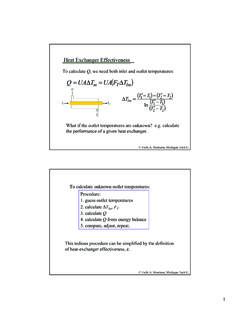
8 Further data can then be determined. The six most important parameters are as follows: The amount of heat to be transferred ( heat load). The inlet and outlet temperatures on the primary and secondary sides. The maximum allowable pressure drop on the primary and secondary sides. The maximum operating temperature. The maximum operating pressure. The flowrate on the primary and secondary the flow rate, specific heat and temperature difference on one side are known, the heat load can be calculated. See also page programThis means the inlet and outlet temperatures of both media in the heat = Inlet temperature hot sideT2 = Outlet temperature hot sideT3 = Inlet temperature cold sideT4 = Outlet temperature cold side4 Alfa Laval heat exchangersTemperatureTemperatureT2T3 T2 T1 - T2 LMTD = T1 T2 InT1T4 T1 The temperature program is shown in the diagram loadDisregarding heat losses to the atmosphere, which are negligible, the heat lost ( heat load) by one side of a plate heat exchanger is equal to the heat gained by the other.
9 The heat load (P) is expressed in kW or mean temperature differenceLogarithmic mean temperature difference (LMTD) is the effective driving force in the heat exchanger. See diagram to the lengthThermal length ( ) is the relationship between temperature difference t on one side and LMTD. = Thermal length describes how difficult a duty is from a thermal ( ) is the mass per unit volume and is expressed in kg/m3 or kg/dm3. t LMTDAlfa Laval heat exchangers 5 CoolingFor some duties, cooling applications for example, the temperature program is very tight with close approaches on the different temperatures.
10 This gives what we refer to as high theta duties and requires high theta units. High theta duties are duties that have > 1 and are characterized by: Long plate, longer time for the fluid to be cooled Low pressing depth that gives less fluid per plate to be cooledPlate heat exchangers are superior compared to shell-and-tube heat exchangers when it comes to theta values. Shell-and-tube heat exchangers can go up to a maximum value of theta ~1 while plate heat exchangers goes up to theta values of 10 and more. For a shell-and-tube to climb over theta value of 1 or more, several shell-and-tube needs to be put in series.