Heat Transfer Module - COMSOL Multiphysics
The Heat Transfer in Solids and Fluids Interface 331 Feature Nodes for the Heat Transfer in Solids and Fluids Interface . . . 331 The Heat Transfer in Porous Media Interface 332 Feature Nodes for the Heat Transfer in Porous Media Interface . . . . 334 The Heat Transfer in Building Materials Interface 338
Download Heat Transfer Module - COMSOL Multiphysics

Information
Domain:
Source:
Link to this page:
Documents from same domain
The CFD Module User’s Guide - COMSOL Multiphysics
doc.comsol.comChapter 1: Introduction About the CFD Module 22 ... The Two-Phase Flow, Level Set and Phase Field Interfaces 290 The Laminar Two-Phase Flow, Level Set Interface . ... Governing Equations of the Three-Phase Flow, Phase Field Interface . . 407 Reference for the Three-Phase Flow, Phase Field Interface . ...

Chemical Reaction Engineering Module - COMSOL …
doc.comsol.comThe Chemical Reaction Engineering Module is tailor-made for the modeling of chemical systems primarily affected by chemical composition, reaction kinetics, fluid flow, and temperature as functions of space, time, and each other. It has a number of

COMSOL Multiphysics Programming Reference Manual
doc.comsol.com4 | CONTENTS model.geom() . . . . . . . . . . . . . . . . . . . . . . . . . . . . . . . . . . . . . . . 98

The AC/DC Module User’s Guide - COMSOL Multiphysics
doc.comsol.comCONTENTS| 5 Lumped Parameters 93 Calculating Lumped Parameters with Ohm’s Law. . . . . . . . . . . 93 Calculating Lumped Parameters Using the Energy Method .

LiveLink for MATLAB User’s Guide - COMSOL Multiphysics
doc.comsol.com6 | CONTENTS Running Models in a Loop 181 The Parametric Sweep Node . . . . . . . . . . . . . . . . . 181 Running Model in a Loop Using the MATLAB® Tools .

The RF Module User’s Guide - COMSOL Multiphysics
doc.comsol.comfor problems with a planar symmetry as well as axisymmetric formulations for problems with a cylindrical symmetry. 2D mode analysis of waveguide cross sections with out-of-plane propagation is also supported. In the COMSOL Multiphysics Reference Manual: † Studies and Solvers † The Physics Interfaces † Creating a New Model

Structural Mechanics Module - COMSOL Multiphysics
doc.comsol.comCONTENTS| 3 Contents Chapter 1: Introduction About the Structural Mechanics Module 22 Why Structural Mechanics is Important for Modeling . . . . . . . . . 22

The Particle Tracing Module User’s Guide
doc.comsol.comlenses, electron guns, and mass spectrometers. There are a number of tools available to ... case for ion and electron beams in vacuum systems, the Molecular Flow Module is useful because it provides built-in tools to compute the density of extremely rarefied gases. Similarly, when tracing particles in a fluid system the CFD Module or

The Acoustics Module User’s Guide - COMSOL Multiphysics
doc.comsol.comCONTENTS| 3 Contents Chapter 1: Introduction Acoustics Module Capabilities 23 What Can the Acoustics Module Do? . . . . . . . . . . . . . . . 23
Wave Optics Module - COMSOL Multiphysics
doc.comsol.comIntroduction T his guide describes the Wave Optics Module, an optional add-on package for COMSOL Multiphysics ® designed to assist you to set up and solve electromagnetic wave problems at optical frequencies. This chapter introduces you to the capabilities of this module. A summary of the
Related documents
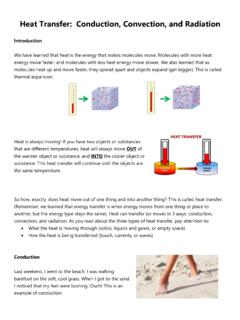
Heat Transfer: Conduction, Convection, and Radiation
alkisites.vansd.orgHeat Transfer: Conduction, Convection, and Radiation Introduction We have learned that heat is the energy that makes molecules move. Molecules with more heat energy move faster, and molecules with less heat energy move slower. We also learned that as molecules heat up and move faster, they spread apart and objects expand (get bigger). This is ...

EXPERIMENT: CALORIMETRY AND HEAT OF …
faculty.cbu.caINTRODUCTION Heat is defined as the transfer of energy from or into a system because of a temperature difference between the system and its surroundings. Heat is often considered, inaccurately, as a form of energy existing as the result of the random motion of molecules.
THERMODYNAMICS: COURSE INTRODUCTION
web.mit.eduI. Changing the State of a System : Heat (VW, S & B: 4.7-4.9) A. Heat is energy transferred between a system and its surroundings by virtue of a temperature difference only. 1. This transfer of energy can change the state of the system. 2. “Adiabatic” means no heat is transferred. B. Zeroth Law of Thermodynamics (VW, S & B: 2.9-2.10) 1.

Energy Transfer and Conversion Methods
ocw.mit.eduHeat Transfer • For heat to be transferred at an appreciable rate, a temperature difference ( T) is required. – Q = U A T – The non-zero T guarantees irreversibility – As T does to zero, area and cost goes to infinity 22 ... Introduction to Sustainable Energy Fall 2010 .
THERMODYNAMICS, HEAT TRANSFER, AND FLUID FLOW, …
sites.ntc.doe.govIntroduction Fluid flow is an important part of most industrial processes; especially those involving the transfer of heat. Frequently, when it is desired to remove heat from the point at which it is generated, some type of fluid is involved in …
Increasing Heat Exchanger Performance
www.bre.comINTRODUCTION Increasing heat exchanger performance usually means transferring more duty or operating the exchanger at a closer temperature approach. This can be accomplished without a dramatic increase in surface area. This constraint directly translates to increasing the overall heat transfer coefficient, U. The overall heat transfer
Introduction to Pinch Technology-LinhoffMarch
www.ou.eduintroduction to pinch technology 3 figure 14: targeting for retrofit applications ... figure 55: isothermal mixing avoids cross-pinch heat transfer so do not mix at different temperatures. ...