
High-Frequency Component Helps Explain the Generalization ...
tion behaviors of neural networks, such as the capacity in memorizing label shuffled data [65] and the vulnerability towards adversarial examples [54, 21] To explain the generalization behaviors of neural net-works, many theoretical breakthroughs have been made progressively, including studying the properties of stochas-
Download High-Frequency Component Helps Explain the Generalization ...

Information
Domain:
Source:
Link to this page:
Documents from same domain
What Have We Learned From Deep Representations for …
openaccess.thecvf.comwhat these powerful models actually have learned. In this paper we shed light on deep spatiotemporal net-works by visualizing what excites the learned models us-ing activation maximization by backpropagating on the in-put. We are the first to visualize the hierarchical features
Finding Tiny Faces in the Wild With Generative Adversarial ...
openaccess.thecvf.comfaces, which are unfriendly for the face classifier. Toward-s this end, we design a refinement sub-network to recover some detailed information. In the discriminator network, the basic GAN [17, 12, 8] is trained to distinguish the real and fake high resolution images. To classify faces or non-
Squeeze-and-Excitation Networks - openaccess.thecvf.com
openaccess.thecvf.comSqueeze-and-Excitation Networks Jie Hu1∗ Li Shen2∗ Gang Sun1 hujie@momenta.ai lishen@robots.ox.ac.uk sungang@momenta.ai 1 Momenta 2 Department of Engineering Science, University of Oxford Abstract Convolutional neural networks are built upon the con-
RegularFace: Deep Face Recognition via Exclusive ...
openaccess.thecvf.comRegularFace: Deep Face Recognition via Exclusive Regularization Kai Zhao Jingyi Xu Ming-Ming Cheng ∗ TKLNDST, CS, Nankai University kaiz.xyz@gmail.com cmm@nankai.edu.cn
Protecting World Leaders Against Deep Fakes
openaccess.thecvf.comProtecting World Leaders Against Deep Fakes Shruti Agarwal and Hany Farid University of California, Berkeley Berkeley CA, USA {shrutiagarwal, hfarid}@berkeley.edu
Auto-DeepLab: Hierarchical Neural Architecture Search for ...
openaccess.thecvf.comAuto-DeepLab: Hierarchical Neural Architecture Search for Semantic Image Segmentation Chenxi Liu1∗, Liang-Chieh Chen 2, Florian Schroff2, Hartwig Adam2, Wei Hua2, Alan Yuille1, Li Fei-Fei3 1Johns Hopkins University 2Google 3Stanford University Abstract Recently, NeuralArchitectureSearch(NAS)hassuccess-
PointNet: Deep Learning on Point Sets ... - CVF Open Access
openaccess.thecvf.comPointNet: Deep Learning on Point Sets for 3D Classification and Segmentation Charles R. Qi* Hao Su* Kaichun Mo Leonidas J. Guibas Stanford University
Frustum PointNets for 3D Object Detection From RGB-D Data
openaccess.thecvf.comFrustum PointNets for 3D Object Detection from RGB-D Data Charles R. Qi1∗ Wei Liu2 Chenxia Wu2 Hao Su3 Leonidas J. Guibas1 1Stanford University 2Nuro, Inc. 3UC San Diego Abstract In this work, we study 3D object detection from RGB-D data in both indoor and outdoor scenes.
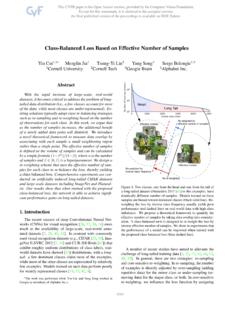
Class-Balanced Loss Based on Effective Number of Samples
openaccess.thecvf.comand large-scale datasets including ImageNet and iNatural-ist. Our results show that when trained with the proposed class-balanced loss, the network is able to achieve signifi-cant performance gains on long-tailed datasets. 1. Introduction The recent success of deep Convolutional Neural Net-works (CNNs) for visual recognition [26, 37, 38, 16] owes
ESRGAN: Enhanced Super-Resolution Generative Adversarial ...
openaccess.thecvf.comESRGAN: EnhancedSuper-Resolution Generative Adversarial Networks Xintao Wang 1, Ke Yu , Shixiang Wu2, Jinjin Gu3, Yihao Liu4, Chao Dong 2, Yu Qiao , and Chen Change Loy5 1 CUHK-SenseTime Joint Lab, The Chinese University of Hong Kong 2 Shenzhen Institutes of Advanced Technology, Chinese Academy of Sciences 3 The Chinese University of Hong Kong, …
Related documents
Sequence to Sequence Learning with Neural Networks
arxiv.orgsearch decoder. This is by far the best result achieved by direct translation with large neural net-works. For comparison,the BLEU score of an SMT baseline on this dataset is 33.30 [29]. The 34.81 BLEU score was achieved by an LSTM with a vocabulary of …
Generating Sequences With Recurrent Neural Networks
arxiv.orgRecurrent Neural Networks Alex Graves Department of Computer Science University of Toronto graves@cs.toronto.edu Abstract This paper shows how Long Short-term Memory recurrent neural net-works can be used to generate complex sequences with long-range struc-ture, simply by predicting one data point at a time. The approach is
ImageNet Classification with Deep Convolutional Neural ...
papers.nips.ccThe learning rates for each net-work were chosen independently to make train-ing as fast as possible. No regularization of any kind was employed. The magnitude of the ... Linear Units (ReLUs). Deep convolutional neural net-works with ReLUs train several times faster than their equivalents with tanh units. This is demonstrated in Figure 1, which ...
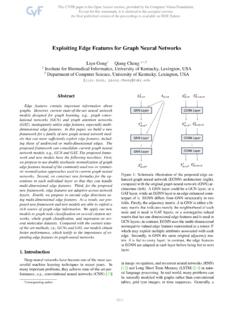
Exploiting Edge Features for Graph Neural Networks
openaccess.thecvf.commodels to graph node classification on several citation net-works, whole graph classification, and regression on sev-eral molecular datasets. Compared with the current state-of-the-art methods, i.e., GCNs and GAT, our models obtain better performance, which testify to the importance of ex-ploiting edge features in graph neural networks. 1.