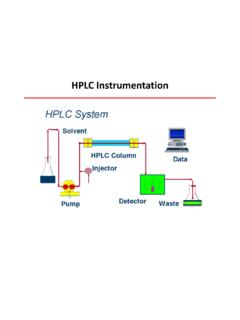
High Performance Liquid Chromatography (HPLC)
Qualitative and Quantitative Analysis Need an interface that can take a continuous liquid eluent from LC and convert analyte to ions in the gas for MS. Electrospray ionization is also an LC interface with MS.
Download High Performance Liquid Chromatography (HPLC)

Information
Domain:
Source:
Link to this page:
Documents from same domain

Standard Operating Procedure: Pumps
www2.chemistry.msu.eduStandard Operating Procedure: Pumps Last Updated: ... operation of ports and evacuation procedures are covered in the glove box SOP document. As a general
Radiation Detection & Measurement Dept. of …
www2.chemistry.msu.eduRadiation Detection & Measurement Dept. of Chemistry --- Michigan State Univ. National Superconducting Cyclotron Lab DJMorrissey Spring/2oo9

Chemistry 151 - Michigan State University
www2.chemistry.msu.eduChemistry 151 • Professor James H. Geiger • Office: Chemistry Building, Room 9 ... Chemistry, the Central Science, 10th edition, Prentice-Hall, 2005. ISBN: 0-13-109686-9. ... Registering for Mastering Chemistry, What You Need: A valid email address

Chapter 3 Stoichiometry - Michigan State University
www2.chemistry.msu.eduChapter 3! Stoichiometry: Calculations with Chemical Formulas and Equations. Stoichiometry Anatomy of a Chemical Equation CH 4 (g) + 2O 2 (g) CO 2 (g) + 2 H 2 O (g) Stoichiometry Anatomy of a Chemical Equation Reactants appear on the left side of the equation. CH 4 (g) + …

Bond Dissociation Energies of Organic Molecules
www2.chemistry.msu.eduBond Dissociation Energies of Organic Molecules STEPHEN J. BLANKSBY*,† AND G. BARNEY ELLISON*,‡ Department of Chemistry, University of Wollongong, NSW, 2522, Australia, and Department of Chemistry &

Chapter 1 Structure and Bonding - Chemistry
www2.chemistry.msu.eduThe atomic mass (atomic weight) of an element is weighted average mass in atomic mass units (amu) of an element’s naturally occurring isotopes. Carbon: Atomic Number and Atomic Mass 12C 6 AC Z 13C 6 (98.9 12.000) (1.1 13.000) 12.011 100 × +× =

Chapter 9: Atomic Absorption Spectrometry
www2.chemistry.msu.eduChapter 9: Atomic Absorption Spectrometry. Read: pp. 230 – 249 Problems: 9-1,3,5,6,8. Figure 9-13a. A(λ)= ε(λ)bC = log P. o /P

Chapter 24 Chemistry of Coordination Compounds
www2.chemistry.msu.edu6 3+ • Co3+ electron configuration: • 4s23d4----" 4s03d6 • Need six orbitals for six ligands so: !Hybridize 1 4s, 3 4p and 2 3d to give: !Sp3d2 orbitals. The 6 …
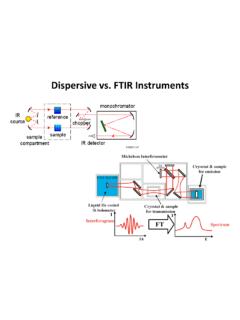
Dispersive vs. FTIR Instruments - Chemistry
www2.chemistry.msu.eduA spectroscopic technique used to observe vibrational, rotational, and other low-frequency [modes in a system. 1] It relies on inelastic scattering, or Raman scattering, of monochromatic light, usually from a laser in the visible, near infrared, or near ultraviolet range.

Principles of FTIR Spectroscopy - Chemistry
www2.chemistry.msu.eduPrinciples of Diffuse Reflectance Method K is the absorption coefficient, and S is the scattering coefficient. In practice, the comparative reflectance r∞ with respect to a standard powder such as KBr or KCl, of which K is near zero (0) in the actual measurement range Spectrum of solid caffeine Measurement of chemicals adhering to a surface ...
Related documents

1400-Fm 9/9/99 7:37 AM Page i CModern Analytical ... - GTU
gtu.ge3A Analysis, Determination, and Measurement 36 3B Techniques, Methods, Procedures, and Protocols 36 3C Classifying Analytical Techniques 37 3D Selecting an Analytical Method 38 3D.1 Accuracy 38 3D.2 Precision 39 3D.3 Sensitivity 39 3D.4 Selectivity 40 3D.5 Robustness and Ruggedness 42 3D.6 Scale of Operation 42 3D.7 Equipment, Time, and Cost 44

Gaseous Diffusion Coefficients - NIST
srd.nist.govGaseous DiHusion CoeHicients T. R. Marrero* and E. A. Mason Brown University, Providence, Rhode Island 02912 Diffusion coefficients of binary mixtures of dilute gases are comprehensively compiled, critically
Waters 2414 Refractive Index Detector
www.waters.comISM Classification: ISM Group 1 Class B This classification has been assigned in accordance with CISPR 11 Industrial Scientific and Medical, (ISM) instruments requirements. Group 1 products apply to intentionally generated and/or used conductively coupled radio-frequency energy that is necessary for the internal functioning of the equipment.