
How Does Batch Normalization Help Optimization?
Batch Normalization (BatchNorm) is a widely adopted technique that enables faster and more stable training of deep neural networks (DNNs). Despite its pervasiveness, the exact reasons for BatchNorm’s effectiveness are still poorly understood. The popular belief is that this effectiveness stems from controlling
Download How Does Batch Normalization Help Optimization?

Information
Domain:
Source:
Link to this page:
Documents from same domain
Generative Adversarial Imitation Learning
proceedings.neurips.ccnetworks [8], a technique from the deep learning community that has led to recent successes in modeling distributions of natural images: our algorithm harnesses generative adversarial training to fit distributions of states and actions defining expert behavior. We test our algorithm in Section 6, where
Prototypical Networks for Few-shot Learning
proceedings.neurips.cc˚: RD!RMwith learnable parameters ˚. Each prototype is the mean vector of the embedded support points belonging to its class: c k= 1 jS kj X (x i;y i)2S k f ˚(x i) (1) Given a distance function d: R M R 
Inductive Representation Learning on Large Graphs
proceedings.neurips.ccnode classification, clustering, and link prediction [11, 28, 35]. ... (e.g., citation data with text attributes, biological data with functional/molecular markers), our approach can also make use of structural features that are present in all graphs (e.g., node degrees). ... through theoretical analysis, that GraphSAGE is capable of learning ...
Bootstrap Your Own Latent A New Approach to Self ...
proceedings.neurips.ccmining strategies [14, 15] to retrieve the nega-tive pairs. In addition, their performance criti-cally depends on the choice of image augmenta- ... to prevent collapsing while preserving high performance. To prevent collapse, a straightforward solution …
Spatial Transformer Networks - NeurIPS
proceedings.neurips.ccConvolutional Neural Networks define an exceptionally powerful class of models, ... localisation, semantic segmentation, and action recognition tasks, amongst others. ... can take any form, such as a fully-connected network or a convolutional network, but should include a final regression layer to produce the transformation ...
Semi-supervised Learning with Deep Generative Models
proceedings.neurips.ccapproximately invariant to local perturbations along the manifold. The idea of manifold learning ... We show for the first time how variational inference can be brought to bear upon the prob- ... probabilities are formed by a non-linear transformation, with parameters , of a set of latent vari-ables z. This non-linear transformation is ...
Unsupervised Learning of Visual Features by Contrasting ...
proceedings.neurips.ccpseudo-labels to learn visual representations. This method scales to large uncurated dataset and can be used for pre-training of supervised networks [7]. However, their formulation is not principled and recently, Asano et al. [2] show how to cast the pseudo-label assignment problem as an instance of the optimal transport problem.
PyTorch: An Imperative Style, High-Performance Deep ...
proceedings.neurips.ccFacebook AI Research benoitsteiner@fb.com Lu Fang Facebook lufang@fb.com Junjie Bai Facebook jbai@fb.com Soumith Chintala Facebook AI Research soumith@gmail.com Abstract Deep learning frameworks have often focused on either usability or speed, but not both. PyTorch is a machine learning library that shows that these two goals
Visualizing the Loss Landscape of Neural Nets
proceedings.neurips.cctask that is hard in theory, but sometimes easy in practice. Despite the NP-hardness of training general neural loss functions [3], simple gradient methods often find global minimizers (parameter configurations with zero or near-zero training loss), even when data and labels are randomized before training [43].
InfoGAN: Interpretable Representation Learning by ...
proceedings.neurips.ccof the digit (0-9), and chose to have two additional continuous variables that represent the digit’s angle and thickness of the digit’s stroke. It would be useful if we could recover these concepts without any supervision, by simply specifying that an MNIST digit is generated by an 1-of-10 variable and two continuous variables.
Related documents

Normalization and Popularization of Mental Illness and Its ...
smhp.psych.ucla.eduNormalization can discourage those experiencing severe mental illness from opening up and can even cause self-doubt in their own assessment on their mental state. This was a particular concern for Sam. This paper explores normalization and popularization of mental illness and its effects. My approach

Chapter 4 Normalization - Villanova
www.csc.villanova.eduNormalization 2 Data Normalization • Formal process of decomposing relations with anomalies to produce smaller, well-structured and stable relations • Primarily a tool to validate and improve a logical design so that it satisfies certain constraints that avoid unnecessary duplication of data

Functional Dependencies and Normalization 1. Functional ...
www.ict.griffith.edu.aunormalization. The approach is: for each FD A b that violates the definition of the normal form, we decompose R into R1 = (A, b), and R2=(R-{b}). This process is repeated until all tables are in the normal form. Example 4 R=(a,b,c,d). F contains …
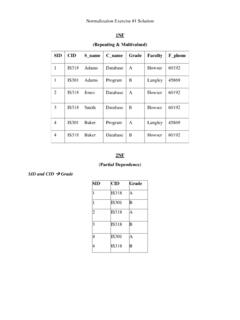
Normalization Exercise Solutions - UNCG
baelearn.uncg.eduNormalization Exercise #3 Solution 3NF (Transitive Dependency) These two tables stay the same. EID PID Btime 1 27 4.5 5 25 3 11 22 7 2 26 8 4 21 9 PID Pname 27 Alpha 25 Beta 22 Gamma 26 Pail 21 Hill However, there is a transitive dependency: DID ...

Semantic Image Synthesis With Spatially-Adaptive …
openaccess.thecvf.comproposed normalization leads to the first semantic image synthesis model that can produce photorealistic outputs for diverse scenes including indoor, outdoor, landscape, and street scenes. We further demonstrate its application for multi-modal synthesis and guided image synthesis.

Arbitrary Style Transfer in Real-Time With Adaptive ...
openaccess.thecvf.coma new interpretation that instance normalization performs style normalization by normalizing feature statistics, which have been found to carry the style information of an im-age [16, 30, 33]. Motivated by our interpretation, we in-troduce a simple extension to IN, namely adaptive instance normalization (AdaIN). Given a content input and a style
Color Transfer between Images - TAU
www.cs.tau.ac.ilpensate for different cluster sizes. We blend the scaled and shifted pixels with weights inversely proportional to these normalized distances, yielding the final color.