
Howden compressor technologies
b 1 The most skilled and experienced collection of compressor expertise ever created. Howden incorporates the originators of diaphragm, twin screw and Roots® technologies, and has introduced major improvements
Download Howden compressor technologies

Information
Domain:
Source:
Link to this page:
Documents from same domain

RootsTM Blowers, Compressors & Controls
www.howden.comUniversal RAI* Blower Heavy-duty, bi-lobe rotary blow-ers in a compact, sturdy design engineered for continuous use with exceptional reliability. • Cost effective design

Rotary Heater Technology - Howden
www.howden.com2 3 Air Preheaters Rotary regenerative air preheaters have a much reduced size and cost relative to recuperative tubular or plate heat exchangers.

Cooling Fan technology - Howden
www.howden.comMaximising efficiency, minimising noise Cooling Fan technology www.howden.com

ExVel Turbo Fans - Howden
www.howden.comWe understand the unique process, mechanical, and aerodynamic performance requirements of vapor compression applications, which differ from most any

TURBO BLOWERS & COMPRESSORS - howden.com
www.howden.comhowden turbo blowers & compressors 1 howden is one of the world’s leading engineering companies in the field of air and gas handling. founded in 1857 in glasgow by james howden and initially specialising
Related documents
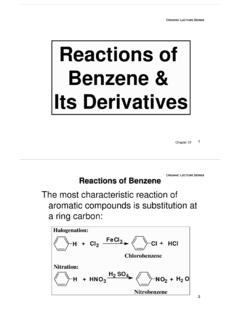
Reactions of Benzene & Its Derivatives
colapret.cm.utexas.edu• Friedel-Crafts alkylation forms a new C-C bond between an aromatic ring and an alkyl group Cl AlCl3 + HCl Benzene 2-Chloropropane (Isopropyl chloride) Cumene (Isopropylbenzene) + The electrophilic partner is a carbocation; it will arrange to the most stable ion: allylic>3o>2o>1o.

Organometallic Chemistry - uni-regensburg.de
www-oc.chemie.uni-regensburg.de• Alkylation or hydroxyalkylation (i.e., reaction with RCHO) of enolates derived from conjugate addition of organocuprates affords vicinal dialkylated products. • However, the reaction is confined to highly reactive alkylating agents such as methyl, allyl, propargyl, benzyl, and α-halocarbonyl compounds or aldehydes.
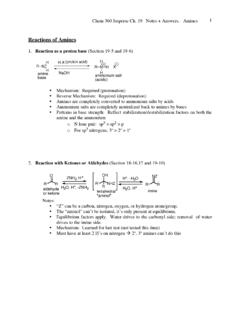
Reactions of Amines
web.mnstate.eduAlkylation of 1º Alkyl Halides (Section 19-12, 19-21A) R Br RN H H N H R H X ammonium salt R 3a. Polyalkylation is routine. o With excess alkyl halide and base, keep on alkylating until it becomes the quaternary ammonium saltE (no surviving H’s on nitrogen, examples below) . Mechanism required for polylalkylations. The mechanism involves ...
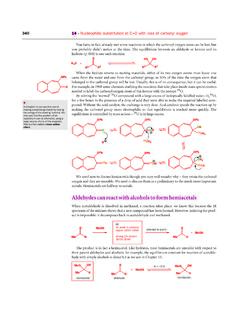
Aldehydes can react with alcohols to form hemiacetals
www.chtf.stuba.skalkylation Meerwein's salt trimethyloxonium tetrafluoroborate oxonium ion alkylation •Formation of acetals and hemiacetals Hemiacetal formation is catalysed by acid or base, but acetal formation is possible only with an acid catalyst because an OH group must be made into a good leaving group. R R O ROH R R HO OR ROH R R RO OR catalysed by ...
Ketones and Aldehydes - Rutgers University
crab.rutgers.eduThe dithiane anion can react as a nucleophile with primary alkyl halides, and this alkylation generates a thioacetal. The hydrolysis of a thioacetal generates an aldehyde. Alternatively, the thioacetal can be further deprotonated and reacted with another (different) alkyl halide to generate a new thioacetal with two alkyl substituents.

Protecting Groups (PG) - ETH Z
ethz.chSide reaction: S‐alkylation, oxidation, lactonization Thioether PG O H N O S O O HF Cleavage O O H N OH S O R Homoserine lactone 12. Fmoc‐Strategy SPPS Fmoc: αNH Boc: Lysine, Tryptophan, Histidine

Fundamentals of Protein Chemistry - Duke GCB
genome.duke.eduCysteine Alkylation- prevents reoxidation to form disulfides. Alkylating Agents: Iodoacetamide, Vinylpyridine. Chemical Methods for Protein Characterization: Proteolysis. Chemical Methods: Acid Hydrolysis, various [H+], time, temp. Cyanogen Bromide cleavage, C-term to Methionine gives a homoserine lactone at Met.

Myers Stereoselective, Directed Aldol Reaction Chem 115
hwpi.harvard.edualkylation Open coordination site required for pericyclic aldol rxn RCHO Syn-Selective Aldol Reactions of Imide-Derived Boron (Z)-Enolates • Chiral controller group biases enolate !-faces such that one of the two diastereomeric (syn) transition states is greatly favored.
5.1 Petroleum Refining - US EPA
www3.epa.govPolymerization and alkylation processes are used to combine small petroleum molecules into larger ones. Isomerization and reforming processes are applied to rearrange the structure of petroleum molecules to produce higher-value molecules of a similar molecular size. 5.1.1.3 Treating Processes -