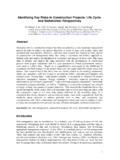
Identifying Key Risks in Construction Projects: Life Cycle ...
has been divided into risk classification, risk identification, risk analysis and risk response, where risk response has been further divided into four actions, i.e. retention, reduction, transfer and avoidance (Berkeley et al., 1991; Flanagan and Norman, 1993). An effective risk
Download Identifying Key Risks in Construction Projects: Life Cycle ...

Information
Domain:
Source:
Link to this page:
Documents from same domain

The Role of Corporate Real Estate in - PRRES
www.prres.net1.1 The role of corporate real estate in corporate companies Joroff et al. (1993) has termed CRE as the 'fifth resource' after the traditional resources of people, technology, information and capital.

Ninth Pacific-Rim Real Estate Society Conference, …
www.prres.netNinth Pacific-Rim Real Estate Society Conference, Brisbane, Australia 19-22 January 2003 The Impact Of Cellular Phone Base Station Towers On Property Values
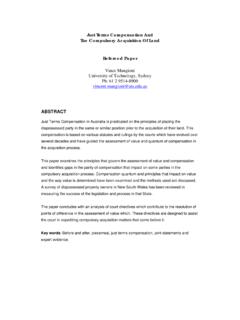
The Dichotomy Between Just Terms Compensation …
www.prres.netJust Terms Compensation And The Compulsory Acquisition Of Land Refereed Paper Vince Mangioni University of Technology, Sydney Ph: 61 2 9514-8900
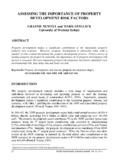
ASSESSING THE IMPORTANCE OF PROPERTY …
www.prres.net22 Pacific Rim Property Research Journal, Vol 12, No 1 ASSESSING THE IMPORTANCE OF PROPERTY DEVELOPMENT RISK FACTORS GRAEME NEWELL and MARK STEGLICK University of Western Sydney ABSTRACT Property development makes a significant contribution to the Australian property

A MODEL FOR VALUING SUBDIVISION …
www.prres.netDepartment of Finance Banking and Property A MODEL FOR VALUING SUBDIVISION DEVELOPMENT LAND Eleventh Annual Conference. …
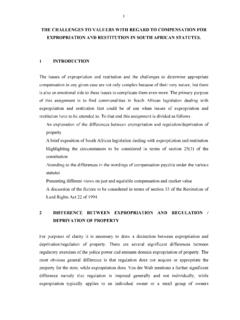
THE CHALLENGES TO VALUERS WITH REGARD TO …
www.prres.net1 THE CHALLENGES TO VALUERS WITH REGARD TO COMPENSATION FOR EXPROPRIATION AND RESTITUTION IN SOUTH AFRICAN STATUTES. 1 INTRODUCTION The issues of expropriation and restitution and the challenges to determine appropriate

THE VALUATION OF WAYLEAVES: TIME FOR …
www.prres.net2 The Valuation of Wayleaves: Time for Change? Introduction From time to time privately held land is required for public purposes. It has for long

Macro-economic Factors Affecting Office Rental …
www.prres.net1 Paper Presented at 2003 PRRES Conference, Brisbane, Australia Macro-economic Factors Affecting Office Rental Values in Southeast Asian Cities: The case of Singapore, Hong Kong, Taipei, Kuala Lumpur

BOARD SIZE, BOARD COMPOSITION AND PROPERTY …
www.prres.netBOARD SIZE, BOARD COMPOSITION AND PROPERTY FIRM PERFORMANCE By Dr. Roselina Shakir Department of Estate Management Faculty of Built Environment

Measuring the Added Value of Corporate Real Estate …
www.prres.net3 firm must develop strategies for the functional areas such as human resources, information technology, finance, and real estate that follow from and support the general business strategy.
Related documents

IS 15656 (2006): Hazard identification and risk analysis ...
law.resource.org3.1.3 Hazard Identification Hazard identification is done by’comparative and/or fimdamentalmethods leading to qualitative or quantitative results. 3.1.4 Quanttjication of Hazards The indices method for hazard identification can assess the hazard potential for the identified scenarios and can be used as a tool for screening.

Offender Classification and Assessment
samples.jblearning.comClassification and assessment are typically performed by correctional coun-selors who have three goals in mind: (1) the public’s need for protection and community safety; (2) the identification and matching of offender needs for treatment and management with correctional resources; and (3) the improve-

Stakeholder Identification and Management Tools Guidance ...
www.cips.orgStakeholder Identification and Management Tools Guidance Notes ... Stakeholders can be classified into three areas – internal, connected and external. This classification depends on their position in relation to the organisation or project. ... this can present risks for the project outcome. Potentially
Supervisory and Regulatory Issues that Merit Authorities ...
www.fsb.orgJun 27, 2017 · risks materialising, experience shows that they can emerge quickly if left unchecked. ... rapidly and enhance risk identification and assessment. Similar to the use of algorithms in other domains, such as securities trading, the complexity and opacity of some big data ... rather than the underlying technologies and the regulatory classification ...
PROBLEM iDENTiFiCATiON, NURSiNG DiAGNOSES, AND …
www.nursingworld.orgPROBLEM iDENTiFiCATiON, NURSiNG DiAGNOSES, AND PLANNiNG ACROSS THE LiFE SPAN. 103. TRAUMA-iNFORMED CARE. Trauma is an overwhelming event that affects feelings of safety, creates a sense of helplessness, and continues to affect ones perception of reality. The World Health Organization (2014) notes

Handbook on the Classification of Prisoners
www.unodc.org“Classification” refers to the placement or allocation of prisoners to one of several custody or supervision levels in order to match the prisoners’ individual risks and needs to correctional resources and the appropriate supervision regime. A well-designed and managed classification process is a cornerstone of an effective prison