II. Synchronous Generators
Synchronous generators. are built in large units, their rating ranging from tens to hundreds of megawatts. Synchronous generator . converts mechanical power to ac electric power. The source of mechanical power, the prime mover, may be a diesel engine, a steam turbine, a water turbine, or any similar device.
Download II. Synchronous Generators

Information
Domain:
Source:
Link to this page:
Documents from same domain
II. Synchronous Generators
www.uotechnology.edu.iqVentilation or Cooling of an Alternator • The slow speed salient pole alternators are ventilated by the fan action of the salient poles which provide circulating air.

Information Systems Analysis and Design
www.uotechnology.edu.iqSystems analysis: The process of understanding and specifying in detail what the information system should do, or is the process of investigation of a system’s operation with a view to changing it to new requirements or improving its current

ELECTRICAL MACHINES II - uotechnology.edu.iq
www.uotechnology.edu.iqTheory of AC Machinery ... • Generators convert mechanical energy to electric energy. Energy Conversion • Motors convert electric energy to mechanical energy. • The construction of motors and generators are similar. • Every generator can operate as a motor and vice versa.

ELECTRICAL MACHINES - uotechnology.edu.iq
www.uotechnology.edu.iqmcpherson” an introduction to electrical machines and transformers” wiley, ny 1981. 11. s. a. nasar “ electric machines and electromechanics” mcgraw‐hill(schaum), ny 1981. ... langsdorf “ theory of alternating current machinery “ 2nd ed. mcgraw‐

CHAPTER TWO: Boiler Operation Maintenance & Safety Study …
www.uotechnology.edu.iqSafety Study Guide 2.1 Boiler Design and Construction Boiler: A boiler is a closed vessel in which water is heated, steam is generated, superheated or any combination thereof under pressure or vacuum by the direct application of heat from combustible fuels or electricity. The steam produced is used for:

Chapter 10 Heat Exchangers
www.uotechnology.edu.iqChapter 10 Heat Exchangers: A heat exchanger is a component that allows the transfer of heat from one fluid (liquid or gas) to another fluid. Reasons for heat transfer include ... Figures 10-12 to 10-17. Examples 10-9 to 10-14 illustrate the use of the effectiveness-NTU method in heat-exchanger analysis.

Information Systems: Definitions and Components
www.uotechnology.edu.iqcomponents that collect (or retrieve), process, store, and distribute information ... In most cases an information system also includes people. The basic components of information systems are listed below. Note that not every system includes all these components. ... data, the human voice and other sounds, are also important forms of data. Data ...
JUST IN TIME (JIT), LEAN, AND TOYOTA PRODUCTION …
www.uotechnology.edu.iqThe Toyota Production System (TPS) is an integrated socio-technical system, developed by Toyota that comprises its management philosophy and practices. The TPS organizes manufacturing and logistics for the automobile manufacturer, including interaction with suppliers and customers. The system is developed between 1984 and 1975. 13 Principles of ...
ELECTRICAL MACHINES II - الجامعة التكنولوجية
www.uotechnology.edu.iqIntroduction to AC Machines Dr. Suad Ibrahim Shahl 6 In AC armature windings, the separate coils may be connected in several different manners, but the two most common methods are lap and wave In polyphase windings it is essential that
10. Starting Method for Induction Motors
www.uotechnology.edu.iq10. Starting Method for Induction Motors A 3-phase induction motor is theoretically self starting. The stator of an induction motor consists of 3-phase windings, which when connected to a 3-phase supply creates a rotating magnetic field. This will link and cut the rotor conductors which in turn will induce a current in the rotor conductors and
Related documents
EE 340 Spring 2011 - UNLV
www.egr.unlv.edu• Steam turbines are most efficient when rotating at high speed; therefore, to generate 60 Hz, they are usually rotating at 3600 rpm (2-pole). • Water turbines are most efficient when rotating at low speeds (200-300 rpm); therefore, they usually turn generators with many poles. e n m p f 120
Nuclear Reactor Types - Stanford University
large.stanford.eduthrough the channels where it is allowed to boil, to steam drums, thence driving electrical turbo-generators. Many of the major components, including pumps and steam drums, are located within a concrete shield to protect operators against the radioactivity of the steam. Nuclear Reactor Types 5
MODELS 4.5KW 6KW 9KW 12KW 15KW QUICK A ... - Steam …
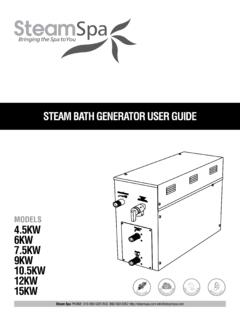
steamspa.com7. Install an exhaust fan outside of the steam room for the excess steam to be expelled from the shower room. 8. The steam generator has a hanging groove for wall installations.. 9. Both sides and the top of the steam generator need to reserve at least 12 inches space. 10.
Specification 36. Heating, hot and cold water, steam and ...
assets.publishing.service.gov.uk2.2 Steam Boilers 2.2.1 Water Tube Boilers 2.2.2 Steel Shell, 3-pass Economic Boilers 2.2.3 Steel Shell Reverse-flame Boilers 2.2.4 Continuous-coil Steam Generators 2.2.5 Electrode Boilers 2.2.6 Waste Heat Boilers 2.2.7 Electrical Resistance Heated Boilers 2.3 Hot Water Boilers 2.3.1 Water Tube Boilers Page iii viii ix X xi xii 1 1 2 2 2 2 3 3 ...

UNIT-III STEAM TURBINES - Government College Of ...
gcoeara.ac.inIn steam turbines, the overall transformation of heat energy of steam into mechanical work takes place in two stages:- ... adopted for all major world power stations, and the size of generators had increased from his first 7.5 kW set up to units of 500MW capacity. 11 12 11

Clean Steam Systems in the Pharmaceutical Industry
pdhonline.comGeneration of clean steam relies on the evaporation of good quality feedwater. Contaminants remain in the concentrated feedwater within the generator, and are periodically removed by “blowdown”. Clean steam generators are designed to prevent droplets (which may contain contaminants) being carried forward with the clean steam. Fig. 1 shows an

Combined Heat and Power Technology Fact Sheet Series
www.energy.govengines or steam turbines. Sorption chillers, which are avail-able as either absorption or adsorption designs. 1, are driven with thermal energy produced from a direct fired burner integrated with the chiller, or with thermal energy supplied indirectly to the chiller. Indirect thermal sources include hot water, steam, or combustion exhaust.
Maintenance and Overhaul of Steam Turbines WGP42 05
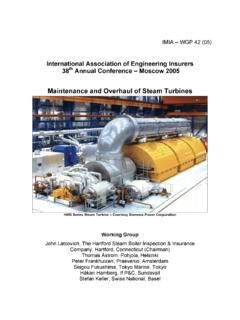
www.steamforum.comSteam turbines provide a means of converting saturated, superheated, or supercritical steam from boilers or heat recovery steam generators (HRSG) into rotational torque and power. Consequently steam turbines are utilized to drive a variety of equipment types of numerous