
IMAGE GUIDED RADIATION THERAPY CODING AND …
IGRT allows radiation oncologists to ensure that the target volume is treated with the planned dose of radiation. Whenever a target volume is located near or within critical structures and/or to further the therapeutic ratio. Such situations include where: target volume is in close proximity to a critical organ at risk.
Download IMAGE GUIDED RADIATION THERAPY CODING AND …

Information
Domain:
Source:
Link to this page:
Documents from same domain

Difficult Base of Tongue Cancer Contouring: MD Anderson ...
www.astro.orgDifficult Base of Tongue Cancer Contouring: MD Anderson Cancer Center Nikhil G. Thaker, MD Waqar Haque, MD Adam S. Garden, MD Head and Neck Radiation Oncology 2014

Palliative Radiotherapy for Bone Metastases: An ASTRO ...
www.astro.orgOncology, Boston Medical Center, Boston, Massachusetts; §§ Department of Radiation Oncology, Ohio State University, Columbus, Ohio; ║║ Department of Radiation Oncology, Sunnybrook Odette Cancer Center and the Princess Margaret Hospital, University of …

Safety is No Accident - American Society for Radiation ...
www.astro.orgDaily Morning Huddles 18 3.4.11. Safety Rounds 18 3.4.12. Routine Public Announcements and Updates 18 3.4.13. Incident Learning 18 3.4.14. Quality Assurance Committee 18 3.4.15. Credentialing and Training of Staff 19 3.5. INGRAINING …

ASTRO Guidance on Supervision of Radiation Therapy ...
www.astro.orgThe Role of Advanced Practice Providers Advanced practice providers (nurse practitioners and physicians assistants) and other non- ... Requirements of general supervision must be met to support billing of outpatient therapeutic services. Effective January 1, 2020, under the new general supervision ...

RADIATION ONCOLOGY CPT® and HCPCS CODES BY …
www.astro.orgSystem (HCPCS) G-codes to report CPT codes that were deleted in 2015. The agency will continue requiring the use of G-codes under the Medicare Physician Fee Schedule (MPFS) in 2016 to ... the code definitions, work relative value units and direct inputs for the practice expense relative value units for G6001-G6015 will remain at the levels ...

2018 Update on Radiation Treatment for Head/Neck Cancer
www.astro.orghead/neck cancer cases (oral cavity, oropharynx, larynx, hypopharynx, nasopharynx, major salivary glands) including the roles of surgery, radiation therapy and use of systemic agents 2. Become familiar with the new AJCC staging system for HPV-associated oropharynx cancers 3. Improve technical competence in planning head/neck IMRT cases 4.

Medicare’s Physician Supervision Requirements
www.astro.orgphysician practitioner must be prepared to step in and perform the service, not just respond to an emergency. The supervising physician does not necessarily need to be of the same specialty as the procedure or service that is being performed or …
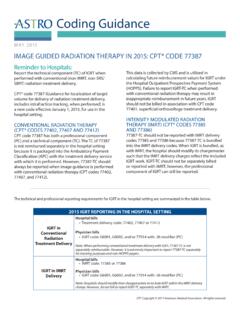
Coding Guidance - American Society for Radiation Oncology
www.astro.orgSBRT) radiation treatment delivery. CPT® code 77387 (Guidance for localization of target volume for delivery of radiation treatment delivery, includes intrafraction tracking, when performed) is a new code effective January 1, 2015, for use in the hospital setting. CONVENTIONAL RADIATION THERAPY (CPT® CODES 77402, 77407 AND 77412)
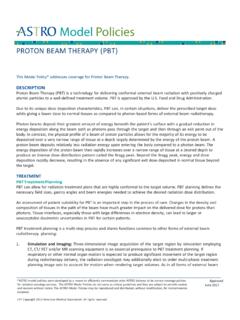
Model Policies - American Society for Radiation Oncology
www.astro.orgThis Model Policy* addresses coverage for Proton Beam Therapy. DESCRIPTION Proton Beam Therapy (PBT) is a technology for delivering conformal external beam radiation with positively charged atomic particles to a well-defined treatment volume. PBT is approved by the U.S. Food and Drug Administration.

SBRT for Prostate Cancer - American Society for Radiation ...
www.astro.org– 7-year biochemical relapse free survival (bRFS) was 93.7%, late >=3 GU and GI toxicity rates were 2% and 1.1% ... IJROBP 2019 • King et al – pooled analysis of prospective trials from 8 institutions with a total of 1100 patients – 5-year bRFS was 93% – No difference in outcome with ADT use ... simulation one week after the fiducial ...
Related documents

HIGHLIGHTS OF PRESCRIBING INFORMATION ERBITUXsafely …
pi.lilly.com• Initial dose:400mg/m2 administered as a 120-minute intravenous infusionone week prior to initiating a course of radiation therapy. (2.1) • Subsequent doses: 250 mg/m2 administered as a 60-minute infusion every week for the duration of radiation therapy (6–7 weeks).(2.1) • Complete ERBITUX administration 1 hour prior to radiation ...

Radiation Shielding By Dr. Ronald Turner
three.jsc.nasa.govAug 11, 2009 · 1972 SPE for a variety of shielding materials. Source: Radiation Risk Assessments for Lunar Missions-Shielding Evaluation Criteria, Francis A. Cucinotta, presented to the NAS Lunar Shielding Study Panel December 12, 2006 . Lunar Surface BFO Radiation Dose (cGy) 0.1 1.0 10.0 100.0 1000.0 FEB 56 NOV 60 AUG 72 AUG 89 SEP 89 OCT 89 CentiGray …

US Department of Energy, Dose Ranges Rem Chart.
www.nrc.govradiation protection units, the rem and Sievert. Medical diagnostics are expressed as estimated maximum organ dose; as they are not in “effective dose” they do not imply an estimation of risk (no tissue weighting). Dose limits are in effective dose, but …

Radiation Therapy for Prostate Cancer: A Patient Guide
urology.ucsf.eduRadiation therapy uses ionizing radiation in the form of photons or protons to kill cancer cells by damaging their DNA. Cancer cells with damaged DNA cannot divide or multiply and will eventually die. The overarching goal of radiation therapy is to deliver a therapeutic dose of ionizing radiation to the tumor

The DOE Ionizing Radiation Dose Ranges Chart
www.energy.govhigh doses of ionizing radiation, given at a fast rate (seconds to minutes) causes damage to living tissue that may not be repaired. Depending on the total dose, high dose rate exposure can result in higher risk of cancer over a lifetime, radiation sickness, or even death. Humans differ by age, gender, genetic predisposition, state of health ...
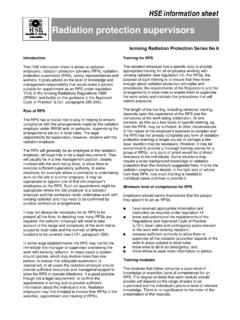
Radiation protection supervisors - HSE
www.hse.gov.ukradiation so far as reasonably practicable; and the concepts of internal and external radiation exposure. 2 The quantities used for: measuring ionising radiation, including the units of measurement; activity of radioactive substances; and contamination; as appropriate to the circumstances. NB A detailed understanding of all dose quantities may

NURSING PROCEDURES FOR RADIATION THERAPY PATIENTS
uams.edudose radiation primarily to treat malignant conditions. Diagnostic radionuclides and radiation-producing devises (x-ray machines) are mainly used to investigate and diagnose potential health issues. Despite the benefits that radiation provides to health care, radiation exposure may pose some health risk to both patient and worker. An
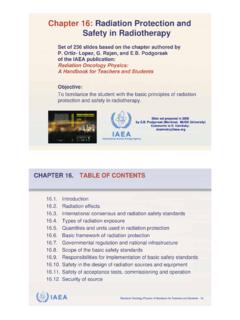
Chapter 16: Radiation Protection and Safety in Radiotherapy
international.anl.govIAEA Radiation Oncology Physics: A Handbook for Teachers and Students - 16.5.2 Slide 2 16.5 QUANTITIES AND UNITS IN RADIATION PROTECTION 16.5.2. Radiation protection quantities (Organ dose) Organ dose DT is defined as the mean dose in a specified tissue or organ T of the human body, given by: • mT is the mass of the organ or tissue under ...

Introduction to Radiation
nuclearsafety.gc.caRadiation is energy in the form of waves of particles. There are two forms of radiation – non-ionizing and ionizing – which will be discussed in sections 3.1 and 3.2, respectively. 3.1 Non-ionizing radiation . Non-ionizing radiation has less energy than ionizing radiation; it does not possess enough energy to . )

Generic Ionising Radiation Risk Statements v4
www.hra-decisiontools.org.ukroutine clinical care, and where the total radiological risk is less than 0.01% Dose and risk assessment in the IRAS form (Part B Section 3 Question C1) This study requires exposures to ionising radiation which are detailed in A1 and B1. Some/all of the exposures required by the study are additional to routine clinical care.