Image Restoration Using Very Deep Convolutional Encoder ...
The proposed framework mainly contains a chain of convolutional layers and symmetric decon-volutional layers, as shown in Figure 1. We term our method “RED-Net”—very deep Residual Encoder-Decoder Networks. 2.1 Architecture The framework is fully convolutional and deconvolutional. Rectification layers are added after each
Download Image Restoration Using Very Deep Convolutional Encoder ...

Information
Domain:
Source:
Link to this page:
Documents from same domain
Generative Adversarial Imitation Learning
proceedings.neurips.ccnetworks [8], a technique from the deep learning community that has led to recent successes in modeling distributions of natural images: our algorithm harnesses generative adversarial training to fit distributions of states and actions defining expert behavior. We test our algorithm in Section 6, where
Prototypical Networks for Few-shot Learning
proceedings.neurips.cc˚: RD!RMwith learnable parameters ˚. Each prototype is the mean vector of the embedded support points belonging to its class: c k= 1 jS kj X (x i;y i)2S k f ˚(x i) (1) Given a distance function d: R M R 
Inductive Representation Learning on Large Graphs
proceedings.neurips.ccnode classification, clustering, and link prediction [11, 28, 35]. ... (e.g., citation data with text attributes, biological data with functional/molecular markers), our approach can also make use of structural features that are present in all graphs (e.g., node degrees). ... through theoretical analysis, that GraphSAGE is capable of learning ...
Bootstrap Your Own Latent A New Approach to Self ...
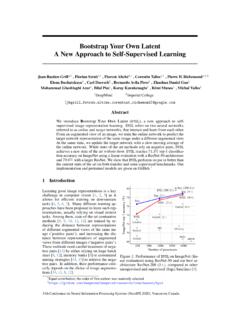
proceedings.neurips.ccmining strategies [14, 15] to retrieve the nega-tive pairs. In addition, their performance criti-cally depends on the choice of image augmenta- ... to prevent collapsing while preserving high performance. To prevent collapse, a straightforward solution …
Spatial Transformer Networks - NeurIPS
proceedings.neurips.ccConvolutional Neural Networks define an exceptionally powerful class of models, ... localisation, semantic segmentation, and action recognition tasks, amongst others. ... can take any form, such as a fully-connected network or a convolutional network, but should include a final regression layer to produce the transformation ...
Semi-supervised Learning with Deep Generative Models
proceedings.neurips.ccapproximately invariant to local perturbations along the manifold. The idea of manifold learning ... We show for the first time how variational inference can be brought to bear upon the prob- ... probabilities are formed by a non-linear transformation, with parameters , of a set of latent vari-ables z. This non-linear transformation is ...
Unsupervised Learning of Visual Features by Contrasting ...
proceedings.neurips.ccpseudo-labels to learn visual representations. This method scales to large uncurated dataset and can be used for pre-training of supervised networks [7]. However, their formulation is not principled and recently, Asano et al. [2] show how to cast the pseudo-label assignment problem as an instance of the optimal transport problem.
PyTorch: An Imperative Style, High-Performance Deep ...
proceedings.neurips.ccFacebook AI Research benoitsteiner@fb.com Lu Fang Facebook lufang@fb.com Junjie Bai Facebook jbai@fb.com Soumith Chintala Facebook AI Research soumith@gmail.com Abstract Deep learning frameworks have often focused on either usability or speed, but not both. PyTorch is a machine learning library that shows that these two goals
Visualizing the Loss Landscape of Neural Nets
proceedings.neurips.cctask that is hard in theory, but sometimes easy in practice. Despite the NP-hardness of training general neural loss functions [3], simple gradient methods often find global minimizers (parameter configurations with zero or near-zero training loss), even when data and labels are randomized before training [43].
InfoGAN: Interpretable Representation Learning by ...
proceedings.neurips.ccof the digit (0-9), and chose to have two additional continuous variables that represent the digit’s angle and thickness of the digit’s stroke. It would be useful if we could recover these concepts without any supervision, by simply specifying that an MNIST digit is generated by an 1-of-10 variable and two continuous variables.
Related documents
![arXiv:1706.02216v4 [cs.SI] 10 Sep 2018](/cache/preview/9/a/6/8/0/7/1/d/thumb-9a68071d73afd8997ff3a74956baa9eb.jpg)
arXiv:1706.02216v4 [cs.SI] 10 Sep 2018
arxiv.orgGraph convolutional networks. In recent years, several convolutional neural network architectures for learning over graphs have been proposed (e.g., [4, 9, 8, 17, 24]). The majority of these methods do not scale to large graphs or are designed for whole-graph classification (or both) [4, 9, 8, 24].
Abstract - arXiv
arxiv.orgConvolutional LSTM Network: A Machine Learning ... According to the philosophy underlying the deep learning approach, if we have a reasonable end-to-end model and sufficient data for training it, we are close to solving the ... The pioneering LSTM encoder-decoder framework proposed in [23] provides a

Image Colorization with Deep Convolutional Neural …
cs231n.stanford.eduImage Colorization with Deep Convolutional Neural Networks Jeff Hwang jhwang89@stanford.edu You Zhou youzhou@stanford.edu Abstract We present a convolutional-neural-network-based sys-tem that faithfully colorizes black and white photographic images without direct human assistance. We explore var-ious network architectures, objectives, color ...
Convolutional Neural Networks
proceedings.mlr.pressConvolutional Neural Networks Lingxiao Yang 1 2 3Ru-Yuan Zhang4 5 Lida Li6 Xiaohua Xie Abstract ... s are based on a hand-crafted encoder-decoder structure. Compared to that study, our work provides an alternative ... Network Architectures. In 2012, a modern deep ConvNet, AlexNet (Krizhevsky et al.,2012), was released for large-scale image ...

Stacked Convolutional Auto-Encoders for Hierarchical ...
people.idsia.chDeep architectures can be trained in an unsupervised layer-wise fashion, and later fine-tuned by back-propagationto be-come classifiers [9]. Unsupervised initializations tend to avoid local minima and increase the network’s performance stability [6]. Most methods are based on the encoder-decoder paradigm, e.g., [20]. The in-

Deep Convolutional Dictionary Learning for Image Denoising
openaccess.thecvf.comDeep Convolutional Dictionary Learning for Image Denoising Hongyi Zhenga,b,* Hongwei Yonga,b,* Lei Zhanga,b,† aThe Hong Kong Polytechnic University bDAMO Academy, Alibaba Group {cshzheng,cshyong,cslzhang}@comp.polyu.edu.hk Abstract Inspired by the great success of deep neural net-

Long-Term Recurrent Convolutional Networks for Visual ...
openaccess.thecvf.comdeep”, are effective for tasks involving sequences, visual and otherwise. We develop a novel recurrent convolutional architecture suitable for large-scale visual learning which is end-to-end trainable, and demonstrate the value of these models on benchmark video recognition tasks, image de-scription and retrieval problems, and video narration ...

Convolutional LSTM Network: A Machine Learning Approach ...
papers.nips.ccConvolutional LSTM Network: A Machine Learning ... According to the philosophy underlying the deep learning approach, if we have a reasonable end-to-end model and sufficient data for training it, we are close to solving the ... The pioneering LSTM encoder-decoder framework proposed in [23] provides a
Graph Convolutional Matrix Completion
www.kdd.orgThe decoder model is a pairwise decoder Aˇ = д(Z), which takes pairs of node embeddings (zi,zj)and predicts entries Aˇ ... Graph Convolutional Matrix Completion KDD’18 Deep Learning Day, August 2018, London, UK.