Increasing Heat Exchanger Performance
INTRODUCTION Increasing heat exchanger performance usually means transferring more duty or operating the exchanger at a closer temperature approach. This can be accomplished without a dramatic increase in surface area. This constraint directly translates to increasing the overall heat transfer coefficient, U. The overall heat transfer
Download Increasing Heat Exchanger Performance

Information
Domain:
Source:
Link to this page:
Documents from same domain
A Comparison of Physical Solvents for Acid Gas Removal …
www.bre.com1 A COMPARISON OF PHYSICAL SOLVENTS FOR ACID GAS REMOVAL INTRODUCTION Physical solvents such as DEPG (Selexol™ or Coastal AGR®), NMP or N-Methyl-2- Pyrrolidone (Purisol®), Methanol (Rectisol®), Propylene Carbonate (Fluor Solvent™), and others are becoming increasingly popular as gas treating solvents, especially for coal gasification …

The Use of MDEA and Mixtures of Amines for Bulk CO2 …
www.bre.comThe use of MDEA and mixtures of amines for bulk CO2 removal was explored using three case studies. A process simulation program called TSWEET was used to study the effect of the amine used and the major operating parameters on the performance of MDEA solutions for bulk CO2 removal. The results showed that MDEA can be used

Analysis of Amine Solutions by Gas Chromatography
www.bre.comSupelco catalytically removed small amounts of oxygen and water. Due to the high injection port temperatures necessary to vaporize the amine, the injection septa sealed poorly. The poor septum seal resulted in imaginary peaks (due to leaking of helium out of …

Sour Water: Where it comes from and how to handle it
www.bre.comonly the GPA sponsored GPSWAT model, but also other electrolytic models found in today’s commercial simulation products such as ProMax. Table 5 : Summary of GPA Sponsored Research for Sour Water Systems Report Systems Studied Year RR -41 H2S-H2O, N 2-H2O, CO -H2O, H 2-H2O 1980 [12] RR -48 H2S-H2O, CO 2-H2O, C1 -H2O 1982 [13]

How to Estimate Reid Vapor Pressure (RVP) of Blends
www.bre.comL and feed liquid F so that L/F = 0.97. Step 4. Using the values from step 3, calculate a new L/F with the equation Step 5. Use the value of L/F from step 4 to recalculate the flash from step 3 and a new value of L/F from step 4. In most cases, the assumed and calculated values agree within the specified criterion within less than five ...
Solubility of Hydrocarbons in Physical Solvents - BR&E
www.bre.comsolubility data very closely and the be used to investigate factors affecting hydrocarbon solubility in physical solvents. Ethylene Glycol GPA RR-117 [7], RR-149 [8], RR-137 [9] contain equilibrium data for solubility of methane, propane, n-heptane, ABSTRACT This paper compares the solubility of hydrocarbons in several physical solvents such
Related documents
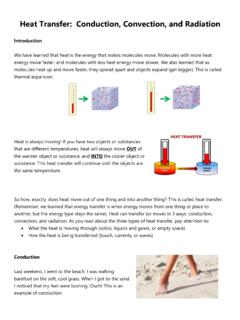
Heat Transfer: Conduction, Convection, and Radiation
alkisites.vansd.orgHeat Transfer: Conduction, Convection, and Radiation Introduction We have learned that heat is the energy that makes molecules move. Molecules with more heat energy move faster, and molecules with less heat energy move slower. We also learned that as molecules heat up and move faster, they spread apart and objects expand (get bigger). This is ...

EXPERIMENT: CALORIMETRY AND HEAT OF …
faculty.cbu.caINTRODUCTION Heat is defined as the transfer of energy from or into a system because of a temperature difference between the system and its surroundings. Heat is often considered, inaccurately, as a form of energy existing as the result of the random motion of molecules.
THERMODYNAMICS: COURSE INTRODUCTION
web.mit.eduI. Changing the State of a System : Heat (VW, S & B: 4.7-4.9) A. Heat is energy transferred between a system and its surroundings by virtue of a temperature difference only. 1. This transfer of energy can change the state of the system. 2. “Adiabatic” means no heat is transferred. B. Zeroth Law of Thermodynamics (VW, S & B: 2.9-2.10) 1.

Heat Transfer Module - COMSOL Multiphysics
doc.comsol.comThe Heat Transfer in Solids and Fluids Interface 331 Feature Nodes for the Heat Transfer in Solids and Fluids Interface . . . 331 The Heat Transfer in Porous Media Interface 332 Feature Nodes for the Heat Transfer in Porous Media Interface . . . . 334 The Heat Transfer in Building Materials Interface 338

Energy Transfer and Conversion Methods
ocw.mit.eduHeat Transfer • For heat to be transferred at an appreciable rate, a temperature difference ( T) is required. – Q = U A T – The non-zero T guarantees irreversibility – As T does to zero, area and cost goes to infinity 22 ... Introduction to Sustainable Energy Fall 2010 .

THERMODYNAMICS, HEAT TRANSFER, AND FLUID FLOW, …
sites.ntc.doe.govIntroduction Fluid flow is an important part of most industrial processes; especially those involving the transfer of heat. Frequently, when it is desired to remove heat from the point at which it is generated, some type of fluid is involved in …
Introduction to Pinch Technology-LinhoffMarch
www.ou.eduintroduction to pinch technology 3 figure 14: targeting for retrofit applications ... figure 55: isothermal mixing avoids cross-pinch heat transfer so do not mix at different temperatures. ...