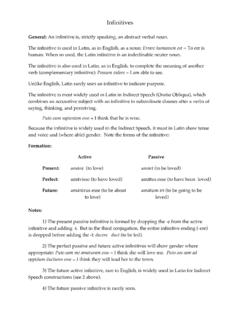
Infinitives
Infinitives General: An infinitive is, strictly speaking, an abstract verbal noun. The infinitive is used in Latin, as in English, as a noun: Errare humanum est = To err is human. When so used, the Latin infinitive is an indeclinable neuter noun.
Download Infinitives

Information
Domain:
Source:
Link to this page:
Documents from same domain
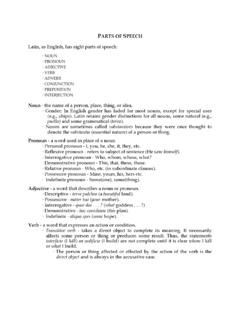
Parts of Speech - The Latin Library
www.thelatinlibrary.comPARTS OF SPEECH Latin, as English, has eight parts of speech: · NOUN · PRONOUN · ADJECTIVE · VERB · ADVERB · CONJUNCTION · PREPOSITION · INTERJECTION Noun - the name of a person, place, thing, or idea.
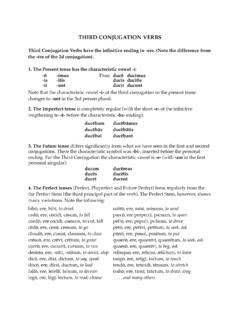
Third Conjugation Verbs - The Latin Library
www.thelatinlibrary.comTHIRD CONJUGATION VERBS Third Conjugation Verbs have the infinitive ending in -ere. (Note the difference from the -ēre of the 2d conjugation).
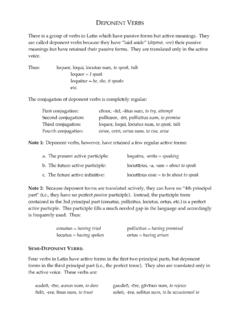
DEPONENT VERBS - The Latin Library
www.thelatinlibrary.comDEPONENT VERBS There is a group of verbs in Latin which have passive forms but active meanings. They are called deponent verbs because they have “laid aside” (dëpönö, -ere) their passive
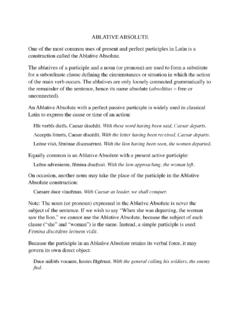
ABLATIVE ABSOLUTE
www.thelatinlibrary.comABLATIVE ABSOLUTE One of the most common uses of present and perfect participles in Latin is a construction called the Ablative Absolute. The ablatives of a participle and a noun (or pronoun) are used to form a substitute
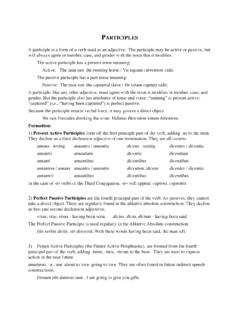
PARTICIPLES - The Latin Library
www.thelatinlibrary.comPARTICIPLES A participle is a form of a verb used as an adjective. The participle may be active or passive, but will always agree in number, case, and gender with the noun that it …
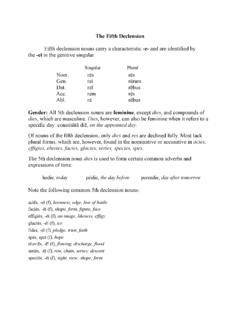
The Fifth Declension
www.thelatinlibrary.comThe Fifth Declension Fifth declension nouns carry a characteristic -e- and are identified by the -eī in the genitive singular. Singular Plural Nom. rēs rēs ...
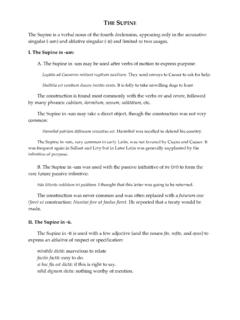
T SUPINE - The Latin Library
www.thelatinlibrary.comTHE SUPINE The Supine is a verbal noun of the fourth declension, appearing only in the accusative singular (-um) and ablative singular (-ü) and limited to two usages.
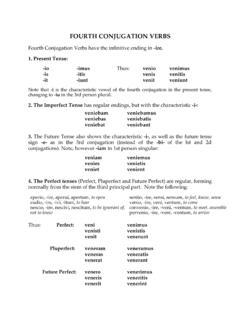
FOURTH CONJUGATION VERBS - The Latin Library
www.thelatinlibrary.comFOURTH CONJUGATION VERBS Fourth Conjugation Verbs have the infinitive ending in -ire. 1. Present Tense:-io-is-it-imus-itis-iunt Thus: venio venis venit venimus
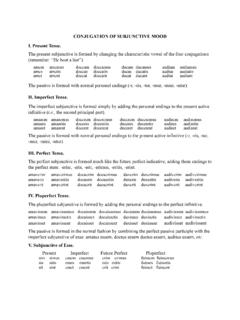
CONJUGATION OF SUBJUNCTIVE MOOD I. Present …
www.thelatinlibrary.comCONJUGATION OF SUBJUNCTIVE MOOD I. Present Tense. The present subjunctive is formed by changing the characteristic vowel of the four conjugations
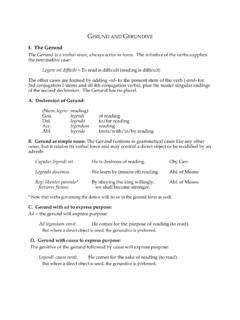
I. The Gerund - The Latin Library
www.thelatinlibrary.comGERUND AND GERUNDIVE I. The Gerund The Gerund is a verbal noun, always active in force. The infintive of the verbs supplies the nominative case: Legere est difficile = To read is difficult (reading is difficult)
Related documents
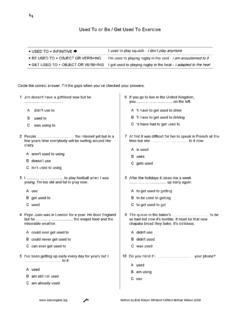
Used To or To Be Used To Exercise at Auto-English
www.autoenglish.orgwww.autoenglish.org Written by Bob Wilson ©Robert Clifford McNair Wilson 2008 Used To or Be / Get Used To Exercise Š USED TO + INFINITIVE ˘

Gerund or Infinitive Fill in the correct form.
www.english-grammar.atGERUND - INFINITIVE GI 2 Gerund or Infinitive – Fill in the correct form. 1. Mary enjoys listening to music. 2. I don’t mind doing the washing up. 3. Irregular verbs are not easy to remember. 4. Mathew is really good at cooking. 5.

T he I nfi ni tive
www.chompchomp.comT he I nfi ni tive Recognize an infinitive when you see one. To sneeze, to smash, to cry, to shriek, to jump, to dunk, to read, to eat, to slurp— all of these are infinitives. An infinitive will almost always begin with to followed by the simple form of the verb, like this:
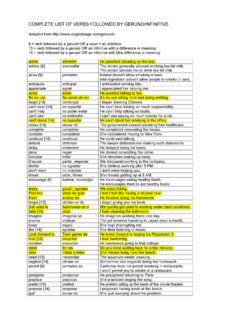
COMPLETE LIST OF VERBS FOLLOWED BY …
blocs.xtec.catShe needs me to send the letter quickly. neglect [14] desentendre’s She neglected to tell me the date of the meeting. Offer oferir-se per Frank offered to drive us to the supermarket.

Conjugation of Verbs - The Latin Library
www.thelatinlibrary.comConjugation of Verbs The inflection of a verb is called a Conjugation. Most verb inflections in English have disappeared, although we still distinguish between I go, he goes, etc. Latin, however, retains full inflections for most verbs, the forms of which must be mastered in order to
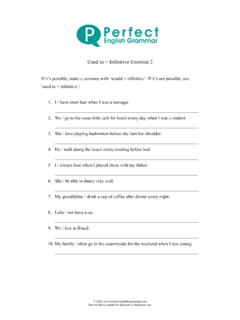
Used to exercise 2 - Perfect English Grammar
www.perfect-english-grammar.com© 2012 www.perfect-english-grammar.com May be freely copied for personal or classroom use. Used to + Infinitive Exercise 2 If it’s possible, make a sentence with ...

PAST SIMPLE/USED TO/WOULD - Blog de Cristina
www.cristinacabal.comOn winter days, we used to / would sit around the fire and tell stories When I was a child, my sister used to /would take me to the cinema every Sunday. • Used to≠ Would 1. When we refer to a past state, we can only use "used to" I used to have /would have a Toyota Celica Mary used to be/would be a teacher but she's now retired
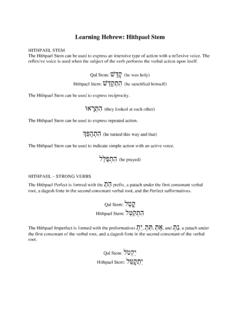
Learning Hebrew: Hithpael Stem - Becoming Jewish
www.becomingjewish.orgThe Hithpael Imperative, Infinitive Construct, and Infinitive Absolute are formed with a ְתִה prefix, a patach under the first consonant of the verbal root, and a dagesh forte in the second
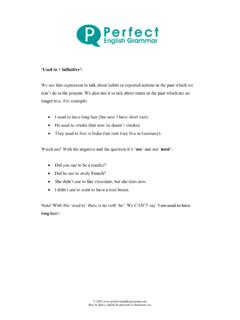
‘Used to + infinitive’ - Perfect English Grammar
www.perfect-english-grammar.com© 2012 www.perfect-english-grammar.com May be freely copied for personal or classroom use. ‘Would + infinitive’ We can also use ‘would + infinitive’ to talk ...