
INSTRUMENTAL ANALYSIS (I)
property (e.g. spectroscopy, electrode potential) Quantitative - measuring property and determining relationship to concentration (e.g. spectrophotometry, mass spectrometry) Often, same instrumental method used for qualitative and quantitative analysis . Types of Instrumental Methods . Property
Download INSTRUMENTAL ANALYSIS (I)

Information
Domain:
Source:
Link to this page:
Documents from same domain
II. Synchronous Generators
www.uotechnology.edu.iqVentilation or Cooling of an Alternator • The slow speed salient pole alternators are ventilated by the fan action of the salient poles which provide circulating air.

Information Systems Analysis and Design
www.uotechnology.edu.iqSystems analysis: The process of understanding and specifying in detail what the information system should do, or is the process of investigation of a system’s operation with a view to changing it to new requirements or improving its current

ELECTRICAL MACHINES II - uotechnology.edu.iq
www.uotechnology.edu.iqTheory of AC Machinery ... • Generators convert mechanical energy to electric energy. Energy Conversion • Motors convert electric energy to mechanical energy. • The construction of motors and generators are similar. • Every generator can operate as a motor and vice versa.

ELECTRICAL MACHINES - uotechnology.edu.iq
www.uotechnology.edu.iqmcpherson” an introduction to electrical machines and transformers” wiley, ny 1981. 11. s. a. nasar “ electric machines and electromechanics” mcgraw‐hill(schaum), ny 1981. ... langsdorf “ theory of alternating current machinery “ 2nd ed. mcgraw‐

CHAPTER TWO: Boiler Operation Maintenance & Safety Study …
www.uotechnology.edu.iqSafety Study Guide 2.1 Boiler Design and Construction Boiler: A boiler is a closed vessel in which water is heated, steam is generated, superheated or any combination thereof under pressure or vacuum by the direct application of heat from combustible fuels or electricity. The steam produced is used for:

Chapter 10 Heat Exchangers
www.uotechnology.edu.iqChapter 10 Heat Exchangers: A heat exchanger is a component that allows the transfer of heat from one fluid (liquid or gas) to another fluid. Reasons for heat transfer include ... Figures 10-12 to 10-17. Examples 10-9 to 10-14 illustrate the use of the effectiveness-NTU method in heat-exchanger analysis.

Information Systems: Definitions and Components
www.uotechnology.edu.iqcomponents that collect (or retrieve), process, store, and distribute information ... In most cases an information system also includes people. The basic components of information systems are listed below. Note that not every system includes all these components. ... data, the human voice and other sounds, are also important forms of data. Data ...
JUST IN TIME (JIT), LEAN, AND TOYOTA PRODUCTION …
www.uotechnology.edu.iqThe Toyota Production System (TPS) is an integrated socio-technical system, developed by Toyota that comprises its management philosophy and practices. The TPS organizes manufacturing and logistics for the automobile manufacturer, including interaction with suppliers and customers. The system is developed between 1984 and 1975. 13 Principles of ...
II. Synchronous Generators
www.uotechnology.edu.iqArmature Reaction in Synchronous Machines . Armature reaction. refers to • the influence on the magnetic field in the air gap when the phase windings a, b, and c on the stator are connected across a load. • The flux produced by the armature winding reacts with the flux set up by the poles on the rotor, causing the total flux to change.
ELECTRICAL MACHINES II - الجامعة التكنولوجية
www.uotechnology.edu.iqIntroduction to AC Machines Dr. Suad Ibrahim Shahl 6 In AC armature windings, the separate coils may be connected in several different manners, but the two most common methods are lap and wave In polyphase windings it is essential that
Related documents

X-ray Photoelectron Spectroscopy - Thermo Fisher Scientific
assets.thermofisher.comcompensation, which allows for the analysis of insulators. Some of these specialist implementations are discussed in forthcoming chapters. Of course, many other tools for analyzing surface chemistry exist. Infrared and Raman spectroscopy are widely used tech niques that can reveal a surface’s molecular, but not elemental,
Final Concept Paper ICH Q14: Analytical Procedure ...
database.ich.orgspectroscopic or spectrometry data (e.g., NIR, Raman, NMR or MS) some of which often require multivariate statistical analyses. The guideline will continue to provide a general framework for the principles of analytical procedure validation applicable …

Instrum Analysis - University of Richmond
facultystaff.richmond.eduinclude atomic emission, molecular fluorescence, and Raman scatter methods. 3. The technique of mass spectroscopy is a powerful method for analysis in which the analyte is ionized and subsequently detected. Although in common usage, the term “spectroscopy” is
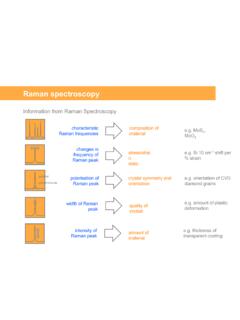
Raman spectroscopy - University of California, Irvine
www.chem.uci.eduRaman spectroscopy utilizing a microscope for laser excitation and Raman light collection offers that highest Raman light collection efficiencies. When properly designed, Raman microscopes allow Raman spectroscopy with very high lateral spatial resolution, minimal depth of field and the highest possible laser energy density for a given laser power.

Biochemistry and Molecular Biology - kau
www.kau.edu.sa12.3 Fluorescence spectroscopy 493 12.4 Luminometry 507 12.5 Circular dichroism spectroscopy 509 12.6 Light scattering 514 12.7 Atomic spectroscopy 516 12.8 Suggestions for further reading 519 13 Spectroscopic techniques: II Structure and interactions 522 A. HOFMANN 13.1 Introduction 522 13.2 Infrared and Raman spectroscopy 523

METHODS OF SOIL ANALYSIS PART3 Chemical Methods
www.waterboards.ca.govFourier transform infrared, Raman, electron spin resonance, x-ray photoelectron, and x-ray absorption fine structure spectroscopies. The application of these meth