
INTERACTIONS BETWEEN ORGANISMS . AND …
INTERACTIONS BETWEEN ORGANISMS . AND ENVIRONMENT 2·1 FUNCTIONAL RELATIONSHIPS An understanding of the relationships between an organism and its environment can be attained only when the environmental factors that can be experienced by the organism are considered. This is difficult because it is first necessary for the
Download INTERACTIONS BETWEEN ORGANISMS . AND …

Information
Domain:
Source:
Link to this page:
Documents from same domain
What is Restorative Justice -- revised2
www.d.umn.edurestorative justice briefing paper - 2 centre for justice & reconciliation at prison fellowship international may 2005 po box 17434, washington, dc 20041♦phone 703.481.0000♦fax 703.481.0003♦email dvanness@pfi.
Motivation In Sport - University of Minnesota Duluth
www.d.umn.eduWhat do coaches want from the study of motivation? Higher task achievement from their athletes High task persistency from their athletes Higher effort from their athletes
ECE 1315 Digital Logic Design Laboratory Manual
www.d.umn.eduECE 1315 Digital Logic Design Laboratory Manual ... equipment that you will use in the lab to build and test ... display digital inputs and outputs from your ...
ANTICOAGULANT, THROMBOLYTIC, and ANTI …
www.d.umn.eduMed 6541 Hematopoiesis and Host Defences Spring 2006 Dr. Janet Fitzakerley 307 Med jfitzake@d.umn.edu Anticoagulants www.d.umn.edu/~jfitzake Page 1 of 21
Experiential Learning Theory - University of …
www.d.umn.eduExperiential Learning Theory: Previous Research and New Directions David A. Kolb Richard E. Boyatzis Charalampos Mainemelis Department of Organizational Behavior

Analog Integrated Circuit Design 2nd Edition
www.d.umn.eduto the design of a comparator. Random circuit noise can cause the output to change from one logic level to the other, even when the comparator input is held constant. Hence, in order to measure the input offset

Analog Integrated Circuit Design
www.d.umn.edu• Good analog circuit designers are scarce (very well compensated, gain lots of respect, regarded as “artists” because of the “creative” circuit design they do…
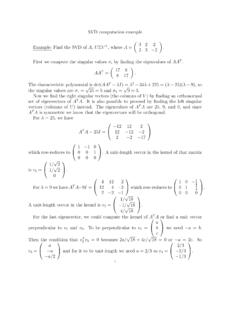
SVD computation example A U V T A 3 2 2 AA
www.d.umn.eduSVD computation example Example: Find the SVD of A, UΣVT, where A = 3 2 2 2 3 −2 . First we compute the singular values σ i by finding the eigenvalues of AAT. AAT = …
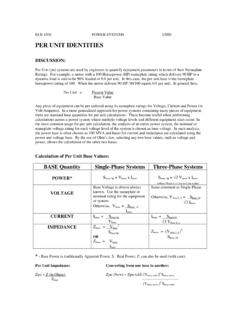
PER UNIT IDENTITIES - University of Minnesota Duluth
www.d.umn.eduECE 4501 POWER SYSTEMS UMD PER UNIT IDENTITIES DISCUSSION: Per Unit (pu) systems are used by engineers to quantify equipment parameters in terms of their Nameplate
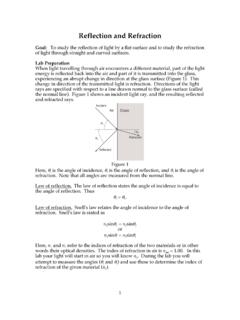
Lab 8 Reflection and Refraction
www.d.umn.edu1" " Reflection and Refraction Goal: To study the reflection of light by a flat surface and to study the refraction of light through straight and curved surfaces. Lab Preparation When light travelling through air encounters a different material, part of the light
Related documents

AMERICAN CHEMICAL SOCIETY Guidelines for Chemical ...
www.acs.org1 . Differentiate between hazard and risk . 2 . Define acute and chronic toxicity and cite some examples of each . 3 . State the general effects that corrosives have on the skin . 4 . State the general hazards associated with the use and storage of flammable chemicals commonly used in the laboratory . 5 .

Science Content Standards
sde.idaho.govLS1-K-2. Use classification supported by evidence to differentiate between living and non-living items. • Further Explanation: Use chart or Venn diagram to sort objects or pictures into living and not-living items. Supporting Content LS1.C: Organization for Matter and Energy Flow in Organisms • All animals need food in order to live and grow.

The 10 elements of agroecology - Home | Food and ...
www.fao.orginteractions between people, multi-species herds and variable environmental conditions, building resilience and contributing to ecosystem services such as seed dispersal, habitat preservation and soil fertility.17,18 While agroecological approaches strive to maximise
Lecture 1 – Introduction to Ecology
dspace.mit.eduabundance of organisms and the interactions among them, and the study of how these organisms in turn mediate the transport and transformation of energy and matter in the biosphere (i.e., the study of the design of ecosystem structure and function).” The goal of ecology is to understand the principles of operation of natural systems and to
Third Grade
www.nextgenscience.orgof types of organisms that lived long ago and also about the nature of their environments. Third ... Ask questions to determine cause and effect relationships of electric or magnetic interactions between two objects not in contact with each other. [Clarification Statement: Examples of an electric force could include the force on hair from an ...

CHAPTER 2 Interactions in Ecosystems - Miss S. Harvey
missharvey.weebly.comTRY THIS: Modelling Interactions In this activity, you will explore the interactions that one organism has with the other organisms around it, and with the environment in which it lives. Materials: notebook or graphic organizer 1. Create a graphic organizer to represent interactions between a spider and its environment. 2.

Interactions Between the Atmosphere & Hydrosphere
schoolwires.henry.k12.ga.usInteractions Between the Atmosphere & Hydrosphere Weather & Climate ~occur every 3-7 years ... (living organisms) Geosphere (crust, mantle, core) Mantle Core Hydrosphere (water) Crust (soil and rock) Atmosphere (air) ... There is a link between air circulation,
Earth Science: Sphere Interactions
www.auburn.wednet.edu• The interactions you've been describing are the processes of Earth system science. The current "balance" among these complex interactions makes it possible for life to flourish here. Because the spheres are all part of the same interconnected system, changes in any sphere ultimately affect the other spheres as well.

Diversity is not only a characteristic of living organisms ...
www.ncert.nic.inwhich studies the interactions among organisms and between the organism and its physical (abiotic) environment. Ecology is basically concerned with four levels of biological organisation – organisms, populations, communities and biomes. In this chapter we explore ecology at organismic and population levels. 13.1 ORGANISM AND ITS ENVIRONMENT