Introduction to Composite Materials
results in better properties than those of the indi-vidual components used alone. In contrast to metallic alloys, each material retains its separate chemical, physical, and mechanical properties. the two constituents are a reinforcement and a matrix. the main advantages of composite ma-terials are their high strength and stiffness, com-
Download Introduction to Composite Materials

Information
Domain:
Source:
Link to this page:
Documents from same domain

ASM Handbook - ASM International
www.asminternational.orgASM International is indebted to the Co-Chairs and Editors of this Handbook, Stephen D. Cramer and Bernard S. Covino, Jr., who had the vision and the drive to undertake the huge effort to update and revise the 1987 Corrosion volume.

Friction Stir Welding of Ferrous and Nickel Alloys
www.asminternational.orgFriction Stir Welding of Ferrous and Nickel Alloys Carl D. Sorensen and Tracy W. Nelson ... Tool Cooling.The welding zone tempera-tures frequently reach 900 to 1200 °C (1650 to ... have high thermal conductivity relative to the tool steel commonly used for aluminum. To prevent damage to the spindle bearings and to establish a consistent ...

External Corrosion of Oil and Natural Gas Pipelines
www.asminternational.orgExternal Corrosion of Oil and Natural Gas Pipelines John A. Beavers and Neil G. Thompson, CC Technologies PIPELINES play an extremely important role

ALLOYING - ASM International
www.asminternational.orgALLOYING UNDERSTANDING THE BASICS Edited by J.R. Davis Davis & Associates ASM International® Materials Park, Ohio 44073-0002 www.asminternational.org fm 10/23/01 5:01 AM Page i

SUBJECT GUIDE Heat Treating - ASM International
www.asminternational.orgateria ar i 44732 :: 44335151 :: ainternatinarg :: eererieenterainternatinarg Published by ASM International:: Data shown are typical, not to be used for ...

Chapter 1 Introduction to Chemical Vapor Deposition (CVD)
www.asminternational.orgChapter 1 Introduction to Chemical Vapor Deposition (CVD) J. R. Creighton and P. Ho Sandia National Laboratories P.O. Box 5800, MS0601 Albuquerque, NM 87185-0601

Glass Fibers - ASM International
www.asminternational.orgGlass Fibers Frederick T. Wallenberger, James C. Watson, and Hong Li, PPG Industries, Inc. GLASS FIBERS are among the most versatile industrial materials known today.

Introduction to Selection of Titanium Alloys
www.asminternational.orgplanned for use in aircraft or in gas turbine en-gines for aerospace applications. Desired mechanical properties such as yield or ultimate strength to density (strength effi-ciency), fatigue crack growth rate, and fracture toughness, as well as manufacturing consider-ations such as welding and forming require-ments, are extremely important.
Properties of materials - ASM International
www.asminternational.orgMicrostructure . The structural features that can be seen using a microscope, but seldom with the naked eye; ranges from glassy to c rystalline; includes grain boundaries ... affects the extent of crystallization and resulting mechanical properties. Melting point . The temperature at which liquid b egins to form as a material is heated. Not

An Introduction to Nitriding - ASM International
www.asminternational.orgThe first patent for the development of the nitriding process was applied for in March 1908 in Elizabeth, NJ. The patent was finally approved in June 1913, some five years after the initial application. Machlet had been working for a number of years on the process prior to his patent application Chapter 1: An Introduction to Nitriding / 3
Related documents

Additive Manufacturing
home.iitk.ac.inrather than a reinforcement phase to enhance the mechanical or other properties of the final product. An example of the second category is the bio-composite poly-epsilon-caprolactone and hydroxyapatite (PCL/HA) bone scaffold fabricated using SLS, with the addition of HA to enhance the strength and biocompatibility of PCL .
Chapter 16 Composites
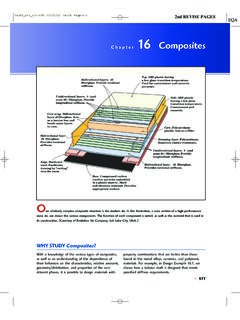
in.bgu.ac.ilparticle-reinforced composites. 3. Distinguish the three different types of fiber-reinforced composites on the basis of fiber length and orientation; comment on the distinctive me-chanical characteristics for each type. 4. Calculate longitudinal modulus and longitudinal strength for an aligned and continuous fiber-reinforced composite. 5.

Physical Properties - Plastics & Rubber
plastics-rubber.basf.comPHYSICAL PROPERTIES Mechanical properties Glass transition temperature The glass transition temperature (Tg) of a plastics is the point at which a reversible transition of amorphous phases from a hard brittle condition to a visco-elastic or rubber-elastic ... For glass fiber-reinforced Elastollan ...
Advanced Composite Material for Aerospace Application-a …
ripublication.comProperties . 4th Generation (1990s): Hybrid Materials, Nan composites and Biomimetic Strategies. The First Generation (1940s): Glass Fiber Reinforced Polymers (GFRPs) While it seems obvious that making whole components (wings, nose cones, helicopter rotors, etc.) out of these high strength materials would be the answer, this was not the solution.

Chapter 8: Mechanical Properties of Metals
www.cheric.orgPolymers Composites /fibers E(GPa) Based on data in Table B.2, Callister & Rethwisch 9e. Composite data based on reinforced epoxy with 60 vol% of aligned carbon (CFRE), aramid (AFRE), or glass (GFRE) fibers. Young’s Moduli: Comparison 109Pa 0.2 8 0.6 1 Magnesium, Aluminum Platinum Silver, Gold Tantalum Zinc, Ti Steel, Ni Molybdenum Graphite ...

Guide for the Design and Structures ACI 440.2R-17
www.concrete.orgalso known as fiber-reinforced polymers (FRPs), have emerged as a viable option for repair and rehabilitation. For the purposes of this guide, an FRP system is defined as the fibers and resins used to create the composite laminate, all applicable resins used to bond it …
Polymer Matrix Composites - Princeton University
www.princeton.edumechanical properties (usually strength and stiff-ness); however, there is no unambiguous line separating the two. Reinforced plastics, which are relatively inexpensive, typically consist of poly-ester resins reinforced with low-stiffness glass fibers (E-glass). They have been in use for 30 to 40 years in applications such as boat hulls, cor-
1. Classification of materials
www.uotechnology.edu.iqAnother of these technologically important materials is the “carbon fiber reinforced polymer” (or “CFRP”) composite—carbon fibers that are embedded within a polymer. These materials are stiffer and stronger than the glass fiber-reinforced materials (Figures 1.2 and 1.3), yet they are more expensive.