Introduction to Database Systems Module 1, Lecture 1
Database Management Systems, R. Ramakrishnan 2 What Is a DBMS? A very large, integrated collection of data. Models real-world enterprise. – Entities (e.g., students, courses) – Relationships (e.g., Madonna is taking CS564) A Database Management System (DBMS) is a software package designed to store and manage databases.
Download Introduction to Database Systems Module 1, Lecture 1

Information
Domain:
Source:
Link to this page:
Documents from same domain
REVIEW - University of Wisconsin–Madison
pages.cs.wisc.edulearning discovers intricate structure in large data sets by using the backpropagation algorithm to indicate how a machine ... NATURE | VOL 521 | 28 MAY 2015 REVIEW

The Adaptive Lasso and Its Oracle Properties
pages.cs.wisc.eduThe Adaptive Lasso and Its Oracle Properties Hui Z OU Thelassoisapopulartechniqueforsimultaneousestimationandvariableselection.Lassovariableselectionhasbeenshowntobeconsistent

Cookbook - University of Wisconsin–Madison
pages.cs.wisc.eduThis cookbook integrates a variety of topics in probability the-ory and statistics. It is based on literature [1,6,3] and in-class material from courses of the statistics …

Understanding Modern Device Drivers
pages.cs.wisc.eduUnderstanding Modern Device Drivers Asim Kadav and Michael M. Swift Computer Sciences Department, University of Wisconsin-Madison ... kernel code with over 5 million lines of code in the Linux kernel, and cause significant complexity, bugs and development costs. ... drivers. In addition, a better understanding of driver code can lead ...
DATABASE MANAGEMENT SYSTEMS SOLUTIONS MANUAL THIRD EDITION
pages.cs.wisc.edu1 INTRODUCTION TO DATABASE SYSTEMS Exercise 1.1 Why would youchoosea databasesysteminstead ofsimply storingdata in operating system files? When would it make sense not to use a database system? Answer 1.1 A database is an integrated collection of data, usually so large that it has to be stored on secondary storage devices such as disks or tapes.
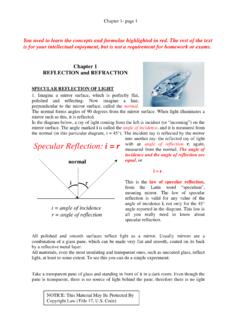
Specular Reflection: i = r
pages.cs.wisc.eduREFLECTION and REFRACTION SPECULAR REFLECTION OF LIGHT 1. Imagine a mirror surface, which is perfectly flat, polished and reflecting. Now imagine a line, perpendicular to the mirror surface, called the normal. The normal forms angles of 90 degrees from the mirror surface. When light illuminates a

CS 547 Lecture 34: Markov Chains
pages.cs.wisc.eduCS 547 Lecture 34: Markov Chains Daniel Myers State Transition Models A Markov chain is a model consisting of a group of states and specified transitions between the states. Older texts on queueing theory prefer to derive most of their results using Markov models, as opposed to the mean

CS 547 Lecture 35: Markov Chains and Queues
pages.cs.wisc.eduContinuous Time Markov Chains Our previous examples focused on discrete time Markov chains with a finite number of states. Queueing models, by contrast, may have an infinite number of states (because the buffer may contain any number of ... which are treated the same as any other transition in a Markov …

1 An Inside Look at Botnets
pages.cs.wisc.eduAn Inside Look at Botnets Paul Barford Vinod Yegneswaran {pb,vinod}@cs.wisc.edu Computer Sciences Department University of Wisconsin, Madison Abstract The continued growth and diversification of the Internet has been accompanied by an increasing prevalence of attacks and intrusions [40]. It can be argued, however,

Semi-Supervised Learning Tutorial
pages.cs.wisc.eduSemi-Supervised Learning Tutorial Xiaojin Zhu Department of Computer Sciences University of Wisconsin, Madison, USA ICML 2007 Xiaojin Zhu (Univ. Wisconsin, Madison) Semi-Supervised Learning Tutorial ICML 2007 1 / 135
Related documents

Fundamentals of Database Systems - MIM
mim.ac.mw16.1 The Role of Information Systems in Organizations .....468 16.2 The Database Design Process .....471
An Introduction To Geographical Information Systems (GIS)
badpets.netAn Introduction To Geographical Information Systems (GIS) What is a Geographical Information System? A Geographical Information System is a collection of spatially referenced data (i.e. data that have locations attached to them) and the tools required to work with the data.
Course Notes on Databases and Database Management …
cs.ulb.ac.beDatabase Management Systems (DBMSs) † DBMS: a collection of general-purpose, application-independent programs providing services to 3 deflne the structure of a database, i.e., data types and constraints that the data will have to satisfy 3 manage the storageof data, safely for long periods of time, on some storage medium controled by the DBMS 3 manipulate a database, …
Databases: MySQL Introduction
weblearn.ox.ac.ukDatabases: MySQL introduction 7 IT Learning Programme 1 Introduction The Structured Query Language (SQL) is the language of databases. SQL was, is, and will stay for the foreseeable future the database language for relational database servers such as IBM DB2, Microsoft SQL Server, MySQL, Oracle,
An Introduction to Spatial Database Systems
www.cise.ufl.edurelational database systems there have been attempts to manage such data in database systems. Characteristic for the technology emerging to address these needs is the capability to deal with large collections of relatively simple geometric objects , for example, a …
DATABASE MANAGEMENT SYSTEMS SOLUTIONS MANUAL
www.cs.cornell.eduIntroduction to Database Systems 3 Answer 1.5 The DBA is responsible for: Designing the logical and physical schemas, as well as widely-used portions of the external schema. Security and authorization. Data availability and recovery from failures. Database tuning: The DBA is responsible for evolving the database, in particular
Introduction to Biometrics and Biometric Systems
www.tam.usace.army.milAccomplishing tomorrows training requirements today. •Software program •Collect Biometric and other Identifying info •Save biometrics and info to database •Query and Search the database (currently 1.2 Mil and growing) •Current Uses •Anti-terrorism/Force Protection Screening (AT/FP) •Detainee Operations