Introduction to Database Systems Module 1, Lecture 1
Database Management Systems, R. Ramakrishnan 1 Introduction to Database Systems Module 1, Lecture 1 Instructor: Raghu Ramakrishnan raghu@cs.wisc.edu
Download Introduction to Database Systems Module 1, Lecture 1

Information
Domain:
Source:
Link to this page:
Documents from same domain
REVIEW - University of Wisconsin–Madison
pages.cs.wisc.edulearning discovers intricate structure in large data sets by using the backpropagation algorithm to indicate how a machine ... NATURE | VOL 521 | 28 MAY 2015 REVIEW

The Adaptive Lasso and Its Oracle Properties
pages.cs.wisc.eduThe Adaptive Lasso and Its Oracle Properties Hui Z OU Thelassoisapopulartechniqueforsimultaneousestimationandvariableselection.Lassovariableselectionhasbeenshowntobeconsistent

Cookbook - University of Wisconsin–Madison
pages.cs.wisc.eduThis cookbook integrates a variety of topics in probability the-ory and statistics. It is based on literature [1,6,3] and in-class material from courses of the statistics …

Understanding Modern Device Drivers
pages.cs.wisc.eduUnderstanding Modern Device Drivers Asim Kadav and Michael M. Swift Computer Sciences Department, University of Wisconsin-Madison ... kernel code with over 5 million lines of code in the Linux kernel, and cause significant complexity, bugs and development costs. ... drivers. In addition, a better understanding of driver code can lead ...

DATABASE MANAGEMENT SYSTEMS SOLUTIONS MANUAL THIRD EDITION
pages.cs.wisc.edu1 INTRODUCTION TO DATABASE SYSTEMS Exercise 1.1 Why would youchoosea databasesysteminstead ofsimply storingdata in operating system files? When would it make sense not to use a database system? Answer 1.1 A database is an integrated collection of data, usually so large that it has to be stored on secondary storage devices such as disks or tapes.
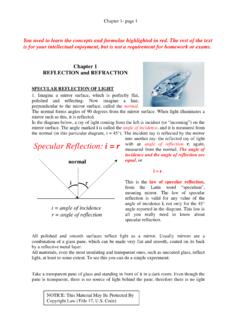
Specular Reflection: i = r
pages.cs.wisc.eduREFLECTION and REFRACTION SPECULAR REFLECTION OF LIGHT 1. Imagine a mirror surface, which is perfectly flat, polished and reflecting. Now imagine a line, perpendicular to the mirror surface, called the normal. The normal forms angles of 90 degrees from the mirror surface. When light illuminates a

CS 547 Lecture 34: Markov Chains
pages.cs.wisc.eduCS 547 Lecture 34: Markov Chains Daniel Myers State Transition Models A Markov chain is a model consisting of a group of states and specified transitions between the states. Older texts on queueing theory prefer to derive most of their results using Markov models, as opposed to the mean

CS 547 Lecture 35: Markov Chains and Queues
pages.cs.wisc.eduContinuous Time Markov Chains Our previous examples focused on discrete time Markov chains with a finite number of states. Queueing models, by contrast, may have an infinite number of states (because the buffer may contain any number of ... which are treated the same as any other transition in a Markov …

1 An Inside Look at Botnets
pages.cs.wisc.eduAn Inside Look at Botnets Paul Barford Vinod Yegneswaran {pb,vinod}@cs.wisc.edu Computer Sciences Department University of Wisconsin, Madison Abstract The continued growth and diversification of the Internet has been accompanied by an increasing prevalence of attacks and intrusions [40]. It can be argued, however,

Semi-Supervised Learning Tutorial
pages.cs.wisc.eduSemi-Supervised Learning Tutorial Xiaojin Zhu Department of Computer Sciences University of Wisconsin, Madison, USA ICML 2007 Xiaojin Zhu (Univ. Wisconsin, Madison) Semi-Supervised Learning Tutorial ICML 2007 1 / 135
Related documents
Module 1: Introduction to Strategic Leadership
www.hrdtraining.comModule 1: Introduction to Strategic Leadership - 5 Note: → Show Slide 5: Leading by Focusing on Others. Slide 5 Leading by Focusing on Others Leaders generate exceptional performance by giving their attention to what others need to succeed, then Leaders attempt to influence the performance of others through how they (the leaders) act or behave

Module 1.1: STATA for Absolute Beginners - edX
edge.edx.orgModule 1.1: STATA for Absolute Beginners Module 1.1 is for students who have no previous experience with STATA or students who are looking for a basic refresher. This module is completely voluntary and not a requirement for the class. However, if ... Introduction to graphics
Introduction to Hotspot Analysis
www.cdc.gov1 878274 3 187734 3 s 47731S 3 3 928491 4 S 3141S 2948494 0 478375 -0 751443 GiPValue 0 040±2 0 097334 0 0 814188 0 74s€s€ 0 0 539337 0 358773 0 247599 0 178491 0 000039 0 0 ... Introduction to Hotspot Analysis Author: CEHI Subject: GIS Exchange Training Keywords:

Self Study Modules on Tuberculosis Modules 1-5 …
www.cdc.govJun 01, 2020 · Modules 1–5 — Introduction About Modules 1–5 The Self-Study Modules on Tuberculosis, 1-5 package includes fve modules, an introduction, and a glossary. z. Introduction (this booklet) z Module 1: Transmission and Pathogenesis of Tuberculosis . z Module 2: Epidemiology of Tuberculosis . z Module 3: Targeted Testing and the Diagnosis of ...

CORE MODULE 1: Introduction to Monitoring and Evaluation
www.fhi360.orgCore Module 1: 2 Introduction to Monitoring and Evaluation Session Overview and Schedule TIME TOPIC TRAINING METHOD 11:05-12:00 55 min F. Levels of Monitoring and Evaluation and Responsibilities Facilitator Presentation 12:00-1:00 60 min LUNCH 1:00-2:00 60 min G. Goals, Objectives, and M&E Questions Facilitator Presentation,

MODULE ONE Introduction to: Occupational Safety & …
www.osha.govMODULE ONE Introduction to: Occupational Safety & Health Administration Learning Objective: Upon completion of this unit you will be able to summarize the foundations and functions of OSHA as it pertains to Wisconsin Dairy Farming. Learner Outcomes: You will be able to: 1. Explain the importance of OSHA, including its history. 2.
MODULE #1: A Brief History of Science science
www.rainbowresource.comMODULE #1: A Brief History of Science Introduction This course will take you on a tour of what I consider to be the most interesting of all human endeavors: science. Now, of course, I am well aware that many people (perhaps even you) do not think science is interesting. Nevertheless, I do believe that most people’s dislike of science comes