Introduction to Stochastic Processes - Lecture Notes
probability mass function (p 0;p 1;:::), you simply need to compute the sum P 1 i=1 p i. If it happens to be equal to 1, you can safely conclude that X never takes the value +1. Otherwise, the probability of +1is positive. The random variables for which S= f0;1gare especially useful. They are called indicators.
Download Introduction to Stochastic Processes - Lecture Notes

Information
Domain:
Source:
Link to this page:
Documents from same domain
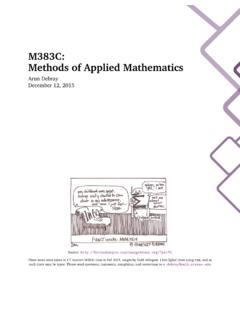
M383C: Methods of Applied Mathematics - web.ma.utexas.edu
web.ma.utexas.eduMethods of Applied Mathematics Arun Debray December 12, 2015 Source: ... The professor is an applied mathematician, doing numerical analysis, and more specifically, approximation of differential equations. Functional analysis is useful for that, but also plenty of other
Methods of Applied Mathematics
web.ma.utexas.eduMethods of Applied Mathematics Todd Arbogast and Jerry L. Bona Department of Mathematics, and Institute for Computational Engineering and Sciences The University of Texas at Austin ... In applying mathematics, real phenomena or objects are conceptualized as abstract mathematical objects. Collections of such objects are called sets.
EXAM FM SAMPLE QUESTIONS - web.ma.utexas.edu
web.ma.utexas.eduEXAM FM SAMPLE QUESTIONS Financial Economics June 2014 changes Questions 1-30 are from the prior version of this document. They have been edited to conform more closely to current question writing style, but are unchanged in content. Question 31 is the former Question 58 …
Introduction to Real Analysis M361K - web.ma.utexas.edu
web.ma.utexas.eduIntroduction to Real Analysis M361K. Preface These notes are for the basic real analysis class. (The more advanced class is M365C.) They were writtten, used, revised and revised again and again over the past five years. The course has been taught 12 times by eight different instructors. Contributors to
Introduction to Real Analysis M361K - web.ma.utexas.edu
web.ma.utexas.eduCHAPTER 1 Introduction 1. Goals The purpose of this course is three-fold: (1) to provide an introduction to the basic definitions and theo-rems of calculus and real analysis.
Introduction to Exotic Options. Asian Options.
web.ma.utexas.eduIntroduction to Exotic Options. Asian Options. 1 Introduction to Exotic Options 2 Asian Options. De nition ... in convertible bonds as it is based on the stock price over a 20-day period at the end of the bonds life Asian options are less valuable than otherwise identical ordinary options.
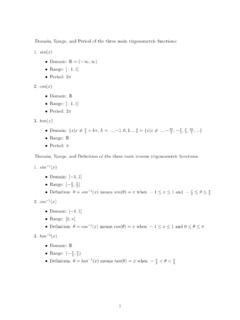
Domain, Range, and Period of the three main trigonometric ...
web.ma.utexas.eduor subtract the period until I get an angle that is in the range of tan 1(x). For Sin and Cos, I add or subtract 2ˇbecause that is their period. For Tan, I add or subtract ˇ, the period of tan(x). ... Created Date: 4/10/2009 7:51:06 AM ...
Stochastic partial di⁄erential equations and portfolio choice
web.ma.utexas.eduStochastic partial di⁄erential equations and portfolio choice Marek Musielayand Thaleia Zariphopoulouz Dedicated to Eckhard Platen on the occasion of his 60th birthday December 13, 2009 Abstract We introduce a stochastic partial di⁄erential equation which describes
Stochastic partial di⁄erential equations and portfolio choice
web.ma.utexas.eduStochastic partial di⁄erential equations and portfolio choice M. Musiela and T. Zariphopoulouy BNP Paribas, London and the University of Texas at Austin

EUCLIDEAN PARALLEL POSTULATE
web.ma.utexas.eduFeb 05, 2010 · EUCLIDEAN PARALLEL POSTULATE 2.1 INTRODUCTION. There is a well-developed theory for a geometry based solely on the five Common Notions and first four Postulates of Euclid. In other words, there is a geometry in which neither the Fifth Postulate nor any of its alternatives is taken as an axiom. This
Related documents

A Modern Introduction to Probability and Statistics
cis.temple.eduWe have divided attention about evenly between probability and statistics. The very first chapter is a sampler with differently flavored introductory ex-amples, rangingfrom scientific success stories to a controversialpuzzle. Topics that follow are elementary probability theory, simulation, joint distributions,

Introduction to Probability Models
mitran-lab.amath.unc.eduIntroduction to probability models / by Sheldon Ross. – Eleventh edition. pages cm Includes bibliographical references and index. ISBN 978-0-12-407948-9 1. Probabilities. I. Title. QA273.R84 2014 519.2–dc23 2013035819 British Library Cataloguing in Publication Data A catalogue record for this book is available from the British Library ISBN ...
Probability, Statistics, and Stochastic Processes
ramanujan.math.trinity.educhapters develop probability theory and introduce the axioms of probability, random variables, and joint distributions. The following two chapters are shorter and of an “introduction to” nature: Chapter 4 on limit theorems and Ch apter 5 on simulation. Statistical inference is treated in Chapter 6, which includes a section on Bayesian v
Operations Research: An Introduction to Models and ...
catalog.extension.oregonstate.eduAn Introduction to Models and Probability Concepts J. Reeb and S. Leavengood EM 8718 October 1998 $2.50 According to the Operations Research Society of America, “Operations research is concerned with scientifically deciding how to best design and operate man-machine systems, usually under conditions requiring the alloca-tion of scarce ...

PROBABILITY AND STATISTICS FOR ECONOMISTS
ssc.wisc.eduPreface This textbook is the first in a two-part series covering the core material typically taught in a one-year Ph.D. course in econometrics.

Introduction to Probability Models by Ross Sheldon
www.ctanujit.orgIntroduction to Probability Models Ninth Edition Sheldon M. Ross University of California Berkeley, California AMSTERDAM •BOSTON HEIDELBERG LONDON NEW YORK •OXFORD PARIS • SAN DIEGO SAN FRANCISCO •SINGAPORE SYDNEY TOKYO Academic Press is an imprint of Elsevier

An Introduction to Logistic and Probit Regression Models
www.liberalarts.utexas.eduModeling a Binary Outcome • Latent Variable Approach • We can think of y* as the underlying latent propensity that y=1 • Example 1: For the binary variable, heart attack/no heart attack, y* is the propensity for a heart attack. • Example 2: For the binary variable, in/out of the labor force, y* is the propensity to be in the labor force. ...
![[FMM] Finite Mixture Models](/cache/preview/2/f/e/3/5/9/b/e/thumb-2fe359bec6e16b9423570fba22429479.jpg)
[FMM] Finite Mixture Models
www.stata.coman unobserved subpopulation. We use the terms “class probability” or “component probability” to refer to the probability of belonging to a given component in the mixture. Class probabilities are also referred to in the literature as “mixing weights” or …

Introduction to Probability - VFU
www.vfu.bgthe generic structure of such models, and their basic properties. The models we consider assign probabilities to collections (sets) of possible outcomes. For this reason, we must begin with a short review of set theory. 1.1 SETS Probability makes extensive use of set operations, so let us introduce at the outset the relevant notation and ...