Ionic and Covalent Compounds Name: KEY
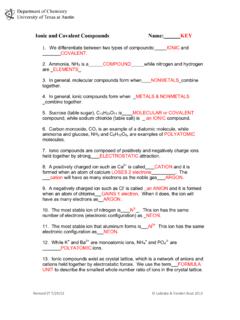
Ionic and Covalent Compounds Name: KEY!! 1. We differentiate between two types of compounds: IONIC and COVALENT. ! 2. Ammonia, NH3 is a COMPOUND while nitrogen and hydrogen are _ELEMENTS_. ! 3. In general, molecular compounds form when NONMETALS_combine together. ! 4. In general, ionic compounds form when _METALS & …
Download Ionic and Covalent Compounds Name: KEY

Information
Domain:
Source:
Link to this page:
Documents from same domain

Kinetic Molecular Theory Supplemental Worksheet
ch301.cm.utexas.eduKinetic Molecular Theory – Supplemental Worksheet 1. What assumptions do we make when using the ideal gas laws? Are the assumptions always true? 2. Consider 2 gases, A and B, each in a 1.0 L container with both gases at the same temperature and pressure. ... mole fraction of methane in the mixture is 0.623. Calculate the total kinetic energy ...
More Practice: Energy, Frequency, Wavelength and the ...
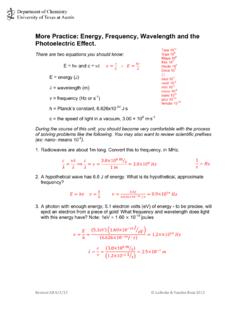
ch301.cm.utexas.eduMore Practice: Energy, Frequency, Wavelength and the Photoelectric Effect. There are two equations you should know: E = h! and c =!!" !=!!!!!∴!!!=!!! E = energy (J) = wavelength (m) ! = frequency (Hz or s-1) h = Planck’s constant, 6.626x10⁻³⁴ J∙s c = the speed of light in a vacuum, 3.00 × 10⁸ m∙s-1

IonicBonding!and!Writing!Formulas!Name:!KEY!!! Part A. Use ...
ch301.cm.utexas.edu4. SO3 sulfur trioxide ! 5. N 2O dinitrogen monoxide ! 6. NO nitrogen monoxide ! 7. N2O3 dinitrogen trioxide ! 8. NO2 nitrogen dioxide ! 9. 19.N2O4 2 dinitrogen tetroxide ! 10. N2O5 dinitrogen pentoxide 11. PCl3 phosphorous trichloride ! 12. PCl5 phosphorous pentachloride ! 13. NH3nitrogen trihydride ! 14. SCl6sulfur hexachloride ! 15 ...

University of Texas at Austin
ch301.cm.utexas.eduCOVALENT BONDING Name Covalent bonding occurs when two or more nonmetals share electrons. attempting to attain a stable octet of electrons at least part of the time. For example: Note that hydrogen Is content with 2, not 8. electrons. Show how covalent bonding occurs in each of the following pairs of atoms. Atoms may
Common Polyatomic Ions Name(s) Formula Name(s) Formula
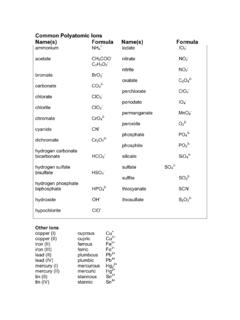
ch301.cm.utexas.eduCommon Polyatomic Ions Name(s) Formula Name(s) Formula ammonium NH4 + acetate CH3COO-C2H3O2-bromate BrO3-carbonate CO3 2-chlorate ClO3-chlorite ClO2-chromate CrO4 2-cyanide CN-dichromate Cr2O7 2-hydrogen carbonate bicarbonate HCO3-hydrogen sulfate bisulfate HSO4-hydrogen phosphate biphosphate HPO4 2-hydroxide OH-
Kinetics formulas copy - Chemistry 301
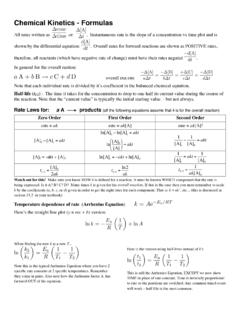
ch301.cm.utexas.eduHalf-life (t 1/2): The time it takes for the concentration to drop to one half its current value during the course of the reaction. Note that the “current value” is typically the initial starting value - but not always. Rate Laws for: a A products (all the following equations assume that k is for the overall reaction)

LEWIS STRUCTURES PRACTICE WORKSHEET
ch301.cm.utexas.eduLEWIS STRUCTURES PRACTICE WORKSHEET Draw the Lewis Structures for each of the following molecules. If you are not sure if your structure is correct, do a formal charge check. You should consult the Lewis structure rules and a periodic table while doing this exercise. A periodic table will be available for the exam, but the list of rules will ...

Thermodynamics Unit Internal Energy, Work and Heat
ch301.cm.utexas.edu3. The change in internal energy for the combustion of 1.00 mol CH 4(g) in a cylinder according to the reaction CH4(g) + 2 O2(g) CO2 (g) + 2 H20(g) is ‐892.4 kJ. If a piston connected to the cylinder performs 492 kJ of expansion work due to the combustion,
Related documents

Study Guide - Mr. Burghardt Ponderosa High School Shingle ...
phsmrb.weebly.comidentify each type as a(n) ionic or covalent bond. In the case of the ionic bond, indicate which atom has lost an electron by adding a colored arrow to show the direction of electron transfer. For the covalent bond, indicate the shared electrons. Type of bond: Figure 2—2 Type of bond: I …
COVALENT
chemunlimited.comUnit 4 (Covalent Compounds) 1. Write the electron dot structure (Lewis Dot Structure) for covalent compounds or ions. 2. Use electronegativity to determine the polarity of a bond or molecule. 3. Given the formula of a covalent compound, write its correct name; given the name of a covalent compound, write its formula. 4.

Rules for naming compounds 2010 - Creighton University
mattson.creighton.eduRules for naming compounds. First of all, decide if the compound is ionic, covalent-molecular or an acid. Each of these three has its own rules that cannot be mixed and matched. Naming ionic compounds: Name the cation then the anion. Examples: NaNO3 sodium nitrate Na2SO4 sodium sulfate CaCl2 calcium chloride K3PO4 potassium phosphate
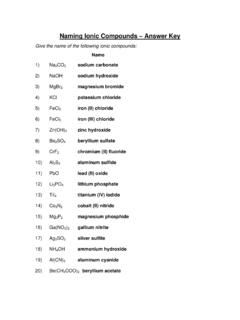
Naming Ionic Compounds – Answer Key - Weebly
siemianowski.weebly.comNaming Ionic Compounds – Answer Key Give the name of the following ionic compounds: Name 1) Na 2CO 3 sodium carbonate 2) NaOH sodium hydroxide 3) MgBr 2 magnesium bromide 4) KCl potassium chloride 5) FeCl 2 iron (II) chloride 6) FeCl 3 iron (III) chloride 7) Zn(OH) 2 zinc hydroxide 8) Be 2SO 4 beryllium sulfate 9) CrF

Simple Binary Ionic Compounds - appohigh.org
appohigh.orgMar 18, 2015 · Ionic compounds are compounds formed by the combination of a cation and a anion. (Think: "metal plus nonmetal"). Ionic compounds are more commonly known as "salts." Binary ionic compounds are compounds containing only two elements, as demonstrated in the examples below. When writing formulas for ionic compounds, we use subscripts to indicate ...
University of Texas at Austin
ch301.cm.utexas.eduCOVALENT BONDING Name Covalent bonding occurs when two or more nonmetals share electrons. attempting to attain a stable octet of electrons at least part of the time. For example: Note that hydrogen Is content with 2, not 8. electrons. Show how covalent bonding occurs in each of the following pairs of atoms. Atoms may
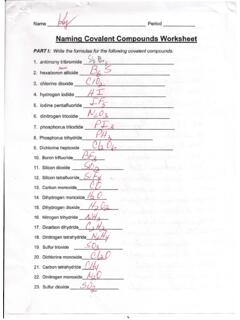
Naming Covalent Compounds Worksheet Key
www.humbleisd.netList 5 Properties of Covalent Com ounds: List 5 Properties of Ionic Compounds: List 5 Properties of Metallic Compounds: c. 00 PART IV. Determine whether the following compounds are covalent or ionic and give them their proper names or Formulas C 2. CO 3. PC13 C CF4 u 8. 9. Mgo cus S02 NC13

Naming Compounds Practice Worksheet
www.lcps.orgA) CuO ionic B) BBr 3 nonpolar covalent C) CCl 4 polar covalent D) KCl ionic E) IF nonpolar covalent 1 85) Which of the following pairs is incorrectly matched? formula bond type A) MgO ionic B) CoS ionic C) CH 4 polar covalent D) NF 3 polar covalent E) N 2 nonpolar covalent
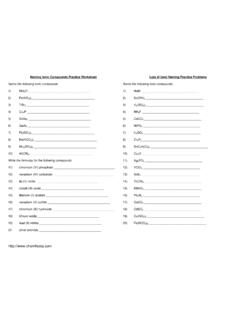
Naming Ionic Compounds Practice Worksheet
www.sfponline.orgNaming Ionic Compounds Practice Worksheet Name the following ionic compounds: 1) NH 4 Cl _____ 2) Fe(NO 3) 3 ... Mixed Ionic/Covalent Compound Naming For each of the following questions, determine whether the compound is ionic or covalent and name it …