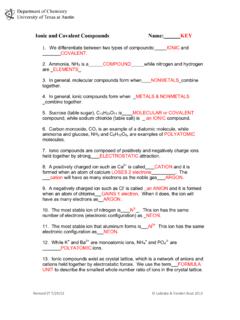
Ionic and Covalent Compounds Name: KEY
5. Sucrose (table sugar), C12H22O11 is MOLECULAR or COVALENT compound, while sodium chloride (table salt) is _ an IONIC compound. ! 6. Carbon monoxide, CO, is an example of a diatomic molecule, while ammonia and glucose, NH3 and C6H12O6, are examples of POLYATOMIC molecules. ! 7. Ionic compounds are composed of positively and negatively …
Download Ionic and Covalent Compounds Name: KEY

Information
Domain:
Source:
Link to this page:
Documents from same domain

Kinetic Molecular Theory Supplemental Worksheet
ch301.cm.utexas.eduKinetic Molecular Theory – Supplemental Worksheet 1. What assumptions do we make when using the ideal gas laws? Are the assumptions always true? 2. Consider 2 gases, A and B, each in a 1.0 L container with both gases at the same temperature and pressure. ... mole fraction of methane in the mixture is 0.623. Calculate the total kinetic energy ...
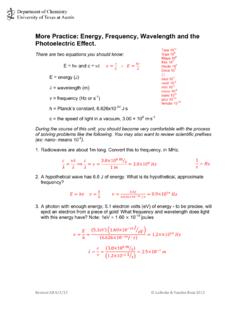
More Practice: Energy, Frequency, Wavelength and the ...
ch301.cm.utexas.eduMore Practice: Energy, Frequency, Wavelength and the Photoelectric Effect. There are two equations you should know: E = h! and c =!!" !=!!!!!∴!!!=!!! E = energy (J) = wavelength (m) ! = frequency (Hz or s-1) h = Planck’s constant, 6.626x10⁻³⁴ J∙s c = the speed of light in a vacuum, 3.00 × 10⁸ m∙s-1

IonicBonding!and!Writing!Formulas!Name:!KEY!!! Part A. Use ...
ch301.cm.utexas.edu4. SO3 sulfur trioxide ! 5. N 2O dinitrogen monoxide ! 6. NO nitrogen monoxide ! 7. N2O3 dinitrogen trioxide ! 8. NO2 nitrogen dioxide ! 9. 19.N2O4 2 dinitrogen tetroxide ! 10. N2O5 dinitrogen pentoxide 11. PCl3 phosphorous trichloride ! 12. PCl5 phosphorous pentachloride ! 13. NH3nitrogen trihydride ! 14. SCl6sulfur hexachloride ! 15 ...

University of Texas at Austin
ch301.cm.utexas.eduCOVALENT BONDING Name Covalent bonding occurs when two or more nonmetals share electrons. attempting to attain a stable octet of electrons at least part of the time. For example: Note that hydrogen Is content with 2, not 8. electrons. Show how covalent bonding occurs in each of the following pairs of atoms. Atoms may
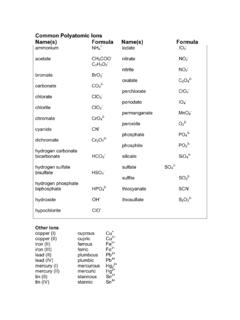
Common Polyatomic Ions Name(s) Formula Name(s) Formula
ch301.cm.utexas.eduCommon Polyatomic Ions Name(s) Formula Name(s) Formula ammonium NH4 + acetate CH3COO-C2H3O2-bromate BrO3-carbonate CO3 2-chlorate ClO3-chlorite ClO2-chromate CrO4 2-cyanide CN-dichromate Cr2O7 2-hydrogen carbonate bicarbonate HCO3-hydrogen sulfate bisulfate HSO4-hydrogen phosphate biphosphate HPO4 2-hydroxide OH-
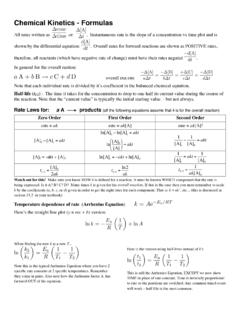
Kinetics formulas copy - Chemistry 301
ch301.cm.utexas.eduHalf-life (t 1/2): The time it takes for the concentration to drop to one half its current value during the course of the reaction. Note that the “current value” is typically the initial starting value - but not always. Rate Laws for: a A products (all the following equations assume that k is for the overall reaction)

LEWIS STRUCTURES PRACTICE WORKSHEET
ch301.cm.utexas.eduLEWIS STRUCTURES PRACTICE WORKSHEET Draw the Lewis Structures for each of the following molecules. If you are not sure if your structure is correct, do a formal charge check. You should consult the Lewis structure rules and a periodic table while doing this exercise. A periodic table will be available for the exam, but the list of rules will ...

Thermodynamics Unit Internal Energy, Work and Heat
ch301.cm.utexas.edu3. The change in internal energy for the combustion of 1.00 mol CH 4(g) in a cylinder according to the reaction CH4(g) + 2 O2(g) CO2 (g) + 2 H20(g) is ‐892.4 kJ. If a piston connected to the cylinder performs 492 kJ of expansion work due to the combustion,
Related documents
Experiment: Identification of Unknowns* Introduction
classes.kvcc.edumolecular-weight amines and oxygen-containing compounds. Low molecular-weight compounds are generally limited to those with fewer than five carbon atoms. Carboxylic acids with fewer that five carbon atoms are soluble in water and form solutions that give an acidic response (pH < 7) when tested with litmus paper. ...

Empirical and Molecular Formula Worksheet
nobel.scas.bcit.caEmpirical and Molecular Formula Worksheet ANSWER KEY. Write the empirical formula for the following compounds. 1) C. 6H6 CH. 6) C8H18 C 4 H 9 7) WO2 WO 2 8) C2H6O2 CH 3 O 9) X39Y13 X 3 Y 6) A compound with an empirical formula of C. 2. OH. 4. and a molar mass of 88 grams per mole. What is the molecular formula of this compound? C. 4. O. 2. H. 8
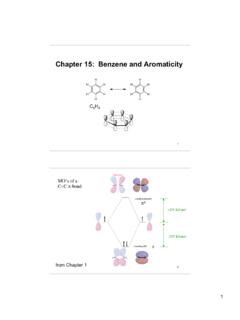
Chapter 15: Benzene and Aromaticity - College of Arts and ...
as.vanderbilt.eduπ-molecular orbitals of hexatriene five nodes four nodes three nodes two nodes one node zero nodes 6 AO’s = 6 MO’s six p-orbitals 6 Conjugation: series of overlapping p-orbitals Aromaticity: cyclic conjugated organic compounds such as benzene, that exhibit special stability due to resonance delocalization of π-electrons.

VSEPR and Molecular Shapes Tables - Glendale Community …
web.gccaz.eduThe various molecular geometries for these types of molecules are shown in tables and described on the following pages: Molecular Geometries Where Central Atom Has Lone Pairs (Continued) Original Shape without Lone Pairs # of Outer Atoms # of Lone Pairs General Formula Molecular Geometry Name trigonal planar (AB3) 2 1 AB2E bent or angular 3 1 AB3E
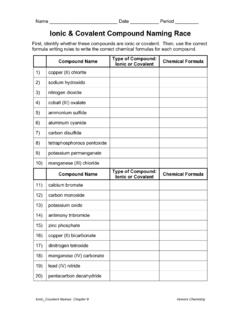
Ionic & Covalent Compound Naming Race
www.gardencity.k12.ny.usFirst, identify whether these compounds are ionic or covalent. Then, use the correct naming rules to write the correct names for each compound. Chemical Formula Type of Compound: Ionic or Covalent Compound Name 21) CdBr 2 22) Cr(Cr 2O 7) 3 23) SBr 2 24) (NH 4) 2CrO 4 25) CuO 26) Pt 3(PO 3) 4 27) Al(ClO 4) 3 28) NH 3 29) Ca(C 2H 3O 2) 2 30) N 2O ...

Naming Compounds Practice Worksheet
www.lcps.orgD) All exist in nature as individual atoms rather than molecular form. 89) Which of the following statements concerning double covalent bonds is correct? A) They always involve the sharing of 2 electron pairs. B) They are found only in molecules containing polyatomic ions. C) They occur only between atoms containing 4 valence electrons.

Chapter 3: Organic Compounds: Alkanes and Cycloalkanes
www.vanderbilt.eduChapter 3: Organic Compounds: Alkanes and Cycloalkanes >11 million organic compounds which are classified into families according to structure and reactivity Functional Group (FG): group of atoms which are part of a large molecule that have characteristic chemical behavior. FG’s behave similarly in every molecule they are part of.