ISRM Suggested methods - RockMass
1 ISRM Suggested methods 1. Basic Geotechnical Description of Rock Masses, 1981 April 2. A Survey of Computer Programs in Rock Mechanics Research and Engineering Practice, 1988
Download ISRM Suggested methods - RockMass

Information
Domain:
Source:
Link to this page:
Documents from same domain
CLASSIFICATION // CHARACTERIZATION OF SOME …
www.rockmass.net- Orientation of foliation/bedding/layering - Anisotropy, (schistosity, foliation, bedding) - Weathering or alteration - Strength Other characteristics of rocks :
A guide to core logging for rock engineering - …
www.rockmass.netA guide to core logging for rock engineering . 3 . Proceedings of the Symposium on Exploration for Rock Engineering / Johannesburg / November 1976.

compressive strength and the factor m in Hoek …
www.rockmass.net2011-02-27 Normal variation of compressive strength and the factor m in Hoek-Brown failure criterion for some rocks (data from Hanssen, 1988; Hoek and Brown, 1980 and Hoek et al., 1992). Rock name Uniaxial compressive strength

Joint characteristics - RockMass
www.rockmass.netJanuary 2015 Reference: A. Palmström, RockMass.net Joint characteristics . Introduction . There is a difficulty in giving a concise definition of what constitutes a joint.
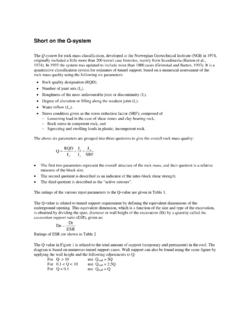
Short on the Q-system - RockMass
www.rockmass.netShort on the Q-system . The Q-system for rock mass classification, developed at the Norwegian Geotechnical Institute (NGI) in 1974, originally included a little more than 200 tunnel case histories, mainly from Scandinavia (Barton et al., 1974). In 1993 the system was updated to include more than 1000 cases (Grimstad and Barton, 1993).

METHODS TO QUANTIFY THE PARAMETERS APPLIED IN …
www.rockmass.netA3 - 2 . 1 METHODS TO DETERMINE THE UNIAXIAL COMPRESSIVE STRENGTH OF ROCKS . For some engineering or rock mechanical purposes the numerical characterization of rock material
CLASSIFICATION // CHARACTERIZATION OF SOME ROCK …
www.rockmass.netIntact rock strength . The uniaxial compressive strength of a rock material constitutes the highest strength limit of the rock mass of which it forms a part. It is determined in accordance with the standard laboratory procedures. For the purpose of rock mass classification, the use of the well -known point load strength index can be useful as the

The RMR (Rock Mass Rating) system
www.rockmass.netCohesion of the rock mass > 400 kPa 300 - 400 kPa 200 - 300 kPa 100 - 200 kPa < 100 kPa Friction angle of the rock mass o < 45. o. 35 - o45. o. 25 - 35 15 - 25 < 15. o. Table 2: RMR classification guide for excavation and support in rock tunnels (Bieniawski, 1989).
Related documents

CHAPTER1 Chemical Reactions and Equations
ncert.nic.inCHEMICAL REACTIONS AND EQUATIONS 3 9. Solid calcium oxide r eacts vigor ously with water to for m calcium hydr oxide accompanied by liberation of heat. This process is called slaking of lime.
WHY IS TYPE S HYDRATED LIME SPECIAL?
www.buildinglime.orgPage 2 1 Introduction The “S” in Type S hydrated lime, as defined by ASTM C 206 and ASTM C 207, was coined because the hydrated lime was considered to be “Special”.
AN OVERVIEW OF LIME SLAKING AND FACTORS THAT …
www.chemcosystems.netA slurry slaker generally uses an initial lime to water ratio of 1 to 3.3 to 1 to 5 depending on the make of equipment and quality of CaO and water.
Guidelines for Lime Stabilization - Welcome to The GDOT
www.dot.ga.govRevised 3/07/11. GUIDELINES FOR LIME STABILIZATION. I. Why Use Lime? Lime Stabilization has the potential to reduce initial construction costs through improved
CLASSIFICATION // CHARACTERIZATION OF SOME ROCK …
www.rockmass.netis given according to the geological classification based on mineral content, texture, mineral size and origin (sedimentary, igneous, metamorphic).

2-1 Recausticizing - Principles and Practice - TAPPI
www.tappi.org2.1-1 RECAUSTICIZING - PRINCIPLES AND PRACTICE Dale R. Sanchez Process Specialist - Recausticizing Vector Process Equipment Inc. 2079 Gordie Tapp Crescent
Fact Sheet 08 Insert - Water Research
www.water-research.netPAGE OF FOUR EIGHT • June 1998 two Lime Softening aaaaaaaa aaaaaaaaaaaaaaaaaaaaaaaaaaaaaaaaaaaaaaaaaaaaaaaaaaaaaaaaaaaaaaaaaaaaaaaaaaaaaaa

GYPSUM - natureswayresources.com
www.natureswayresources.comwww.natureswayresources.com phosphorous (P) availability,increasedlevelsof aluminum(Al)in groundor surfacewaters due to leachingfromthe soil,and contamination fromimpurities withinthe gypsum,such as boron(B) or heavy