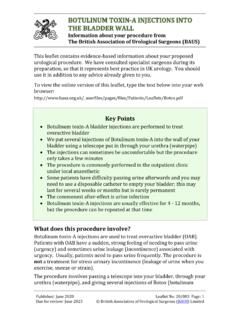
Key Points - BAUS
• an implanted foreign body (stent, joint replacement, pacemaker, heart valve, blood vessel graft); • a regular prescription for a blood thinning agent (e.g. warfarin, aspirin, clopidogrel, rivaroxaban, dabigatran); • a present or previous MRSA infection; or • a high risk of variant-CJD (e.g. if you have had a corneal transplant, a
Download Key Points - BAUS

Information
Domain:
Source:
Link to this page:
Documents from same domain
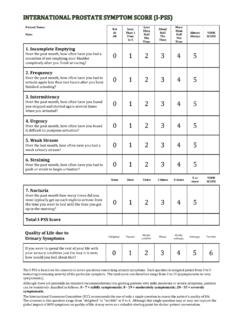
0 1 2 3 4 5 0 1 2 3 4 5 - Home | The British Association ...
www.baus.org.ukindicating increasing severity of the particular symptom. The total score can therefore range from 0 to 35 (asymptomatic to very symptomatic). ... The International Consensus Committee (ICC) recommends the use of only a single question to assess the patient's quality of life.
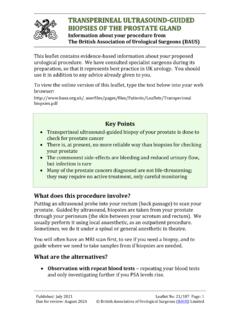
Information about your procedure from The British ...
www.baus.org.ukthrough your perineum (the skin between your scrotum and rectum). We usually perform it using local anaesthetic, as an outpatient procedure. Sometimes, we do it under a spinal or general anesthetic in theatre. You will often have an MRI scan first, to see if you need a biopsy, and to guide where we need to take samples from if biopsies are needed.
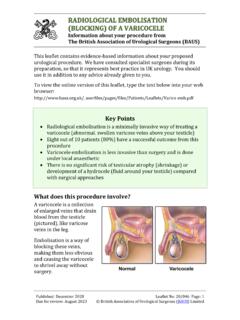
Key Points - BAUS
www.baus.org.uk• bleeding from the puncture site when you get home is very rare but, if it does happen, press firmly on the site for 10 to 20 minutes; this should stop the bleeding • if the bleeding does not stop, you should contact your GP or go to your local Accident & Emergency Department Recurrence of the varicocele Between 1 in 10 &
Information about your procedure from The British ...
www.baus.org.uk• the Information Standard; • the Patient Information Forum; and • the Plain English Campaign. Disclaimer We have made every effort to give accurate information but there may still be errors or omissions in this leaflet. BAUS cannot accept responsibility for any loss from action taken (or not taken) as a result of this information.
Information about your procedure from The British ...
www.baus.org.ukInformation about your procedure from The British Association of Urological Surgeons (BAUS) Published: December 2020 Leaflet No: 20/129 Page: 1
What are lower urinary tract symptoms? - BAUS
www.baus.org.ukbladder and bowel are close to each other, a full bowel can affect your bladder function. • Eat a balanced diet - include both soluble fibre (oats, barley, berries & fruit) and insoluble fibre (roughage such as wheat-based foods, cereal, vegetables & nuts) • Eat regular meals • Empty your bowel when you feel the need - delaying may lead to
Key Points - BAUS
www.baus.org.ukYour surgeon will try to preserve the muscle fibres and nerves that control continence. If you still leak some urine after a year (as 1 in 20 to 1 in 33 patients do), this can be corrected by another procedure such as an artificial urinary sphincter or a male sling. The erection nerves lie very close to your prostate, forming a cobweb of
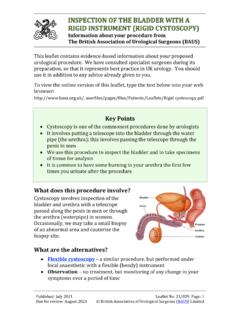
Information about your procedure from The British ...
www.baus.org.ukKey Points • Cystoscopy is one of the commonest procedures done by urologists • It involves putting a telescope into the bladder through the water pipe (the urethra); this involves passing the telescope through the penis in men • We use this procedure to inspect the bladder and to take specimens of tissue for analysis
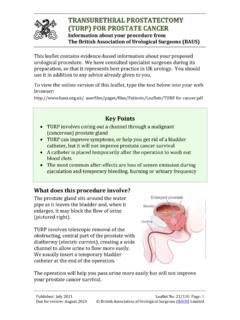
Key Points - BAUS
www.baus.org.uk• TURP involves coring out a channel through a malignant (cancerous) prostate gland • TURP can improve symptoms, or help you get rid of a bladder catheter, but it will not improve prostate cancer survival • A catheter is placed temporarily after the operation to wash out blood clots

Key Points - BAUS
www.baus.org.ukTemporary insertion of a bladder catheter Most patients Recurrent (new) stone formation over the next five to 10 years, requiring further surgery or other treatment 1 in 2 patients (50%) Urinary infection requiring antibiotic treatment Between 1 in 2 & 1 in 10 patients Need for more than one puncture to clear
Related documents
Pacemaker Learning Package - Agency for Clinical Innovation
aci.health.nsw.gov.auPacemaker Learning Package LH_ICU2016_Learning_Package_Pacemaker_Learning_Package 6 | P a g e 3. Conductivity: the ability to transmit an electrical impulse from one cell to another. The electrical current is first initiated in the SA node, the hearts natural pacemaker, located at the top of the right atrium.

Preferred Name Last DB ddonyyyy MRI istory and creening ...
albertahealthservices.caSevere reactions can rarely occur that require medical treatment. These may include difficulty breathing, shock or heart failure. If you feel any discomfort or experience any of these symptoms please inform the nurse or the technologists
CARDIAC DEVICE MONITORING - Medtronic
europe.medtronic.comleadless pacemaker system (Do not report 0389T in conjunction with 0387T, 0390T, 0391T) (For programming of pacemaker systems with lead(s), see 93279-93281) 93279 Programming device evaluation ( in person) with iterative adjustment of the implantable device to test the function of the device and select optimal permanent programmed
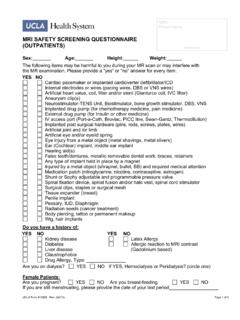
MRI SAFETY SCREENING QUESTIONNAIRE (OUTPATIENTS)
www.uclahealth.orgCardiac pacemaker or implanted cardioverter defibrillator/ICD Internal electrodes or wires (pacing wires, DBS or VNS wires) Artificial heart value, coil, filter and/or stent (Gianturco coil, IVC filter) Aneurysm clip(s) Neurostimulator-TENS Unit, Biostimulator, bone growth stimulator, DBS, VNS

Cardiology Notification and Prior Authorization Program ...
www.uhcprovider.comYes Yes No Pacemaker 33207 Insertion of new or replacement of permanent pacemaker with transvenous electrode(s); ventricular Yes Yes No Pacemaker 33208 Insertion of new or replacement of permanent pacemaker with transvenous electrode(s); atrial and ventricular Yes Yes No Pacemaker/ CRT