
Learning Deep Features for Discriminative Localization
Weakly-supervised object localization: There have been a number of recent works exploring weakly-supervised object localization using CNNs [1, 16, 2, 15]. Bergamoetal [1]propose atechniqueforself-taughtobject localization involving masking out image regions to iden-tify the regions causing the maximal activations in order to localize objects.
Download Learning Deep Features for Discriminative Localization

Information
Domain:
Source:
Link to this page:
Documents from same domain
What Have We Learned From Deep Representations for …
openaccess.thecvf.comwhat these powerful models actually have learned. In this paper we shed light on deep spatiotemporal net-works by visualizing what excites the learned models us-ing activation maximization by backpropagating on the in-put. We are the first to visualize the hierarchical features
Finding Tiny Faces in the Wild With Generative Adversarial ...
openaccess.thecvf.comfaces, which are unfriendly for the face classifier. Toward-s this end, we design a refinement sub-network to recover some detailed information. In the discriminator network, the basic GAN [17, 12, 8] is trained to distinguish the real and fake high resolution images. To classify faces or non-
Squeeze-and-Excitation Networks - openaccess.thecvf.com
openaccess.thecvf.comSqueeze-and-Excitation Networks Jie Hu1∗ Li Shen2∗ Gang Sun1 hujie@momenta.ai lishen@robots.ox.ac.uk sungang@momenta.ai 1 Momenta 2 Department of Engineering Science, University of Oxford Abstract Convolutional neural networks are built upon the con-
RegularFace: Deep Face Recognition via Exclusive ...
openaccess.thecvf.comRegularFace: Deep Face Recognition via Exclusive Regularization Kai Zhao Jingyi Xu Ming-Ming Cheng ∗ TKLNDST, CS, Nankai University kaiz.xyz@gmail.com cmm@nankai.edu.cn
Protecting World Leaders Against Deep Fakes
openaccess.thecvf.comProtecting World Leaders Against Deep Fakes Shruti Agarwal and Hany Farid University of California, Berkeley Berkeley CA, USA {shrutiagarwal, hfarid}@berkeley.edu
Auto-DeepLab: Hierarchical Neural Architecture Search for ...
openaccess.thecvf.comAuto-DeepLab: Hierarchical Neural Architecture Search for Semantic Image Segmentation Chenxi Liu1∗, Liang-Chieh Chen 2, Florian Schroff2, Hartwig Adam2, Wei Hua2, Alan Yuille1, Li Fei-Fei3 1Johns Hopkins University 2Google 3Stanford University Abstract Recently, NeuralArchitectureSearch(NAS)hassuccess-
PointNet: Deep Learning on Point Sets ... - CVF Open Access
openaccess.thecvf.comPointNet: Deep Learning on Point Sets for 3D Classification and Segmentation Charles R. Qi* Hao Su* Kaichun Mo Leonidas J. Guibas Stanford University
Frustum PointNets for 3D Object Detection From RGB-D Data
openaccess.thecvf.comFrustum PointNets for 3D Object Detection from RGB-D Data Charles R. Qi1∗ Wei Liu2 Chenxia Wu2 Hao Su3 Leonidas J. Guibas1 1Stanford University 2Nuro, Inc. 3UC San Diego Abstract In this work, we study 3D object detection from RGB-D data in both indoor and outdoor scenes.
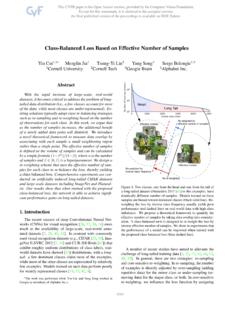
Class-Balanced Loss Based on Effective Number of Samples
openaccess.thecvf.comand large-scale datasets including ImageNet and iNatural-ist. Our results show that when trained with the proposed class-balanced loss, the network is able to achieve signifi-cant performance gains on long-tailed datasets. 1. Introduction The recent success of deep Convolutional Neural Net-works (CNNs) for visual recognition [26, 37, 38, 16] owes
ESRGAN: Enhanced Super-Resolution Generative Adversarial ...
openaccess.thecvf.comESRGAN: EnhancedSuper-Resolution Generative Adversarial Networks Xintao Wang 1, Ke Yu , Shixiang Wu2, Jinjin Gu3, Yihao Liu4, Chao Dong 2, Yu Qiao , and Chen Change Loy5 1 CUHK-SenseTime Joint Lab, The Chinese University of Hong Kong 2 Shenzhen Institutes of Advanced Technology, Chinese Academy of Sciences 3 The Chinese University of Hong Kong, …
Related documents
Faster R-CNN: Towards Real-Time Object Detection with ...
arxiv.org1 Faster R-CNN: Towards Real-Time Object Detection with Region Proposal Networks Shaoqing Ren, Kaiming He, Ross Girshick, and Jian Sun Abstract—State-of-the-art object detection networks depend on region proposal algorithms to hypothesize object locations. Advances like SPPnet [1] and Fast R-CNN [2] have reduced the running time of these detection networks, …

Learning Deep Features for Discriminative Localization
cnnlocalization.csail.mit.eduWeakly-supervised object localization: There have been a number of recent works exploring weakly-supervised object localization using CNNs [1, 16, 2, 15]. Bergamoetal [1]propose atechniqueforself-taughtobject localization involving masking out image regions to iden-tify the regions causing the maximal activations in order to localize objects.
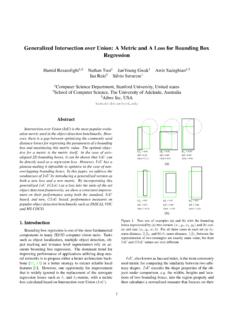
Generalized Intersection over Union: A Metric and A Loss ...
giou.stanford.edupopular object detection benchmarks such as PASCAL VOC and MS COCO. 1. Introduction Bounding box regression is one of the most fundamental components in many 2D/3D computer vision tasks. Tasks such as object localization, multiple object detection, ob-ject tracking and instance level segmentation rely on ac-curate bounding box regression.

1 Object Detection in 20 Years: A Survey - arXiv
arxiv.orgobject detection include but not limited to the following aspects: object rotation and scale changes (e.g., small ob-jects), accurate object localization, dense and occluded object detection, speed up of detection, etc. In Sections 4 and 5, we will give a more detailed analysis of these topics. The rest of this paper is organized as follows. In ...

Multi-Task Multi-Sensor Fusion for 3D Object Detection
openaccess.thecvf.com3D object detection focus on camera based solutions with monocular or stereo images [3, 2]. However, they suffer from the inherent difficulties of estimating depth from images and as a result perform poorly in 3D localization. More recent 3D object detectors rely on depth sensors such as LiDAR [34, 36]. However, although range sensors