
Lecture 1. Material Properties 1. Background
3 3. Properties of materials We shall concern ourselves with three types of issues: (a) Mechanical properties of materials (strength, toughness, hardness, ductility, elasticity, fatigue and creep). (b) Physical properties (density, specific heat, melting and boiling point, thermal expansion and conductivity, electrical and magnetic properties)
Download Lecture 1. Material Properties 1. Background

Information
Domain:
Source:
Link to this page:
Documents from same domain

Lecture 9. Surface Treatment, Coating, Cleaning
ieda.ust.hkA simple example of this process is copper plating using CuSO4 solution, using Copper anodes. Figure 3. Copper plating 9.6. Electroless plating In this case, the plating is achieved by a purely chemical reaction in the solution that causes the metal to be deposited. This process can be used to plate non-conducting parts with a layer of metal.
Lecture 8. Metal Cutting - HKUST IEDA
ieda.ust.hkFriability means that the abrasive particles are brittle, and fracture after some amount of use, creating new sharp edges that will again perform more abrasion. Abrasive tools Figure 9 shows several types of abrasive tools. They all contain abrasive grains that are glued together using

Lecture 7. Plastic Part Manufacture, Injection Molding
ieda.ust.hkeither of the mold halves. Such regions must be created by means of extra moving parts in the mold. Figure 13 below shows a cup-shaped part with a through-hole. One method to mold this part is by the use of a core. The figure below shows the steps of the mold opening. Figure 14(a) shows a more complex mold with four side action cams.
Related documents
5. MECHANICAL PROPERTIES AND PERFORMANCE OF …
courses.washington.edu5. MECHANICAL PROPERTIES AND PERFORMANCE OF MATERIALS Samples of engineering materials are subjected to a wide variety of mechanical tests to measure their strength, elastic constants, and other material properties as well as their performance under a variety of actual use conditions and environments. The results
The Mechanical Properties of Glass
glassproperties.comMechanical Properties of Materials -- Comparison Specific Specific Material Density Modulus Yield Ultimate Yield Stiffness Glass 2.6 70 70 70 26.9 26.9 Aluminum, Alloy 1100-H14 2.7 69 110 120 40.7 25.6 Steel, High Strength, low range 7.85 200 340 550 43.3 25.5 Magnesium, low 1.8 43 80 140 44.4 23.9 Steel, hot rolled, 1% C 7.85 200 580 960 73.9 25.5
Grain Size and Its Influence on Materials Properties
www.heat-treat-doctor.comGrain size effect on properties Grain size has a measurable effect on most mechanical properties. For exam-ple, at room temperature, hardness, yield strength, tensile strength, fatigue strength and impact strength all increase with decreasing grain size. Machinability is also affected; rough machining favors coarse grain size while finish machining

Mechanical Analysis of Soil - Memphis
www.ce.memphis.eduIdentification of soil properties presents challenges to geotechnical engineers. Unlike steel or concrete, the material properties and behavior of soil are difficult to predict due to its variability and limitation on investigation. Mechanical Analysis of Soil As complex as it is, soil can be described simply.

CERAMICS: Properties 1 (Physical, Chemical, Mechanical)
www-personal.umich.eduMECHANICAL PROPERTIES Properties depend both on temperature and degree of crystallinity. 1. Mechanical properties versus melting temperature: Generally strength and modulus go up and down together. Modulus (E) at 25C linearly related to melting temperature (Tm). (Ceramics = 30-350 GPa, Metals = 50-200 GPa, Polymers = <50 GPa) 2.
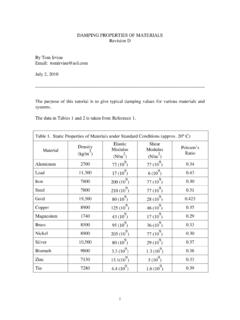
DAMPING PROPERTIES OF MATERIALS - Vibrationdata
vibrationdata.comMechanical Properties of Building Materials under Standards Conditions Material Density (g/cm 3) Elastic Modulus (dyne/cm 2) Longitudinal Wavespeed (cm/sec) Loss Factor Asbestos Concrete 2.0 28e+10 3.7e+05 0.7-2e-02 Asphalt 1.8 - 2.3 7.7e+10 1.9e+05 0.38 12e+10 2.4e+05 0.21 21e+10 3.2e+05 0.055 ...

MECHANICAL PROPERTIES OF MATERIALS
www.me.nchu.edu.twMechanical Properties in Design and Manufacturing •Mechanical properties determine a material’s behavior when subjected to mechanical stresses Properties include elastic modulus, ductility, hardness, and various measures of strength •Dilemma: mechanical properties desirable to the designer, such as high strength, usually make

Lecture notes on Structure and Properties of Engineering ...
www.wright.eduMechanical Properties: Macro Viewpoint • Mechanical properties of solids (forces, elastic behavior) • Mechanical properties of liquids –viscous flows (Newtonian non-Newtonian regimes, viscosity measurements) • Viscoelastic materials (definitions, time dependence, short-range, long-range interactions) • Plastic stress-strain behavior ...

Physics Notes Class 11 CHAPTER 9 MECHANICAL …
ncerthelp.comMECHANICAL PROPERTIES OF SOLIDS Deforming Force A force which produces a change in configuration of the object on applying it, is called a deforming force. ... The materials for which strain produced is much larger than the stress applied, with in the limit of elasticity are called elastomers, e.g., rubber, the elastic tissue of aorta, the ...

Heat Treatment of Plain Carbon and LowAlloy Steels ...
ocw.mit.eduDepartment of Mechanical Engineering Cambridge, MA 02139 2.002 Mechanics and Materials II Spring 2004 Laboratory Module No. 5 Heat Treatment of Plain Carbon and LowAlloy Steels: Effects on Macroscopic Mechanical Properties. 1 Background and Objectives Iron is one of the oldest known metals, and carbon is the cheapest and most effective