Lecture 10: Logistical Regression II— Multinomial Data
About Logistic Regression It uses a maximum likelihood estimation rather than the least squares estimation used in traditional multiple regression. The general form of the distribution is assumed. Starting values of the estimated parameters are used and the likelihood that the sample came from a population with those parameters is computed.
Download Lecture 10: Logistical Regression II— Multinomial Data

Information
Domain:
Source:
Link to this page:
Documents from same domain
Stephanie Schmitt-Groh´e2 3 First draft, Fall 1998
www.columbia.eduInternational Macroeconomics1 Stephanie Schmitt-Groh´e2 Mart´ın Uribe3 First draft, Fall 1998 Last updated: June 25, 2014 1The seeds for this manuscript were lecture notes taken by Alberto Ramos in
Baker and Siemens v9 - Columbia University
www.columbia.educollege, validate it on sub-sets of the 1000 students that were not included when creating the prediction model, and then use the model to make predictions about new students.
Methods of Policy Accommodation at the Interest …
www.columbia.eduMethods of Policy Accommodation at the Interest-Rate Lower Bound Michael Woodford Columbia University September 16, 2012 Revised draft of a paper presented at the Federal Reserve Bank of Kansas City Symposium

Diagnosis and Assessment of Personality Disorders
www.columbia.eduDiagnosis and Assessment of Personality Disorders Michael B. First, M.D. Editor, DSM-IV Text and Criteria Department of Psychiatry, Columbia University
Interest Rate Fundamentals
www.columbia.eduDay-count Convention / Year Fraction: We denote by )τt( , T the chosen time measure between t and T, which is usually referred as the year fraction between t and T. When t and T are less than one day, )τt( , T is to be interpreted as T – t (in years).

LEXINGTON AVENUE LINE HUDSON BERGEN LIGHT …
www.columbia.eduUnion Turnpike Kew Gardens Roosevelt Ave Jackson Heights Chambers St 23 St Prince St Spring St Canal St Canal St Broadway Lafayette St Fulton Fulton St St

Electric Bus Analysis for New York City Transit
www.columbia.eduElectric Bus Analysis for New York City Transit By Judah Aber Columbia University May 2016 Image by AEMoreira042281
Fair Value Accounting in the Banking Industry
www.columbia.eduFAIR VALUE ACCOUNTING IN THE BANKING INDUSTRY Principal Consultant Doron Nissim; Professor, Columbia Business School; Chair of the Accounting Department, Columbia Business School

Research Director WZB Berlin ... - Columbia University
www.columbia.eduMacartan Humphreys | Curriculum Vitae N. MACARTAN HUMPHREYS Research Director WZB Berlin & Professor of Political Science, Columbia University E208 Reichpietschufer 50, 10785 Berlin, Germany
Methodological nationalism and beyond: nation …
www.columbia.eduMethodological nationalism and beyond 303 especially the studies of imperialism by Rosa Luxemburg and others before the First World War, when transnational movements of commodities, capital and labour
Related documents
Logistic Regression - Pennsylvania State University
personal.psu.eduLogistic Regression Fitting Logistic Regression Models I Criteria: find parameters that maximize the conditional likelihood of G given X using the training data. I Denote p k(x i;θ) = Pr(G = k |X = x i;θ). I Given the first input x 1, the posterior probability of its class being g 1 is Pr(G = g 1 |X = x 1). I Since samples in the training data set are independent, the

Logistic Regression: Univariate and Multivariate
www.cantab.netFitting a Logistic Regression in R I We fit a logistic regression in R using the glm function: > output <- glm(sta ~ sex, data=icu1.dat, family=binomial) I This fits the regression equation logitP(sta = 1) = 0 + 1 sex. I data=icu1.dat tells glm the data are stored in the data frame icu1.dat. I family=binomial tells glm to fit a logistic model.
CS229LectureNotes - Stanford University
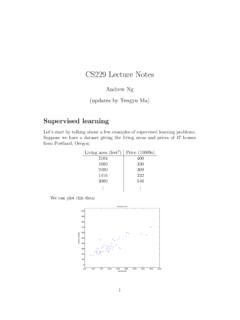
cs229.stanford.eduIf you’ve seen linear regression before, you may recognize this as the familiar least-squares cost function that gives rise to the ordinary least squares regression model. Whether or not you have seen it previously, let’s keep going, and we’ll eventually show this to be a special case of a much broader family of algorithms. 1 LMS algorithm
© Blend Images / Alamy 14 - Amherst College
nhorton.people.amherst.edu14.1 The Logistic Regression Model 14-5 Model for logistic regression In simple linear regression, we modeled the mean y of the response m variable y as a linear function of the explanatory variable: m 5 b 0 1 b 1 x. When y is just 1 or 0 (success or failure), the mean is the probability of p a success. Logistic regression models the mean p

The group lasso for logistic regression
people.ee.duke.eduGroup Lasso for Logistic Regression 55 Linear logistic regression models the conditional probability pβ.xi/=Pβ.Y =1|xi/ by log pβ.xi/ 1−pβ.xi/ =ηβ.xi/, .2:1/ with ηβ.xi/=β0 + G g=1 xT i,gβg, where β0 is the intercept and βg ∈Rdfg is the parameter vector corresponding to the gth predic- tor. We denote by β∈Rp+1 the whole parameter vector, i.e. β=.β0,βT

Stepwise Logistic Regression with R
utstat.toronto.eduStepwise Logistic Regression with R ... = 2k + Deviance, where k = number of parameters Small numbers are better Penalizes models with lots of parameters Penalizes models with poor fit > fullmod = glm(low ~ age+lwt+racefac+smoke+ptl+ht+ui+ftv,family=binomial) ... > # Here was the chosen model from earlier > redmod1 = glm(low ~ lwt+racefac ...