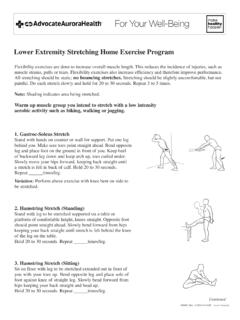
Lower Extremity Stretching Home Exercise Program
Sit on the floor. Bend one knee and cross the leg over the other leg. Turn upper body towards the bent leg. Using the opposite hand slowly pull the knee towards the opposite shoulder until a stretch is felt in the buttocks and along the outside of the hip. Hold 20 to 30 seconds. Repeat times/leg. 15. IT Band Stretch (Inside Lying)
Download Lower Extremity Stretching Home Exercise Program

Information
Domain:
Source:
Link to this page:
Documents from same domain

Lower Extremity Strengthening Exercises in Supine
ahc.aurorahealthcare.orgLower Extremity Strengthening Exercises in Supine, Page 2 X19572bc (Rev. 04/10) ©AHC Lower Extremity The information presented is intended for general information and educational purposes.

Relaxation Exercises - Aurora Health Care
ahc.aurorahealthcare.orgX26017 (07/06) ©AHC Breathing/Relaxation Relaxation Exercises The information presented is intended for general information and educational purposes. It is not intended to replace the advice of your health care provider. Contact your health care provider if you believe you have a health problem.

Hip: Straight Leg Raise – Supine 4-Way - Aurora Health Care
ahc.aurorahealthcare.orgHip: Straight Leg Raise – Supine 4-Way Straight leg raise – flexion 1. Lie on your back. 2. Bend uninvolved knee and put foot on floor. 3. Slowly tighten the thigh muscle of the involved leg, performing a quad set. 4. Flex foot of involved leg toward nose. 5. Slowly lift entire leg 12 to 18 inches off floor.
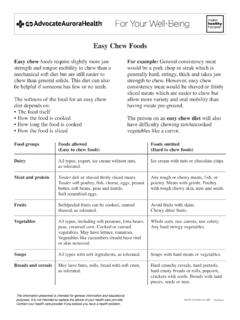
Easy Chew Foods - Aurora Health Care
ahc.aurorahealthcare.orgEasy Chew Foods. Easy chew foods require slightly more jaw strength and tongue mobility to chew than a mechanical soft diet but are still easier to chew than general solids. This diet can also be helpful if someone has few or no teeth. The softness of the food for an easy chew

“D (Rh) Type” and “D Variant” Antigen
ahc.aurorahealthcare.org“D (Rh) Type” and “D Variant” Antigen What is the D antigen? D antigen is a protein with many parts, found on the surface of red blood cells. The D antigen is also known as the “Rh factor” and it tells us your blood type. People are either D (Rh) negative or D (Rh) positive. If your blood type is D negative, your red

Vestibular Rehabilitation Exercises – Level 1
ahc.aurorahealthcare.orgVestibular Rehabilitation Exercises – Level 1, page 3 X20521 (Rev. 12/2019) ©AAHC Vertigo/Vestibular. The information presented is intended for general information and educational purposes. It is not intended to replace the advice of your health care provider. Contact your health care provider if you believe you have a health problem. 6.

Shoulder: Rotator Cuff Isometric Program – Standing
ahc.aurorahealthcare.orgX08252 (Rev. 11/2019) ©AAHC \OT Shoulder/Scapula Shoulder: Rotator Cuff Isometric Program – Standing. Isometric exercises are muscle tightening exercises performed with no joint movement. Their action is to increase circulation for healing and strengthening muscles with minimal joint irritation.
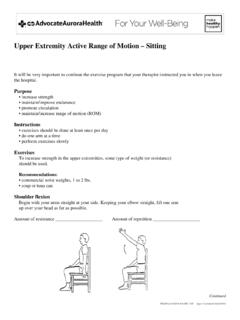
Upper Extremity Active Range of Motion – Sitting
ahc.aurorahealthcare.orgTo increase strength in the upper extremities, some type of weight (or resistance) should be used. Recommendations: • commercial wrist weights, 1 to 2 lbs. • soup or tuna can . Shoulder flexion Begin with your arms straight at your side. Keeping your elbow straight, lift one arm . up over your head as far as possible.
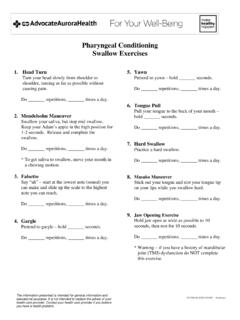
Pharyngeal Conditioning Swallow Exercises
ahc.aurorahealthcare.orgSwallow your saliva, but stop mid swallow. Keep your Adam’s apple in the high position for 1-2 seconds. Release and complete the swallow. Do _____ repetitions, _____ times a day. * To get saliva to swallow, move your mouth in a chewing motion. 3. Falsetto 8. Say “ah” – start at the lowest note (sound) you

Cervical Range of Motion and Isometrics Home Exercise …
ahc.aurorahealthcare.org3. Neck Flexion. Slowly bend your head forward, return to the starting position. Hold . Perform . seconds. Repeat times per day. times. 4. Neck Sidebending. Slowly tilt your head toward one shoulder, then slowly repeat . to the opposite side while keeping your face straight ahead. Hold . Perform . seconds. Repeat times per day. times. 5. Neck ...
Related documents
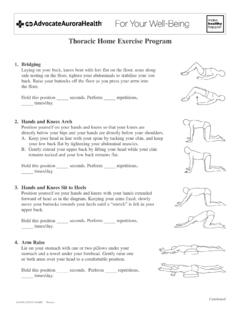
x11638 thoracic home exercise program - Aurora Health Care
ahc.aurorahealthcare.orgSit up tall on the floor with the right leg straight and the left leg bent over it (as in the picture). Use the bent knee to help turn your trunk to the left. Hold this position . seconds. Perform . repetitions, times/day. Repeat to the right. 21. Thoracic Extension to Neutral. Kneel over a chair with your hips at the edge and knees on the floor.
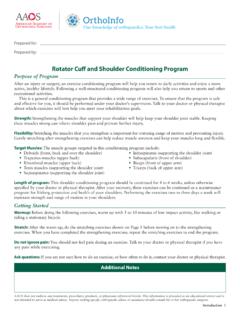
Rotator Cuff and Shoulder Conditioning Program
orthoinfo.aaos.orgshoulder under you and your arm bent, as shown. You can place your head on a pillow for comfort, if needed. • Use your unaffected arm to push your other arm down. Stop pressing down when you feel a stretch in the back of your affected shoulder. • Hold this position for 30 seconds, then relax your arm for 30 seconds. Repetitions 4 reps, 3x a day

When a Representative Payee Manages Your Money
www.ssa.gov(over) my Social Security account . my Social Security account . 5. your payee about how you want to use your money. If you can’t agree on how to spend your money, or if you believe your payee is misusing or stealing your funds, contact Social Security. How to spend a large back